Facts
The victim, an adult woman, alleged that the appellant, a schoolteacher known to her family, promised to marry her and took her to his house on 25 January 2015.
Source reference: paras. 3–7She alleged that, after dinner, he forcibly had sexual intercourse with her and assured her that he would marry her.
Source reference: paras. 3–7She further alleged that the appellant again took her to his house on 10 February 2015, where physical relations were established on 10 and 11 February 2015, and subsequently refused to marry her.
Source reference: paras. 3–7An FIR was registered under Sections 376 and 417 IPC; after investigation, the appellant was charged under Sections 376 and 419 IPC, while his mother was charged under Section 109 IPC.
Source reference: paras. 3–7The trial court acquitted the appellant’s mother but convicted the appellant under Section 376 IPC and sentenced him to seven years’ rigorous imprisonment with a fine of ₹25,000, with a further one-year sentence in default.
Source reference: para. 7The appellant preferred the present appeal.
Source reference: para. 7In evidence, the victim admitted that she was a major, had gone to the appellant’s house with her consent, had remained there overnight, and had consensual physical relations with him on the later visits.
Source reference: paras. 18–22, 24–26The appellant subsequently visited her parents and expressed willingness to marry her, but the marriage did not take place due to opposition from his family.
Source reference: paras. 18–22, 24–26Issues
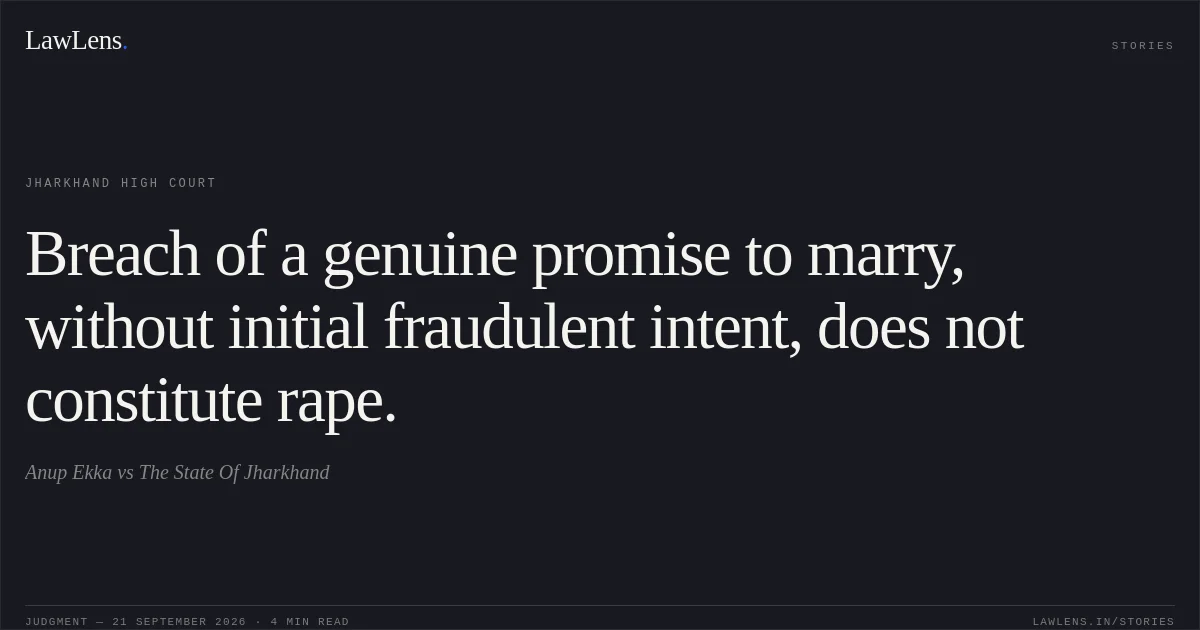
Whether the sexual relationship between the appellant and the adult victim was vitiated by a false promise of marriage amounting to a misconception of fact under Section 90 IPC, thereby constituting rape under Section 376 IPC?
Source reference: paras. 14–16, 24–28Whether the evidence established that the appellant had no intention to marry the victim from the inception of the promise, as opposed to a mere subsequent breach of promise?
Source reference: paras. 24–28Whether the conviction and sentence imposed by the trial court under Section 376 IPC were sustainable?
Source reference: paras. 2, 7, 27–30Law Applied
The court applied Sections 375 and 376 IPC concerning rape and Section 90 IPC concerning consent vitiated by misconception of fact.
Source reference: paras. 14–16Relying on Deepak Gulati v. State of Haryana, (2013) 7 SCC 675, Pramod Suryabhan Pawar v. State of Maharashtra, (2019) 9 SCC 608, Deelip Singh v. State of Bihar, (2005) 1 SCC 88, and the principles discussed in Mahesh Damu Khare v. State of Maharashtra, (2024) 11 SCC 398, the court held that a false promise to marry vitiates consent only where the promise was made in bad faith, with no intention of being fulfilled from the outset, and had a direct nexus with the woman’s decision to engage in sexual intercourse.
Source reference: paras. 14–16A mere breach of a genuine promise, including failure to marry due to subsequent or unforeseen circumstances, does not amount to rape; the prosecution must establish the accused’s fraudulent intention at the inception of the promise.
Source reference: paras. 14–16Reasoning
The court found that the victim was a major and had voluntarily accompanied the appellant to his house with the knowledge and consent of her father.
Source reference: paras. 19–20, 24–25Although she alleged force during the first incident, her subsequent conduct was inconsistent with the prosecution’s case that the relationship was induced solely by deception: she returned to the appellant’s house on 10 February 2015, remained there overnight, and expressly stated that the later physical relations were consensual.
Source reference: paras. 19–20, 24–25The appellant also subsequently visited the victim’s parents and expressed willingness to marry her.
Source reference: para. 26The evidence indicated that the marriage failed because of opposition from the appellant’s family, particularly his mother, rather than because the appellant had lacked any intention to marry from the beginning.
Source reference: para. 26Accordingly, the court treated the case as one involving a possible breach of promise rather than a false promise made with fraudulent intent.
Source reference: paras. 27–28The prosecution therefore failed to prove beyond reasonable doubt that the victim’s consent was vitiated by misconception of fact or that the promise of marriage had a direct nexus with the sexual relationship.
Source reference: paras. 27–28Holding
The High Court held that the prosecution failed to establish that the appellant had made a false promise of marriage without intending to fulfil it from the inception.
The evidence disclosed, at most, a subsequent breach of promise and did not satisfy the ingredients of rape under Section 376 IPC.
Source reference: paras. 27–28The conviction and sentence dated 19 December 2016 were set aside, the appeal was allowed, and the appellant—already on bail—was discharged from the liability of his bail bonds.
Source reference: paras. 29–33The trial court record was directed to be returned, and any pending interlocutory application was disposed of.
Source reference: paras. 29–33Acts & Sections Cited
7 provisions across 2 statutes referred to in this judgment. Each provision opens on LawLens.
Indian Penal Code, 18606
Code of Criminal Procedure, 19731
Original Court PDF
Anup EkkavsThe State Of Jharkhand
Click to open original judgment
Original judgment, available to read, download and summarize on LawLens.in