Facts
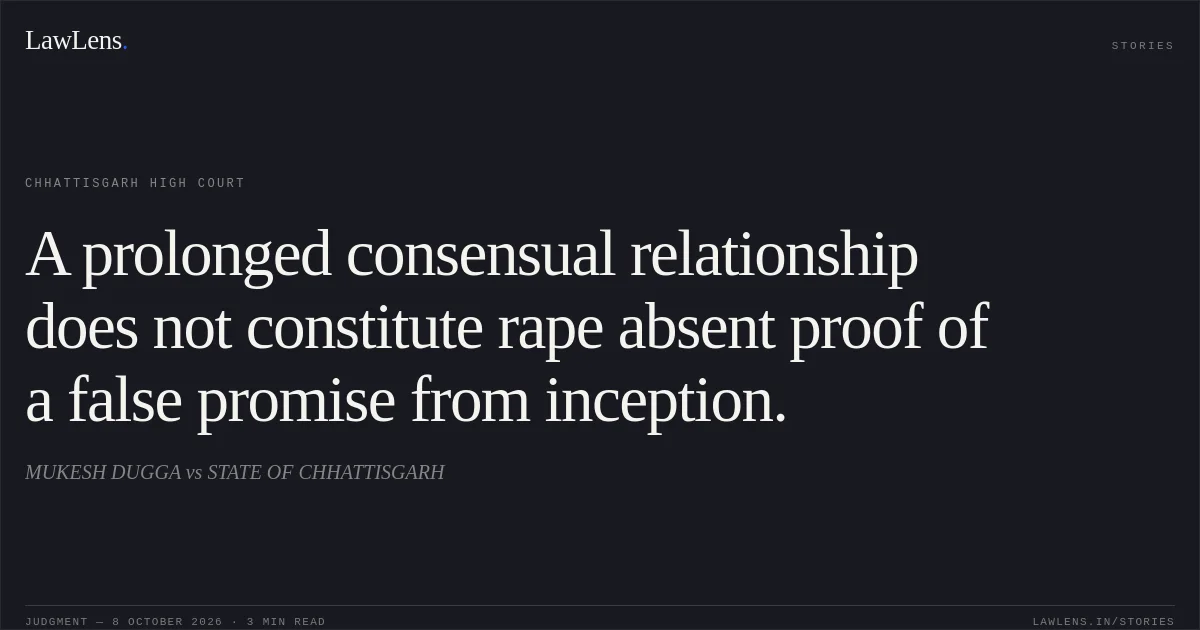
The prosecutrix alleged that she and the appellant, her former classmate, were in a relationship and that, between 2015 and 2017, he repeatedly had sexual relations with her on a promise of marriage.
Source reference: pp. 2–4, paras. 1–6She further alleged that she became pregnant and that the appellant administered medicine which caused a miscarriage.
Source reference: pp. 2–4, paras. 1–6The FIR was lodged in May 2019.
Source reference: pp. 2–4, paras. 1–6The trial court convicted the appellant under Sections 376(2)(n) and 312 of the Indian Penal Code (IPC), while acquitting him of the charges under Sections 294 and 506.
Source reference: pp. 2–4, paras. 1–6He appealed against the convictions and sentences.
Source reference: pp. 2–4, paras. 1–6The High Court allowed the appeal and assessed the evidence concerning the relationship, alleged promise of marriage, pregnancy, and miscarriage.
Source reference: paras. 13–17, 25–28Issues
Whether the prosecution proved that the appellant’s repeated sexual relations with the prosecutrix constituted rape under Section 376(2)(n) IPC, because her consent was based on a false promise of marriage.
Source reference: pp. 9–13, paras. 18–25Whether the prosecution proved beyond reasonable doubt that the appellant voluntarily caused the prosecutrix’s miscarriage, attracting Section 312 IPC.
Source reference: pp. 14–16, paras. 26–28Law Applied
Section 376(2)(n) IPC prescribes enhanced punishment for rape committed repeatedly against the same woman; the Court stated that the provision requires material showing rape on more than one occasion.
Source reference: p. 6, para. 11In assessing whether sexual relations induced by a promise of marriage amount to rape, the Court relied on Prashant v. State of NCT of Delhi, (2025) 5 SCC 764; Rajnish Singh v. State of Uttar Pradesh, (2025) 4 SCC 197; and Samadhan v. State of Maharashtra & Another, 2025 INSC 1351.
Source reference: pp. 10–13, paras. 22–24It applied the principles that a consensual relationship does not become rape merely because it later fails to result in marriage, and that the prosecution must establish deception or a false promise made in bad faith from the inception.
Source reference: pp. 10–13, paras. 22–24Section 312 IPC requires proof that the woman was pregnant, that a miscarriage occurred, and that the accused voluntarily caused it, absent a lawful medical reason.
Source reference: p. 7, para. 12Reasoning
On the rape charge, the Court found that the prosecutrix described a relationship lasting about three years and that the evidence did not substantiate that her continuing consent was caused by a false promise made in bad faith from the outset.
Source reference: pp. 9–10, 13, paras. 19–21, 25It also considered the delay of about two years between the end of the relationship and the FIR, which was lodged after the appellant returned from training in the Armed Forces.
Source reference: pp. 9–10, 13, paras. 19–21, 25On the miscarriage charge, although pregnancy was supported by medical evidence, the prosecution did not establish that the appellant procured or administered the medicine.
Source reference: pp. 14–15, paras. 26–28The medicine wrapper was seized more than two years after the alleged event, and the evidence contained inconsistencies about where the pregnancy was terminated.
Source reference: pp. 14–15, paras. 26–28The Court therefore held that the evidence was insufficient to prove the appellant caused the miscarriage.
Source reference: pp. 14–15, paras. 26–28Holding
The Court held that the prosecution failed to prove either offence and found the trial court’s convictions and sentences unsustainable.
It allowed the appeal, set aside the judgment of conviction and sentence, and acquitted the appellant under Sections 376(2)(n) and 312 IPC.
Source reference: pp. 15–16, paras. 29–33The appellant was entitled to a refund of any fine paid and, being on bail, was not required to surrender; his bail bonds were to remain in force for six months under Section 437-A CrPC.
Source reference: pp. 15–16, paras. 29–33Acts & Sections Cited
8 provisions across 2 statutes referred to in this judgment. Each provision opens on LawLens.
Code of Criminal Procedure, 19734
Indian Penal Code, 18604
Original Court PDF
MUKESH DUGGAvsSTATE OF CHHATTISGARH
Click to open original judgment
Original judgment, available to read, download and summarize on LawLens.in