Facts
The applicant sought anticipatory bail in Case Crime No. 190 of 2026, registered at Police Station Belharkala, District Sant Kabir Nagar, under Sections 76, 87, 69, 115(2), 352 and 351(3) of the Bharatiya Nyaya Sanhita, 2023 (“BNS”).
Source reference: p.1, para. 3The informant-victim, stated to be approximately 19 years old, alleged that the applicant had subjected her to rape on a false promise of marriage.
Source reference: p.1, para. 4The applicant contended that the parties had been in contact and maintained a consensual relationship for approximately two years, and that the FIR was lodged after the relationship deteriorated.
Source reference: p.1, paras. 4–5His arrest had earlier been stayed by the High Court on 10 July 2026. During that period, he allegedly cooperated with the investigation, after which the police filed the charge-sheet on 18 July 2026 and the Magistrate took cognizance on 18 September 2026.
Source reference: p.2, para. 5Issues
Whether the applicant, who was not arrested during investigation, was entitled to anticipatory bail after filing of the charge-sheet and taking of cognizance?
Source reference: p.2, paras. 5, 9, 21Whether the allegations, viewed in light of the parties’ alleged prolonged relationship and the surrounding circumstances, disclosed a case warranting denial of anticipatory bail?
Source reference: pp.1–4, paras. 4–5, 10–21Whether the alleged promise of marriage and subsequent failure of the relationship constituted rape, or whether the material prima facie indicated a consensual relationship without deception from its inception?
Source reference: pp.3–6, paras. 10–19Law Applied
The Court applied Section 482 of the Bharatiya Nagarik Suraksha Sanhita, 2023 (“BNSS”) governing anticipatory bail, together with the settled principle that an accused who was not arrested during investigation and cooperated with the investigation should ordinarily not be taken into custody merely because the charge-sheet has subsequently been filed.
Source reference: p.2, para. 9Relying on Aman Preet Singh v. CBI, (2022) 13 SCC 764, the Court held that, in such circumstances, the accused is ordinarily entitled to bail and that summons, rather than warrants, should normally issue upon cognizance.
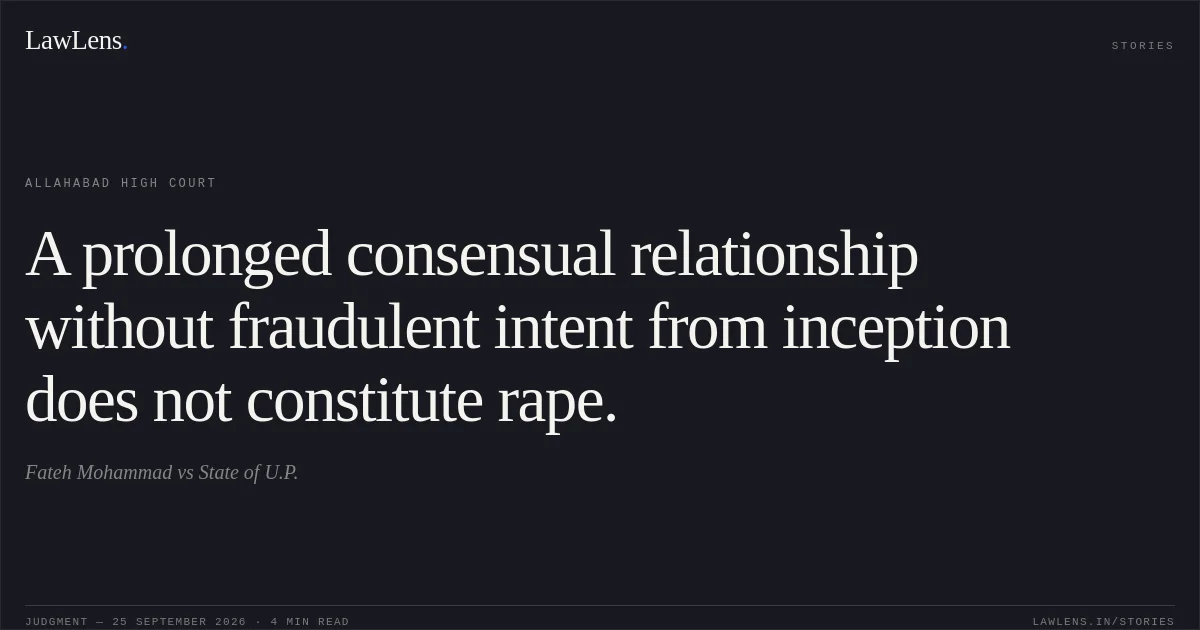
Source reference: p.2, para. 9On the allegation of rape on a promise of marriage, the Court relied on Pramod Suryabhan Pawar v. State of Maharashtra, (2019) 9 SCC 608, for the rule that a promise must have been false from its inception and made with no intention of being performed; a mere subsequent breach of promise is insufficient.
Source reference: p.4, para. 16The Court also relied on Mahesh Damu Khare v. State of Maharashtra, (2024) 11 SCC 398; Prashant v. State of NCT of Delhi, (2025) 5 SCC 764; Samadhan v. State of Maharashtra, 2025 SCC OnLine SC 2528; Rajnish Singh @ Soni v. State of U.P., 2025 (4) SCC 197; Pramod Kumar Navratna v. State of Chhattisgarh, 2026 SCC OnLine SC 154; Ravish Singh Rana v. State of Uttarakhand, 2025 SCC OnLine SC 1055; Sonu @ Subhash Kumar v. State of U.P., (2021) 18 SCC 517; and Kunal Chatterjee v. State of West Bengal, 2025 7 Supreme 489, for the principles that a prolonged consensual relationship between adults does not, without more, establish rape, and that criminal law should distinguish genuine sexual violence from relationships that subsequently become acrimonious.
Source reference: pp.2–6, paras. 10–19Reasoning
The Court found that the applicant’s case was supported by the asserted two-year relationship between two adults, the alleged continued association during that period, the delay in lodging the FIR, and the absence of medical corroboration or injuries corresponding to the allegation of forcible conduct.
Source reference: p.1, paras. 4–5Applying Pramod Suryabhan Pawar, the Court reasoned that the material did not prima facie demonstrate that the applicant had made a promise to marry with no intention of fulfilling it from the outset; the subsequent failure of the relationship could not, by itself, transform the relationship into rape.
Source reference: p.4, para. 16The Court also considered that the applicant had not been arrested during investigation, had allegedly cooperated, and was no longer required for custodial interrogation after submission of the charge-sheet.
Source reference: p.2, para. 5Without expressing a final opinion on the merits, the Court concluded that the case fell within the principles governing prolonged consensual relationships and that a case for anticipatory bail was made out.
Source reference: p.7, paras. 21–22Holding
The High Court allowed the anticipatory bail application.
In the event of arrest or appearance, the applicant was directed to be released on anticipatory bail until conclusion of the trial upon furnishing a personal bond of ₹50,000 with two sureties of the like amount to the satisfaction of the concerned court.
Source reference: p.7, para. 22(i)He was directed to cooperate with the trial and appear as required, not influence or threaten witnesses, and not leave India without prior permission of the trial court.
Source reference: p.7, paras. 22(ii)–(iv)The Court further held that, in case of breach or misuse of the conditions, the Public Prosecutor, Investigating Officer, or informant-complainant could seek cancellation of anticipatory bail before the competent court.
Source reference: p.8, para. 23Acts & Sections Cited
16 provisions across 5 statutes referred to in this judgment. Each provision opens on LawLens.
Bharatiya Nagarik Suraksha Sanhita, 20231
Bharatiya Nyaya Sanhita, 20236
Code of Criminal Procedure, 19734
Indian Penal Code, 18604
Protection of Children from Sexual Offences Act, 20121
Original Court PDF
Fateh MohammadvsState of U.P.
Click to open original judgment
Original judgment, available to read, download and summarize on LawLens.in