Facts
The informant alleged that the petitioner and others received ₹1,37,86,700 in connection with an agreement for sale but failed to execute the sale deed.
Source reference: para. 3, p. 2The petitioner contended that the property stood in the name of his father and that he possessed a one-third share therein. The agreement for sale was executed on 24 February 2019, whereas an injunction restraining alienation of the property was passed in Title Partition Suit No. 47 of 2017 only on 19 September 2019.
Source reference: paras. 4–5, pp. 2–3The petitioner further asserted that he had received only ₹55,31,000 towards his share and had deposited the entire amount before the court concerned.
Source reference: para. 6, p. 3The complainant acknowledged the deposit but alleged that the petitioner had subsequently entered into another agreement concerning the same land, indicating fraudulent intent.
Source reference: para. 7, p. 4The Additional Chief Judicial Magistrate-IX, Patna, took cognizance on 13 June 2022 under Sections 406, 419, 420, 467, 468, 469 and 471 IPC. The petitioner sought quashing of the cognizance order.
Source reference: para. 2, p. 2Issues
Whether the allegations disclosed the ingredients of cheating under Sections 415 and 420 IPC, particularly the existence of fraudulent or dishonest intention at the inception of the transaction?
Source reference: paras. 5, 8, pp. 3–5Whether the petitioner’s conduct constituted forgery or use of a forged document under Sections 467 and 471 IPC when there was no allegation that he had fabricated or authored a false document?
Source reference: paras. 9–11, pp. 5–7Whether continuation of the criminal prosecution against the petitioner amounted to an abuse of the process of law, particularly after deposit of the amount received by him?
Source reference: paras. 12–14, pp. 7–8Law Applied
The Court considered Sections 406, 419, 420, 467, 468, 469 and 471 IPC, including Section 415 IPC, which requires fraudulent or dishonest inducement for the offence of cheating, and Section 464 IPC, which defines the making of a false document.
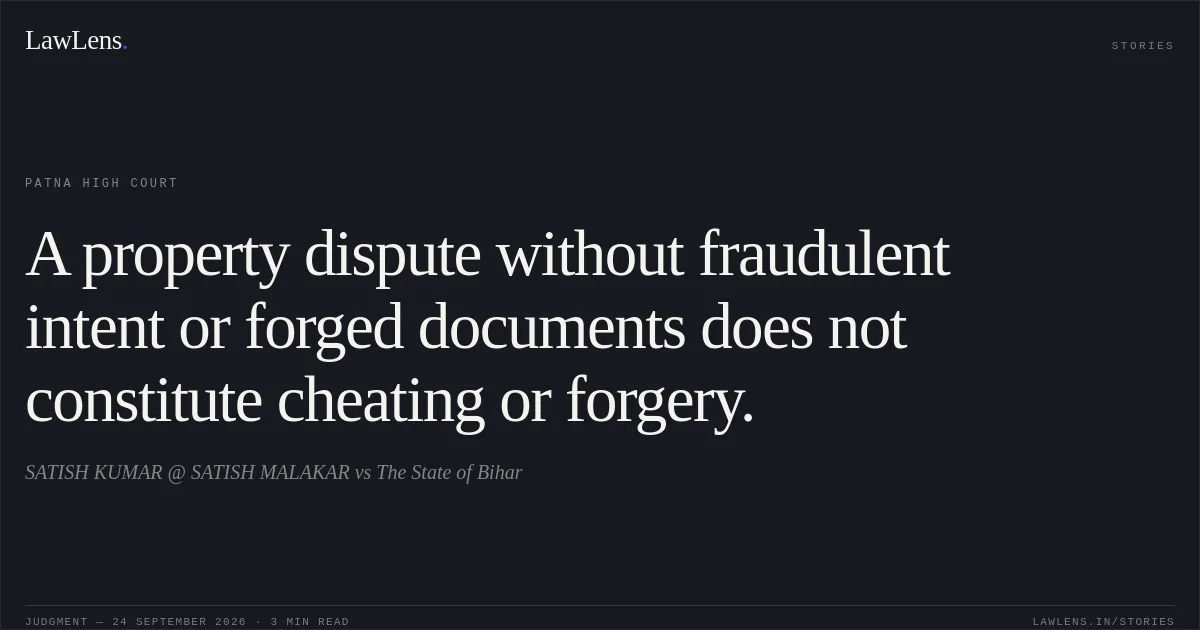
Source reference: no citationThe Court held that an offence under Section 420 IPC requires fraudulent or dishonest intention from the inception of the transaction; a subsequent failure to perform a contractual obligation, without such initial intention, does not by itself constitute cheating.
Source reference: para. 8, p. 5For forgery, the document must fall within the statutory concept of a “false document,” and a person who executes a document claiming property as his own does not commit forgery merely because his title is disputed.
Source reference: no citationThe Court relied on Mohd. Ibrahim v. State of Bihar, (2009) 8 SCC 751, holding that where the accused is neither impersonating another person nor falsely claiming authority to execute a document on another’s behalf, Sections 467 and 471 IPC are not attracted.
Source reference: para. 9, pp. 5–6Reasoning
The Court found that, when the agreement was executed on 24 February 2019, no injunction restraining alienation was in force; the injunction was passed only on 19 September 2019. Therefore, the surrounding facts did not establish fraudulent or dishonest intention at the inception of the agreement.
Source reference: para. 8, p. 5Since the petitioner claimed an interest in the property through his father and allegedly dealt with his own share, the dispute concerned title and performance of a property transaction rather than deception or criminal breach of trust.
Source reference: no citationThe Court also found no allegation that the petitioner had forged, fabricated, authored or used a document known to be forged. Applying Mohd. Ibrahim, it held that a disputed or invalid claim of ownership does not, without more, amount to making a false document or forgery.
Source reference: paras. 9–11, pp. 5–7The petitioner’s deposit of ₹55,31,000, which was acknowledged by the complainant, further supported the conclusion that the dispute was essentially civil and that continuation of the prosecution would serve no legitimate criminal-law purpose.
Source reference: para. 12, p. 7Holding
The Court held that the allegations did not establish the necessary ingredients of cheating or forgery against the petitioner and that the dispute was essentially civil in nature.
It accordingly quashed the order dated 13 June 2022 taking cognizance in Phulwari Sharif P.S. Case No. 588 of 2021, insofar as it related to the petitioner, and allowed the application.
Source reference: paras. 14–15, p. 8The Court clarified that its observations were confined to the criminal proceedings and would not affect any pending civil litigation between the parties.
Source reference: para. 16, p. 8Acts & Sections Cited
9 provisions across 1 statute referred to in this judgment. Each provision opens on LawLens.
Original Court PDF
SATISH KUMAR @ SATISH MALAKARvsThe State of Bihar
Click to open original judgment
Original judgment, available to read, download and summarize on LawLens.in