Facts
The respondent claimed to have purchased the petition premises under a registered sale deed from the administrators of the estate of Meera Bai Dawson. It issued notice alleging wilful default, denial of title, and the need for demolition and reconstruction, but the notice was not served on the petitioner-tenant. The respondent thereafter filed R.C.O.P. No.936 of 2014 seeking eviction on those three grounds.
Source reference: paras. 3–4The petitioner contended that no landlord–tenant relationship existed with the respondent, that his father had constructed the superstructure, and that the petitioner’s independent possessory rights were pending consideration in a civil suit in which interim protection had been granted. The Rent Controller ordered eviction on all three grounds, and the Rent Control Appellate Authority affirmed the order in R.C.A. No.21 of 2025.
Source reference: paras. 4–5In revision under Section 25 of the Tamil Nadu Buildings (Lease and Rent Control) Act, 1960, the petitioner challenged the findings concerning title, attornment, admissibility of the certified sale deed, wilful default, and demolition and reconstruction.
Source reference: paras. 6–14Issues
Whether the respondent established the existence of a landlord–tenant relationship notwithstanding the petitioner’s challenge to the respondent’s title, the absence of formal attornment, and the petitioner’s claim that his father had constructed the superstructure.
Source reference: paras. 20, 25–28Whether the certified copy of the respondent’s registered sale deed could be relied upon in the summary rent-control proceedings despite non-production of the original deed.
Source reference: paras. 20–22, 29–31Whether the petitioner’s conduct constituted wilful default in payment of rent.
Source reference: para. 34Whether the petitioner’s denial of the respondent’s title was mala fide so as to justify eviction.
Source reference: para. 35Whether the respondent established a bona fide requirement for demolition and reconstruction under Section 14(1)(b) of the Act.
Source reference: para. 36Law Applied
The Court applied Section 2(6) of the Tamil Nadu Buildings (Lease and Rent Control) Act, 1960, under which a landlord need not necessarily be the owner; the material requirement is the existence of a landlord–tenant relationship.
Source reference: para. 20Rent-control proceedings are summary in nature and are not required to follow the strict evidentiary framework or elaborate trial procedure applicable to civil suits; a certified copy of a registered sale deed may be relied upon in appropriate circumstances, particularly where its execution is not disputed.
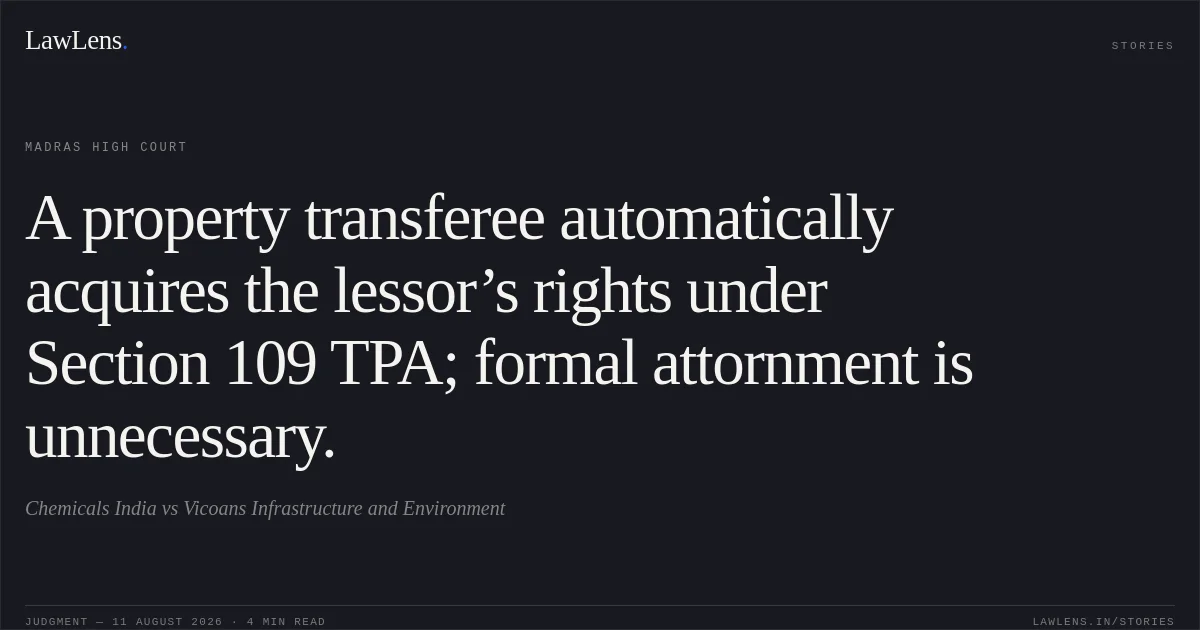
Source reference: paras. 21–22, 29Under Section 109 of the Transfer of Property Act, 1882, the transferee of leased property acquires the lessor’s rights, and formal attornment by the tenant is not necessary because attornment follows by operation of law.
Source reference: paras. 27–28A tenant is bound to tender rent regularly, and where the person entitled to rent is disputed, the tenant may seek permission to deposit rent under Section 9(3) of the Tamil Nadu Act; failure to do so may support a finding of wilful default.
Source reference: para. 34Eviction for denial of title requires a finding that the denial is mala fide, whereas a bona fide denial connected with a pending civil claim will not ordinarily justify eviction on that ground.
Source reference: para. 35The Court also relied on the principles in Appaiya v. Andimuthu @ Thangapandi, C. Chandramohan v. Sengottiyan, Bhogadi Kannababu v. Vuggina Pydamma, and Uma v. K. Purushothaman concerning certified sale deeds, denial of title, the limited scope of title enquiry in rent proceedings, and automatic attornment.
Source reference: paras. 21, 28, 32Reasoning
The Court held that the respondent’s title in the strict sense was not required to be conclusively adjudicated; the relevant question was whether the respondent had prima facie established the landlord–tenant relationship. The petitioner admitted that his father had originally been inducted as a tenant under Meera Bai Dawson and also acknowledged the respondent’s purchase, having impleaded it in the pending civil suit.
Source reference: paras. 20, 22, 26The grant of letters of administration to the vendors was treated as a judgment in rem that remained operative until revoked or set aside, and the respondent’s purchase was therefore sufficient to support its status as transferee-landlord.
Source reference: para. 26Under Section 109 of the Transfer of Property Act, no separate attornment was necessary.
Source reference: paras. 27–28The petitioner produced no documentary evidence, such as property-tax receipts, to establish that his father owned the superstructure.
Source reference: para. 25The certified sale deed was accepted because its execution was not disputed and the proceedings were summary.
Source reference: paras. 21–22, 29On wilful default, the petitioner neither proved payment of rent to the original estate nor to the respondent, nor invoked the statutory mechanism for deposit of rent under Section 9(3); a prior demand specifying the exact rent was not indispensable to the tenant’s continuing obligation to pay.
Source reference: para. 34However, the Court found that the denial of title was not mala fide because the petitioner had instituted a civil suit asserting rights in the property before the eviction petition was filed.
Source reference: para. 35The respondent nevertheless established bona fide demolition-and-reconstruction requirements through the sanctioned plan, and its financial capacity was not seriously challenged.
Source reference: para. 36Holding
The Civil Revision Petition was partly allowed. The eviction order was set aside insofar as it rested on the ground of denial of title, since the denial was bona fide in the circumstances.
Eviction was confirmed on the grounds of wilful default and demolition and reconstruction under Section 14(1)(b) of the Tamil Nadu Buildings (Lease and Rent Control) Act, 1960.
Source reference: para. 37No costs were awarded, the connected miscellaneous petition was closed, and the extempore costs imposed by the Appellate Authority were set aside.
Source reference: para. 38Acts & Sections Cited
1 provisions across 1 statute referred to in this judgment. Each provision opens on LawLens.
Transfer of Property Act, 18821
Original Court PDF
Chemicals IndiavsVicoans Infrastructure and Environment
Click to open original judgment
Original judgment, available to read, download and summarize on LawLens.in