Facts
Amar Nath, admittedly the owner of the suit property, died on 5 July 1984. The plaintiffs—his widow and daughters—claimed inheritance by natural succession and sought partition, possession and permanent injunction. Defendant No.2 was Amar Nath’s son, while defendants Nos.3 and 4 were his grandsons. The appellants claimed exclusive entitlement on the basis of an alleged holographic Will dated 9 March 1973, under which Amar Nath purportedly bequeathed his entire property to defendants Nos.3 and 4.
Source reference: paras. 2–3The trial Court held that the property was self-acquired and not ancestral, but rejected the Will as invalid and suspicious. It accordingly decreed the suit and passed a preliminary decree for partition. The first appellate Court affirmed those findings and dismissed the appeal. The appellants thereafter filed the regular second appeal. The connected first appeal arose from probate proceedings concerning the same Will.
Source reference: paras. 1, 5–6, 38The Courts below found that the attesting witness, Sohan Lal DW-3, had not signed the Will at the time of its execution. The handwriting expert’s evidence indicated that the witness’s signatures and writing had been added after cloth was affixed to repair the torn document, raising a serious doubt about the genuineness and due execution of the Will.
Source reference: paras. 14–18Issues
Whether the suit property was ancestral in the hands of Amar Nath, such that he could not validly bequeath it by Will?
Source reference: paras. 4, 7–9Whether the Will dated 9 March 1973 was duly executed and proved in accordance with law?
Source reference: paras. 10–13, 23–25Whether the suspicious circumstances surrounding the Will were sufficiently explained by its propounders?
Source reference: paras. 28–35Whether the concurrent findings of fact concerning the invalidity of the Will gave rise to a substantial question of law warranting interference in second appeal?
Source reference: paras. 25, 36Whether the connected probate appeal could survive after the Civil Court’s finding that the Will was invalidly executed?
Source reference: para. 38Law Applied
The Court applied Section 63 of the Indian Succession Act, 1925, concerning execution and attestation of an unprivileged Will, and Section 68 of the Indian Evidence Act, 1872, requiring examination of at least one attesting witness to prove execution.
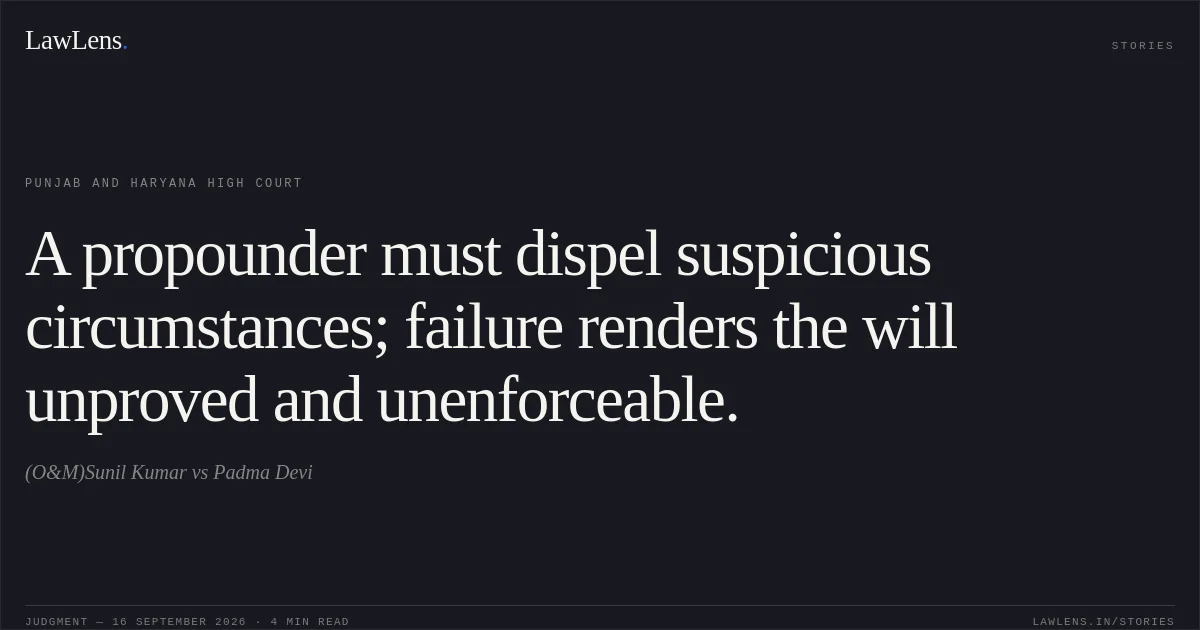
Source reference: paras. 12, 23–25The propounder bears the initial burden of proving the Will and must also remove all legitimate suspicious circumstances surrounding its execution; this burden cannot be discharged merely by relying on weaknesses in the opponent’s case.
Source reference: paras. 12, 23–25A holographic Will may receive favourable consideration once duly proved, but its handwritten character does not exempt it from the statutory requirements of execution and proof.
Source reference: para. 23The Court relied on Jaswant Kaur v. Amrit Kaur, 1977 AIR SC 74, and the principles reiterated in Derek A.C. Lobo v. Ulric M.A. Lobo, 2024 (2) RCR (Civil) 873, including that registration or the form of a Will does not by itself establish validity and that suspicious circumstances must be dispelled by the propounder.
Source reference: paras. 21, 26In a regular second appeal, concurrent findings of fact cannot be disturbed unless they are perverse, based on inadmissible evidence, or involve a substantial question of law.
Source reference: paras. 25, 36Reasoning
The Court held that the plaintiffs failed to prove that the property was ancestral; it was therefore self-acquired property capable of being bequeathed by Amar Nath.
Source reference: para. 9However, this did not establish the validity of the Will. The appellants, as propounders, were required to prove its due execution and explain the suspicious circumstances.
Source reference: paras. 14–17, 30–35DW-3 claimed that he had signed the Will in Amar Nath’s presence and with the same pen and ink used by Amar Nath. This assertion was contradicted by the document and handwriting-expert evidence, which showed that the witness’s writing extended onto cloth later affixed to the torn paper, indicating that his signatures were added subsequently.
Source reference: paras. 14–17, 30–35The non-examination of the second attesting witness further weakened the appellants’ case. Additional suspicious circumstances included the exclusion of Amar Nath’s wife, daughters and son, the fact that the beneficiaries were not residing with or serving him, and the absence of a satisfactory explanation for the testamentary disposition.
Source reference: paras. 14, 18–19, 28–29Since the appellants neither rebutted the expert evidence nor otherwise removed these doubts, the concurrent findings that the Will was forged, fabricated or not duly executed were upheld. No substantial question of law arose.
Source reference: paras. 31–36Holding
The High Court held that the suit property was self-acquired property of Amar Nath, but the Will dated 9 March 1973 was not proved to have been duly executed and was surrounded by unexplained suspicious circumstances.
The plaintiffs and the other natural heirs were therefore entitled to succeed by natural succession.
Source reference: paras. 36–37RSA-2481-2000 was dismissed, and the judgments and preliminary decree for partition passed by the Courts below were affirmed.
Source reference: paras. 36–37In view of the binding finding that the Will was invalidly executed, FAO-419-1992 arising from the probate proceedings was held to have become infructuous and was also dismissed.
Source reference: para. 38Pending applications, if any, were disposed of.
Source reference: para. 39Acts & Sections Cited
3 provisions across 2 statutes referred to in this judgment. Each provision opens on LawLens.
Hindu Succession Act, 19561
Indian Succession Act, 19252
Original Court PDF
(O&M)Sunil KumarvsPadma Devi
Click to open original judgment
Original judgment, available to read, download and summarize on LawLens.in