Facts
OJAS Finance obtained a specific-performance decree against respondents 2–4 on 14 September 1994.
Source reference: paras. 4–5, 9; pp. 2–5The executing court later executed and registered a sale deed in OJAS Finance’s favour in 1999.
Source reference: paras. 4–5, 9; pp. 2–5Rajalakshmi, a third party to the suit and execution proceedings, claimed to have purchased the property from respondents 2–4 in 2016 for value, relying on an Encumbrance Certificate that did not disclose the court-executed sale deed.
Source reference: paras. 4–5, 9; pp. 2–5She sought to obstruct delivery of possession under Order XXI Rule 101 CPC; the executing court rejected her application at the numbering stage.
Source reference: paras. 4–5, 9; pp. 2–5She challenged that rejection under Article 227 of the Constitution.
Source reference: paras. 4–5, 9; pp. 2–5OJAS Finance disputed her bona fide-purchaser claim and contended that the certificate she relied on was a truncated online “view EC,” rather than a regular Encumbrance Certificate.
Source reference: para. 6; pp. 3–4Issues
Whether the executing court erred in rejecting, at the numbering stage, the petitioner’s application to obstruct delivery of the property.
Source reference: paras. 5, 10; pp. 2–3, 5–6Whether a purchaser from the judgment-debtors could claim a right to obstruct execution on the basis that the court-executed sale deed was not reflected in the Encumbrance Certificate.
Source reference: paras. 4, 8–10; pp. 2–3, 5–6Law Applied
Rule 97 provides the procedure for an application concerning resistance or obstruction to delivery of possession; Rule 101 concerns adjudication of questions arising in such proceedings; and Rule 102 bars a transferee pendente lite from invoking the protections available under Rules 98 and 100.
Source reference: paras. 8, 10; pp. 5–6The Court held that the petitioner, claiming through the judgment-debtors, could not use the obstruction procedure to defeat execution of the decree.
Source reference: paras. 8, 10; pp. 5–6It also held that the non-reflection of an encumbrance in an Encumbrance Certificate did not, in these circumstances, confer a right to obstruct execution.
Source reference: paras. 8, 10; pp. 5–6Reasoning
The court-executed sale deed in favour of OJAS Finance was registered in 1999, long before the petitioner’s 2016 purchase from respondents 2–4.
Source reference: para. 9; p. 5The petitioner’s reliance on an Encumbrance Certificate did not alter that position: the certificate was found to be a truncated “view EC,” and, in any event, the omission of an encumbrance from a certificate was not sufficient to establish a right to obstruct execution.
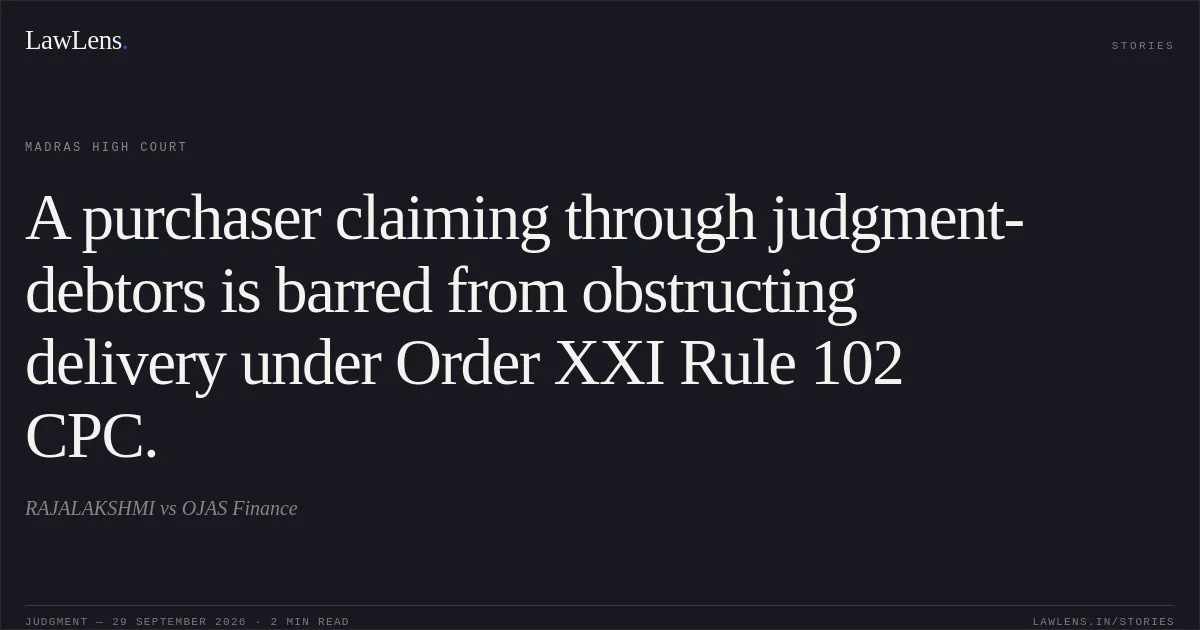
Source reference: paras. 6, 8, 10; pp. 3–6As the petitioner claimed through the judgment-debtors and her purchase post-dated the court sale, the Court held that Order XXI Rule 102 barred her from invoking the obstruction route to defeat the decree.
Source reference: para. 10; p. 6Holding
The High Court dismissed the civil revision petition and upheld the rejection of the petitioner’s application.
It directed the executing court to execute the decree and dispose of E.P. No. 931 of 2016 within four weeks of receiving the order.
Source reference: para. 11; p. 6No costs were awarded, and the connected miscellaneous petition was closed.
Source reference: para. 11; p. 6Original Court PDF
RAJALAKSHMIvsOJAS Finance
Click to open original judgment
Original judgment, available to read, download and summarize on LawLens.in