Facts
The plaintiff entered into two agreements of sale dated 10 August 2008 with the defendants in respect of the suit properties, agreeing to pay ₹88,32,000 for each property. The plaintiff paid an aggregate advance of ₹22,00,000; the balance was payable upon execution of sale deeds. The agreements made obtaining a khatha certificate and a Defence Department NOC conditions precedent to conveyance. Although the khatha was obtained in 2016, the NOC was not secured.
Source reference: pp. 4–6; paras. 3–6The plaintiff alleged that it learned in October 2018 that defendants 1 and 2 had executed a registered agreement of sale in favour of defendant 3 in 2016. It then brought suits seeking permanent injunctions against further dealings with the properties, without seeking specific performance, and applied for leave under Order II Rule 2 CPC to bring a later specific-performance suit.
Source reference: pp. 6–8; paras. 7, 11–12The Trial Court rejected both plaints under Order VII Rule 11(a) and (d) CPC. The plaintiff appealed.
Source reference: pp. 7–9; paras. 8–9Issues
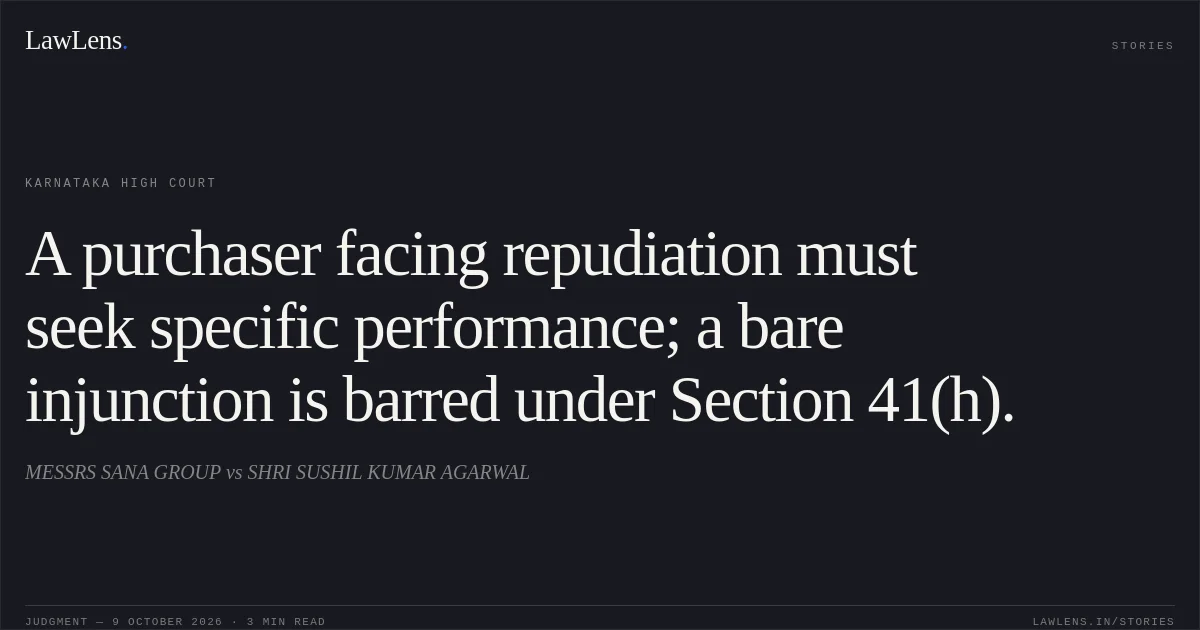
1. Whether the cause of action for specific performance accrued upon expiry of the 60-day period for obtaining the NOC or, at the latest, when the plaintiff learned of the defendants’ transaction with a third party, making the bare injunction suits barred under Section 41(h) of the Specific Relief Act, 1963.
Source reference: p. 9; para. 142. Whether the plaintiff’s applications for leave under Order II Rule 2(3) CPC could prevent rejection of the plaints under Order VII Rule 11(d) CPC.
Source reference: p. 9; para. 14Law Applied
Section 41(h) of the Specific Relief Act, 1963 bars an injunction where an equally efficacious remedy is available through the usual course of proceedings; the court treated specific performance, with interim injunctive relief if needed, as the efficacious remedy for the alleged breach of an agreement to sell.
Source reference: pp. 11–12; para. 18Under Section 54 of the Transfer of Property Act, 1882, an agreement to sell does not itself create an interest in immovable property; the judgment also referred to Section 17(1A) of the Registration Act, 1908 and Section 53A of the Transfer of Property Act in addressing the position of an out-of-possession holder of an unregistered agreement.
Source reference: p. 11; para. 17Article 54 of the Limitation Act, 1963 was applied to the accrual of the right to sue for specific performance.
Source reference: p. 10; para. 16Order VII Rule 11 CPC permits rejection of a plaint where it discloses no cause of action or is barred by law; an Order II Rule 2 application cannot validate a suit otherwise barred by substantive law.
Source reference: pp. 12–15; paras. 20–22The court relied on State of Punjab v. Gurdev Singh, (1991) 4 SCC 1, regarding when the right to sue accrues; RBANMS Educational Institution v. B. Gunashekar & Another, 2025 INSC 490, regarding scrutiny of plaints for suits barred by law; and Sucha Singh Sodhi v. Baldev Raj Walia & Another, (2018) 6 SCC 733, regarding omission of reliefs under Order II Rule 2 CPC.
Source reference: pp. 11–15; paras. 19–22Reasoning
The court held that the plaintiff’s discovery in October 2018 of the registered agreement in favour of defendant 3 amounted to a clear threat and repudiation of the 2008 agreements, giving rise to an immediate cause of action for specific performance; the plaintiff could not defer that relief by relying on the outstanding NOC condition.
Source reference: p. 10; para. 16; p. 12; para. 19Because the plaintiff sought only permanent injunction and was not in possession, the court considered specific performance the appropriate efficacious remedy, with interim protection available in that suit.
Source reference: pp. 11–12; paras. 17–18The applications under Order II Rule 2 CPC did not cure the defect: leave to omit a relief could not overcome the substantive bar under Section 41(h).
Source reference: pp. 13–15; paras. 21–22Holding
The court answered the first issue in the affirmative, holding that the cause of action for specific performance had accrued by October 2018 and that the bare injunction suits were barred under Section 41(h) of the Specific Relief Act. It answered the second issue in the negative, holding that the Order II Rule 2 applications could not save the suits from rejection.
Both appeals were dismissed, and the Trial Court’s orders rejecting the plaints under Order VII Rule 11(a) and (d) CPC were upheld.
Source reference: pp. 12, 15; paras. 19, 22–23Acts & Sections Cited
6 provisions across 5 statutes referred to in this judgment. Each provision opens on LawLens.
Code of Civil Procedure, 19082
Specific Relief Act, 19631
Limitation Act, 19631
Transfer of Property Act, 18821
Registration Act, 19081
Original Court PDF
MESSRS SANA GROUPvsSHRI SUSHIL KUMAR AGARWAL
Click to open original judgment
Original judgment, available to read, download and summarize on LawLens.in