Facts
The informant entered into a written agreement with the petitioner for establishing and operating a mineral-water plant on rented premises at a monthly rent of ₹6,500.
Source reference: p.1–2The petitioner allegedly paid rent until 31 December 2012, thereafter stopped making rent and electricity payments, closed the premises, and put a lock on it.
Source reference: p.1–2The informant allegedly could not contact the petitioner and, after sending a legal notice, filed an informatory petition and representations before the police authorities.
Source reference: p.1–2The complaint was subsequently directed to be registered under Section 156(3) CrPC, resulting in Beur P.S. Case No. 50 of 2014.
Source reference: p.2–4After submission of the charge-sheet and cognizance, the petitioner sought discharge under Section 239 CrPC; the application was rejected by the A.C.J.M. XII, Patna, on 9 November 2016.
Source reference: p.2–4Charges were thereafter framed, and the petitioner challenged the proceedings before the High Court.
Source reference: p.2–4Issues
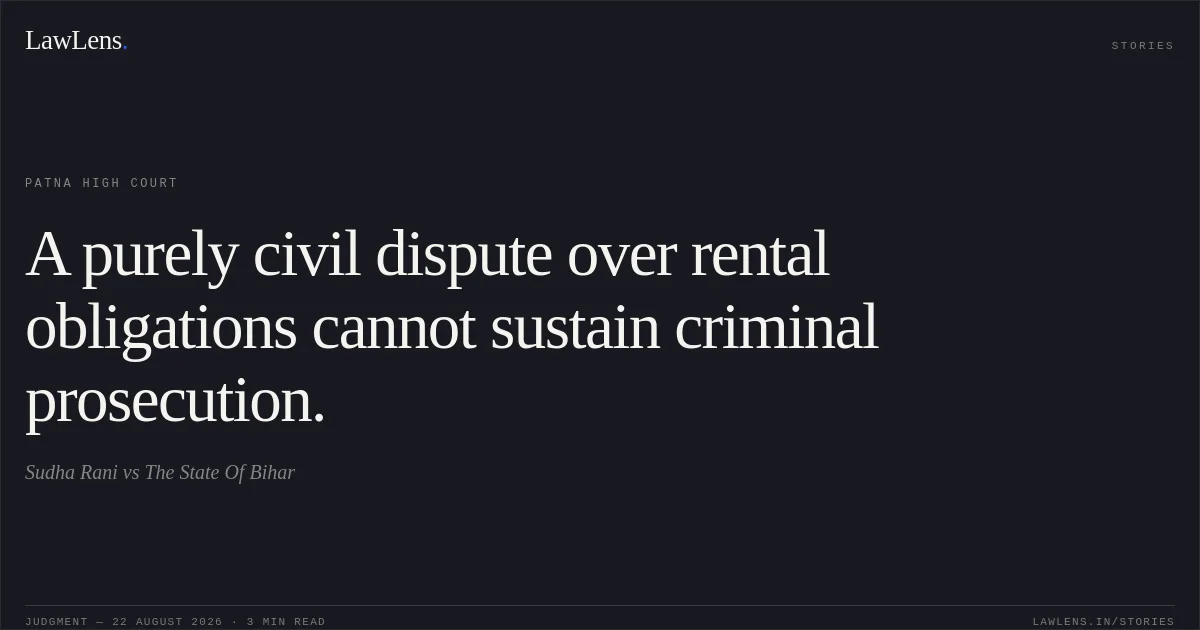
Whether the allegations, taken at their face value, disclosed the ingredients of any criminal offence or merely constituted a civil dispute arising from a rental and business agreement.
Source reference: p.2–5Whether continuation of the criminal prosecution and rejection of the petitioner’s discharge application amounted to an abuse of the process of court.
Source reference: p.2–5Whether the impugned order dated 9 November 2016 and the subsequent criminal proceedings were liable to be quashed in exercise of the High Court’s inherent jurisdiction.
Source reference: p.5Law Applied
The Court considered Section 239 CrPC, which permits discharge in a warrant case instituted on a police report where the charge is groundless.
Source reference: p.2–4It applied the principle that criminal proceedings should not be used to give a criminal colour to a dispute that is essentially civil or contractual in nature.
Source reference: p.2–4The Court relied on State of Haryana v. Bhajan Lal, 1992 Supp (1) SCC 335, particularly the categories concerning allegations that do not disclose an offence and proceedings instituted maliciously or for an ulterior purpose.
Source reference: p.2–4It also relied on Delhi Race Club (1940) Ltd. v. State of Uttar Pradesh, 2024 (10) SCC 690, regarding abuse of criminal process in civil and property disputes.
Source reference: p.2–4Pepsi Foods Ltd. v. Special Judicial Magistrate, (1998) 5 SCC 749, holds that summoning an accused is not a mechanical exercise and requires application of judicial mind to determine whether sufficient grounds exist for proceeding.
Source reference: p.2–4Reasoning
The Court treated the substance of the allegations as relating to non-payment of rent and electricity dues, non-enforcement of contractual terms, and the petitioner’s closure and locking of the rented premises.
Source reference: p.1–3These allegations, even if accepted in their entirety, disclosed a contractual or landlord–tenant dispute and did not establish the requisite criminal intent or a prima facie criminal offence.
Source reference: p.1–3The Court therefore applied the Bhajan Lal principles and the rule against converting civil disputes into criminal prosecutions.
Source reference: p.5In view of the essentially civil nature of the grievance, the continuation of the prosecution was held to constitute an abuse of the process of court.
Source reference: p.5Holding
The High Court allowed the application and quashed the order dated 9 November 2016 by which the petitioner’s application under Section 239 CrPC had been rejected.
It also quashed the subsequent criminal proceedings arising out of G.R. No. 1643 of 2014 and Beur P.S. Case No. 50 of 2014, holding that the dispute was purely civil in nature and that continuation of the prosecution would amount to an abuse of the process of court.
Source reference: p.5Acts & Sections Cited
1 provisions across 1 statute referred to in this judgment. Each provision opens on LawLens.
Code of Criminal Procedure, 19731
Original Court PDF
Sudha RanivsThe State Of Bihar
Click to open original judgment
Original judgment, available to read, download and summarize on LawLens.in