Facts
The petitioner claimed to belong to the “Thakur” Scheduled Tribe under Entry 44, Part IX of the Constitution (Scheduled Tribes) Order, 1950, and had been issued a caste certificate on 27 February 1991.
Source reference: p.2, para. 3The Caste Scrutiny Committee, Amravati, invalidated his claim by order dated 26 July 2002.
Source reference: p.2, para. 3His earlier challenge before the Nagpur Bench was dismissed, but the Supreme Court subsequently set aside that decision and remanded the matter for fresh consideration.
Source reference: p.4, para. 6During the remanded proceedings, the petitioner relied on the caste validity certificate granted to his real brother, Dattatray Manohar Dahake, pursuant to the Bombay High Court’s judgment in Writ Petition No. 6342 of 2018 dated 23 March 2026.
Source reference: p.3, para. 4The family relationship was supported by a family tree verified by the Executive Magistrate, and the Scrutiny Committee thereafter issued the brother’s validity certificate on 28 April 2026.
Source reference: p.6, paras. 8–9The State did not dispute the relationship or the correctness of the family tree, but opposed interference with the Committee’s original decision.
Source reference: p.4, para. 5Issues
Whether the petitioner, whose real brother had been granted a final caste validity certificate as belonging to the “Thakur” Scheduled Tribe, was entitled to similar recognition on the basis of the established blood relationship and family tree.
Source reference: p.6, paras. 8–10Whether the Caste Scrutiny Committee’s order dated 26 July 2002 invalidating the petitioner’s caste claim was liable to be quashed and set aside.
Source reference: p.2, para. 2; p.6, para. 10Law Applied
The Court applied Entry 44, Part IX of the Constitution (Scheduled Tribes) Order, 1950, which recognises “Thakur” as a Scheduled Tribe.
Source reference: p.2, para. 3It relied on Maharashtra Adiwasi Thakur Jamat Swarakshan Samiti v. State of Maharashtra, (2023) 16 SCC 415, particularly the principle that authentic pre-Constitution documents showing tribal status possess high probative value and, where such material is genuine and reliable, a reference to the Vigilance Cell may not be necessary.
Source reference: p.5, para. 7The Court also applied Apoorva d/o Vinay Nichale v. Divisional Caste Certificate Scrutiny Committee No. 1, 2010 (6) Mh.L.J. 401, under which a caste validity certificate granted to a close blood relative ordinarily binds the Scrutiny Committee in relation to another member of the same family, unless there are distinguishing facts or contrary material.
Source reference: p.6, para. 10The Court further considered the reasoning in the brother’s case, where eight pre-Independence documents recording the family’s tribe as “Thakur” were accepted and the Committee’s contrary approach was found perverse.
Source reference: p.5, para. 7Reasoning
The Court found that the brother’s caste validity certificate had been granted after adjudication on merits and had attained finality.
Source reference: p.6, paras. 8–9The relationship between the petitioner and his brother was undisputed and supported by a duly verified family tree.
Source reference: p.6, paras. 8–9Since the brother was a real blood relative and the same family evidence had already resulted in a final declaration of “Thakur” status, the principle in Apoorva required consistent treatment of the petitioner’s claim.
Source reference: p.6, para. 10The Court also relied on the merits of the brother’s judgment, which had accepted multiple pre-Independence documents showing the family’s tribal identity and had rejected the Committee’s reliance on corrected “Bhat” entries.
Source reference: p.5, para. 7In these circumstances, maintaining the petitioner’s invalidation would be inconsistent with the final adjudication concerning his immediate family member; consequently, the original Committee order could not stand.
Source reference: p.6, para. 10Holding
The writ petition was allowed.
The Court quashed and set aside the Caste Scrutiny Committee’s order dated 26 July 2002 and declared the deceased petitioner to belong to the “Thakur” Scheduled Tribe.
Source reference: p.6, para. 10The legal heirs were directed to make an appropriate application to the Scrutiny Committee for issuance of the caste validity certificate on the basis of that declaration.
Source reference: p.7, paras. 11–13Rule was made absolute, with no order as to costs.
Source reference: p.7, paras. 11–13Original Court PDF
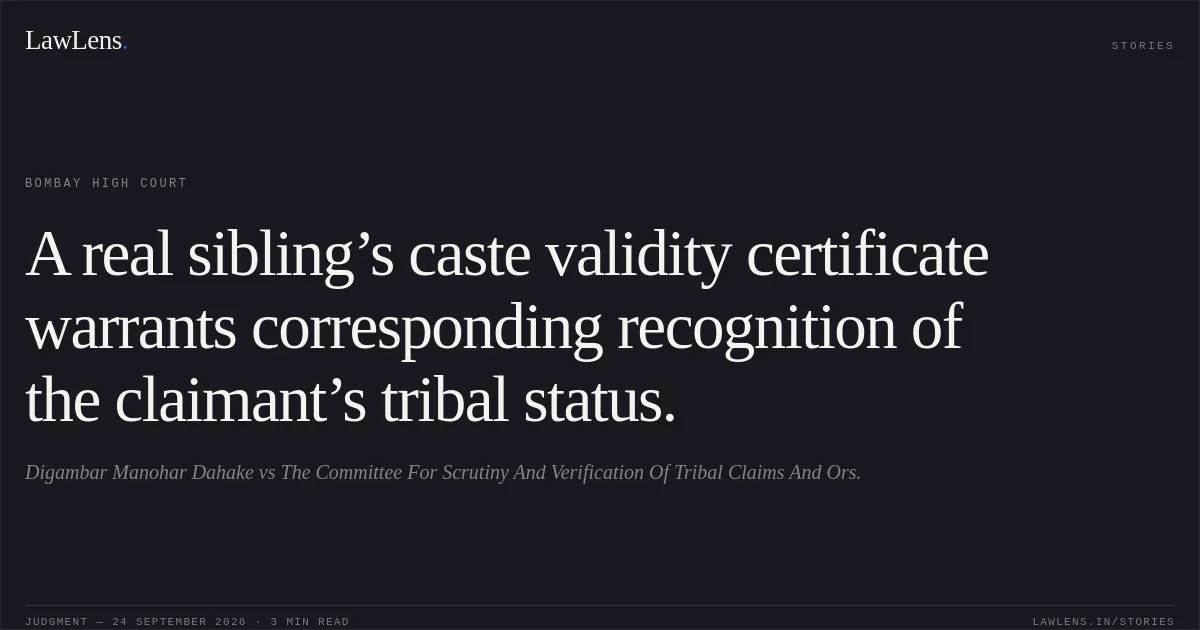
Digambar Manohar DahakevsThe Committee For Scrutiny And Verification Of Tribal Claims And Ors.
Click to open original judgment
Original judgment, available to read, download and summarize on LawLens.in