01Facts
The petitioner completed SSLC and then a two-year Job-Oriented Pre-University Diploma in Computer Techniques (JOC), after which he obtained a Bachelor of Commerce (B.Com) degree.
¶ 3 · p. 3He was admitted to the Three-Year LL.B. course at K.H. Patil School of Law on 21.07.2026.
¶ 4 · p. 3Karnataka State Law University (Respondent No. 2) rejected his request for an eligibility certificate by endorsement dated 08.09.2026, stating that the JOC was a two-year course and that its equivalence to PUC "cannot be decided".
¶ 2 · pp. 2–3The petitioner contended that the question stood concluded by the order in W.A. No. 1060/2025.
¶ 5 · p. 4The University submitted that the position was covered by that order.
¶ 6 · p. 4It was admitted that the B.Com was completed after the JOC.
¶ 7 · p. 5The petition was filed under Articles 226 and 227 of the Constitution to set aside the endorsement.
pp. 1–2The College (Respondent No. 3) was a formal party only.
¶ 1 · p. 202Issues
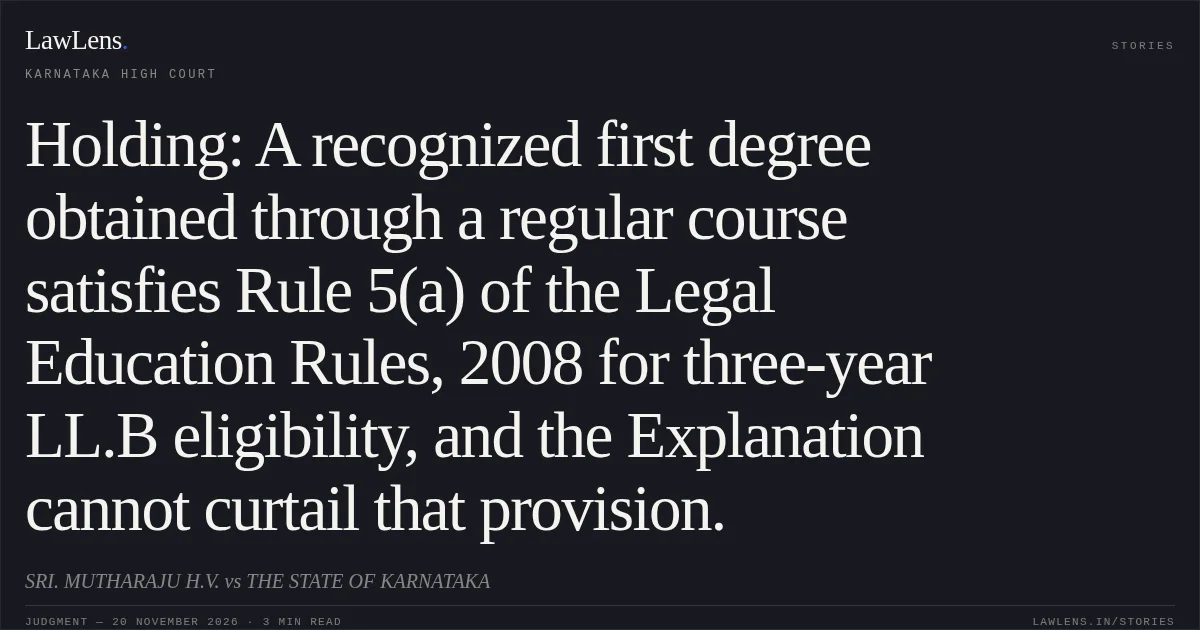
i.1. Whether a candidate who holds a recognised first degree (B.Com) obtained after a regular course is eligible under Rule 5(a) of the Rules for admission to the Three-Year LL.B. course, notwithstanding a preceding two-year JOC that has not been equated with PUC.
¶ 8 · pp. 4–5 · ¶ 9 · p. 9ii.2. Whether the University was justified in refusing the eligibility certificate on the ground that equivalence of the JOC to PUC could not be decided.
¶ 2 · pp. 2–3 · ¶ 9 · p. 903Law Applied
The Court relied on Rule 5(a) of the Rules of Admission to the Three-Year LL.B. course, which requires a basic qualification, and on its Explanation, as construed in Karnataka State Law University v. Rakesh Shetty.
¶ 8 · pp. 4–5Rakesh Shetty holds that the "basic qualification" must be read by reference to the qualification needed to pursue the course leading to the first degree, so a recognised first degree from a regular course satisfies Rule 5(a).
¶ 34–36, 42, as quoted · pp. 5–8Rakesh Shetty adopted the Full Bench decision of the Madras High Court in M. Ramachandran v. Chairman, Law Admissions 2015-2016 (2018 SCC OnLine Mad 13663), under which regular-course prosecution is mandatory only for the immediately preceding qualifying certificate or degree, and a certificate issued by a recognised authority cannot be questioned by another authority unless cancelled or declared invalid by a competent authority or court.
¶ 35–37, as quoted · pp. 5–7Rakesh Shetty further held that the Division Bench decision in Krishnamurthy (a Civil Police Constable recruitment case requiring PUC or equivalent) is distinguishable and does not apply to Rule 5 admissions.
¶ 40–41, as quoted · pp. 8–9The Court also noted the order in W.A. No. 1060/2025; the reference text does not reproduce its reasoning.
¶ 9 · p. 904Reasoning
The petitioner's immediately preceding qualifying degree was the B.Com, which he admittedly obtained after a regular course. Applying Rakesh Shetty and the Full Bench ratio it followed, that B.Com is the "first degree" that satisfies Rule 5(a).
¶ 7 · p. 5 · ¶ 8 · pp. 4–5The University's objection concerned only the equivalence of the earlier JOC to PUC. Under Rakesh Shetty, that question is not determinative once a recognised first degree is held, and Krishnamurthy is inapplicable because it concerned a different recruitment standard. The Court therefore found the refusal unsustainable without deciding JOC–PUC equivalence itself. It treated the matter as governed by the observations in W.A. No. 1060/2025, which it directed the University to take into account.
¶ 8 · pp. 8–9 · ¶ 9 · p. 905Holding
The Court held that the impugned endorsement dated 08.09.2026 (Annexure-D) is set aside.
¶ 9 · p. 9Respondent No. 2 is directed to consider the petitioner's request (Annexure-J) and issue the eligibility certificate for the Three-Year LL.B. course within one week of receipt of a certified copy of the order, taking note of the observations in W.A. No. 1060/2025. Because the certificate is a formal consequence of the order, Respondent No. 3 is directed to permit the petitioner to attend classes forthwith. The writ petition is disposed of.
¶ 9–11 · pp. 9–10Original Court PDF
ASHOKRAJA H KvsSTATE OF KARNATAKA
Click to open original judgment
Original judgment, available to read, download and summarize on LawLens.in