Facts
In 2003, Bank of Baroda initiated recovery proceedings before the Debt Recovery Tribunal (“DRT”) against respondent Nos. 2 to 7. The DRT issued a Recovery Certificate for Rs. 59,25,374/- on 13 December 2007.
Source reference: paras. 1, 5During the pendency of the recovery proceedings, the borrowers acquired an interest in land bearing Survey No. 173/174 Paiki 6, admeasuring 3,099 square metres. The property was not originally subject to the Bank’s recovery proceedings or charged as security for the loan.
Source reference: para. 2The petitioners obtained a title-clearance certificate after a search of the Sub-Registrar’s records and entered into a registered agreement of sale with the borrower on 8 February 2007.
Source reference: para. 3Although the DRT subsequently granted an injunction on 7 March 2007 restraining alienation of the property, the borrower executed a sale deed in favour of the petitioners on 22 March 2007, followed by mutation of the revenue entries in the petitioners’ favour.
Source reference: para. 4In the recovery proceedings, the Bank sought attachment of the property on 29 September 2010, while admitting that the property had not been charged for the loan.
Source reference: para. 5The Recovery Officer rejected the attachment application and observed that the Bank could seek a declaration that the sale deed was void before the appropriate court.
Source reference: para. 6The DRT allowed the Bank’s appeal, holding that the petitioners ought to have been aware of the injunction from the revenue records. The Debt Recovery Appellate Tribunal affirmed that decision.
Source reference: paras. 7–8The petitioners thereafter approached the Gujarat High Court.
Source reference: para. 9Issues
Whether the Bank could attach and proceed against the property in the recovery proceedings when the property was not mortgaged, charged, or offered as collateral for the borrowers’ loan?
Source reference: paras. 5, 10–11Whether the injunction restraining alienation of the property continued after issuance of the Recovery Certificate, particularly when the Recovery Certificate contained no order concerning the property?
Source reference: para. 10Whether the petitioners’ purchase of the property during the subsistence of the injunction justified maintaining the Bank’s claim over the property, having regard to the equities and the passage of time?
Source reference: paras. 4, 7, 10, 13Law Applied
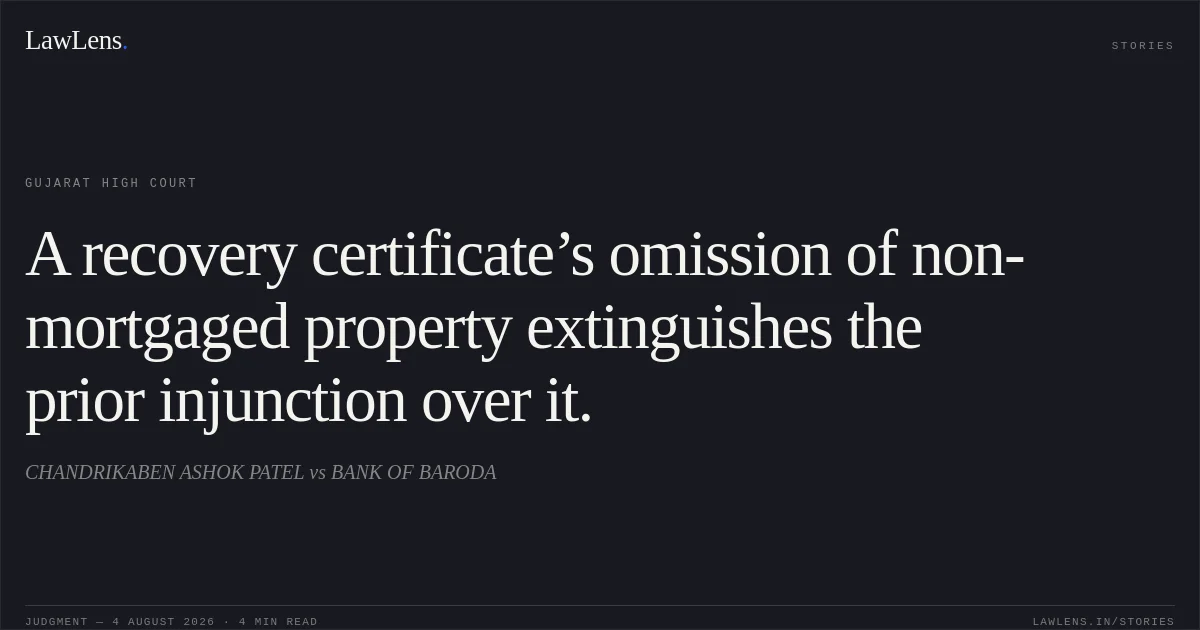
The Court applied the principle that a secured creditor’s rights over a particular property arise from a valid mortgage, charge, or other security interest, and that a property not offered as collateral does not ordinarily become subject to the Bank’s lien merely because it is owned by the borrower.
Source reference: paras. 2, 5, 10The Court also applied the doctrine of merger, holding that an interlocutory injunction must be considered in the context of the final order or Recovery Certificate, and that where the final Recovery Certificate contains no direction concerning the property, the earlier injunction would not subsist in respect of that property.
Source reference: para. 10At the same time, the Court recognised that a decree-holder may proceed against properties owned by the judgment-debtor in execution, subject to the legal rights of third-party purchasers and the appropriate remedy for challenging the sale.
Source reference: paras. 6, 11The final relief was moulded on equitable considerations, including the petitioners’ long possession and payment of full consideration, the fact that the property was not collateral, and the substantial amount already recovered by the Bank.
Source reference: para. 13Reasoning
The Court found that the property was acquired by the borrowers after the Bank had commenced recovery proceedings but was never mortgaged or charged in favour of the Bank.
Source reference: paras. 2, 10Consequently, the Bank could not claim a lien or independent security interest over the property.
Source reference: no citationAlthough an injunction against alienation had been issued during the proceedings, the Recovery Certificate ultimately made no order concerning the property. Applying the doctrine of merger, the Court held that the injunction could not continue indefinitely after the final recovery order omitted any direction regarding the property.
Source reference: para. 10The Court nevertheless accepted that the Bank had some justification for approaching the recovery forum because the injunction had existed and the property belonged to the borrower at the relevant time.
Source reference: para. 11Balancing the Bank’s recovery claim against the petitioners’ purchase of the property more than two decades earlier, their payment of full consideration, the absence of any mortgage, and the Bank’s recovery of more than Rs. 35,00,000/- under the SARFAESI Act, the Court moulded the relief by directing a payment of Rs. 20,00,000/- as a condition for release of the property.
Source reference: para. 13Holding
The Gujarat High Court allowed SCA No. 6405 of 2015 and set aside the orders of the Recovery Officer’s appellate authorities and tribunals concerning attachment of the property.
The petitioners were directed to pay Rs. 20,00,000/- to the Bank in one lump sum within three months from 27 July 2026. Upon receipt of the payment, the Bank was directed to execute the necessary documents relinquishing all claims over the property.
Source reference: para. 14The petitioners undertook not to alienate the property during the three-month period.
Source reference: para. 15In view of this order, SCA No. 8757 of 2015 filed by Kalupur Commercial Co-operative Bank Ltd. was disposed of as no longer surviving for consideration.
Source reference: Order in SCA No. 8757 of 2015Original Court PDF
CHANDRIKABEN ASHOK PATELvsBANK OF BARODA
Click to open original judgment
Original judgment, available to read, download and summarize on LawLens.in