Facts
The petitioners entered into registered agreements to purchase residential flats and paid stamp duty.
Source reference: paras. 3–7; pp. 2–4Before taking possession, they and the developer executed and registered deeds cancelling the agreements, reportedly because the developer could not deliver possession as agreed.
Source reference: paras. 3–7; pp. 2–4Their applications for refund were rejected on the ground that they were filed beyond the six-month period in the amended proviso to Section 48(1) of the Maharashtra Stamp Act.
Source reference: paras. 13–15; pp. 7–8The cancellation deeds predated the amendment, which came into force on 24 April 2015.
Source reference: paras. 13–15; pp. 7–8Issues
Whether the 24 April 2015 amendment reducing the period for seeking a stamp-duty refund could apply to agreements cancelled before that amendment came into force
Source reference: paras. 14–17; pp. 7–9Whether the petitioners’ cancellations and stated reasons brought their claims within the principles governing refunds for genuinely cancelled transactions, notwithstanding the State’s objection concerning supporting evidence and delay
Source reference: paras. 14, 19–26; pp. 7, 10–15Law Applied
Section 47(5) and Section 48(1) of the Maharashtra Stamp Act govern claims for refund of stamp duty; under the pre-amendment provision, the relevant categories of claims could be made within two years, while the 2015 amendment reduced the applicable period to six months from registration of the cancellation deed.
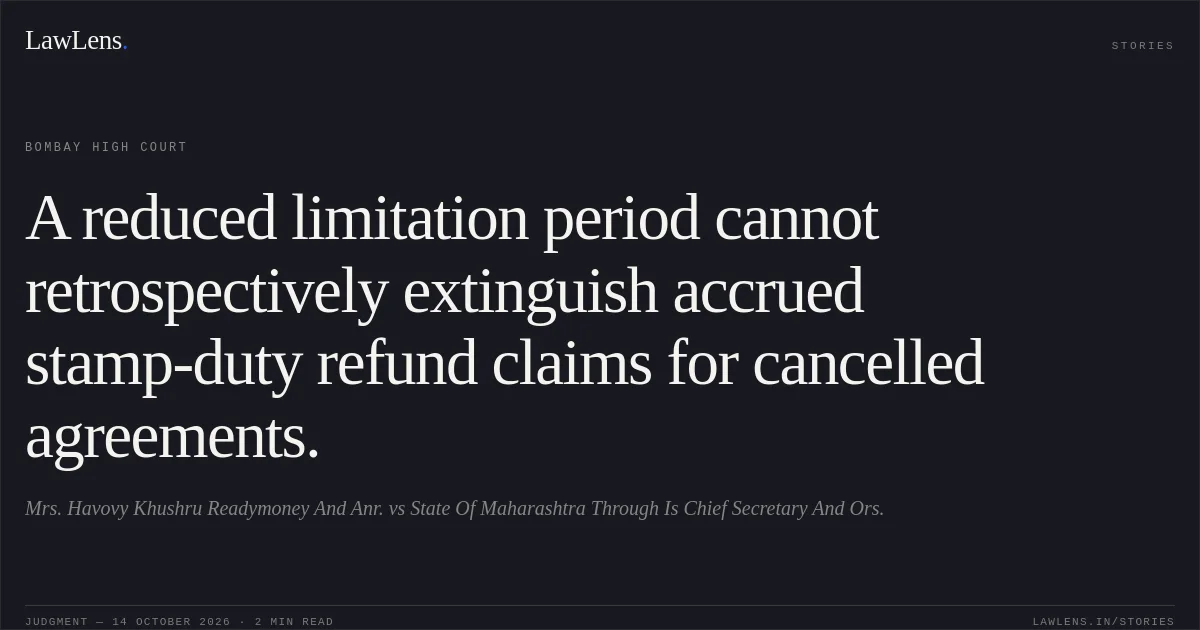
Source reference: paras. 8, 15; pp. 5, 8Relying on Harshit Harish Jain & Another v. State of Maharashtra & Others, (2025) 3 SCC 365, the Court applied the principle that a later reduction in limitation should not retrospectively extinguish an accrued right to claim a refund.
Source reference: paras. 16–18; pp. 8–10It also relied on Bano Saiyed Parwaz v. Chief Controlling Revenue Authority, (2025) 2 SCC 201, and Committee-GFIL v. Libra Buildtech (P) Ltd., (2015) 16 SCC 31, for the principle that a genuine refund claim should not be defeated solely by technicalities.
Source reference: paras. 18–19; pp. 9–10Bhaskar Ramgonda Patil v. District Deputy Registrar (Class I), 2025 SCC OnLine Bom 1075, was distinguished: its limitation reasoning concerned completed transactions and claims for excess duty, rather than transactions that had been cancelled.
Source reference: paras. 20–21, 26; pp. 10–12, 15Reasoning
Because the cancellation deeds were executed and registered before 24 April 2015, the petitioners’ refund claims had arisen under the earlier provision; the amended six-month period could not retrospectively defeat those claims.
Source reference: paras. 16–17, 22, 24–25; pp. 8–9, 12–14The registered cancellation deeds recorded that possession had not been delivered, and the authorities had rejected the applications on limitation grounds without finding that possession had been handed over, that the cancellations were not genuine, or that the transactions had continued.
Source reference: paras. 22–25; pp. 12–14The absence of a separate earlier communication from the developer was therefore insufficient, by itself, to defeat the claims.
Source reference: paras. 22–25; pp. 12–14The Court accordingly treated the cases as claims arising from cancelled transactions, not as claims for excess duty on completed transactions.
Source reference: paras. 21, 25–26; pp. 11–12, 14–15Holding
The Court held that the applications could not be rejected merely by applying the amended six-month period.
It allowed the writ petitions, quashed the rejection orders, and directed Respondent Nos. 2 and 3 to refund the stamp duty paid by each petitioner within eight weeks.
Source reference: paras. 26–30; pp. 14–17The petitioners were also awarded simple interest at 6% per annum from 15 February 2016 until payment; if payment was not made within eight weeks, the unpaid amount would carry further simple interest at 12% per annum thereafter.
Source reference: paras. 26–30; pp. 14–17Acts & Sections Cited
2 provisions across 1 statute referred to in this judgment. Each provision opens on LawLens.
Maharashtra Stamp Act2
Original Court PDF
Mrs. Havovy Khushru Readymoney And Anr.vsState Of Maharashtra Through Is Chief Secretary And Ors.
Click to open original judgment
Original judgment, available to read, download and summarize on LawLens.in