Facts
The respondents sought ejectment and occupational charges, claiming they had purchased the premises in 2011 and that the petitioner occupied it under a registered lease executed with their predecessor in title.
Source reference: p. 2–5, 9–10They relied on evidence of attornment, rent payments and a quit notice.
Source reference: p. 2–5, 9–10The petitioner denied the tenancy and asserted that the property was joint-family property and that his signature on the lease had been fraudulently obtained.
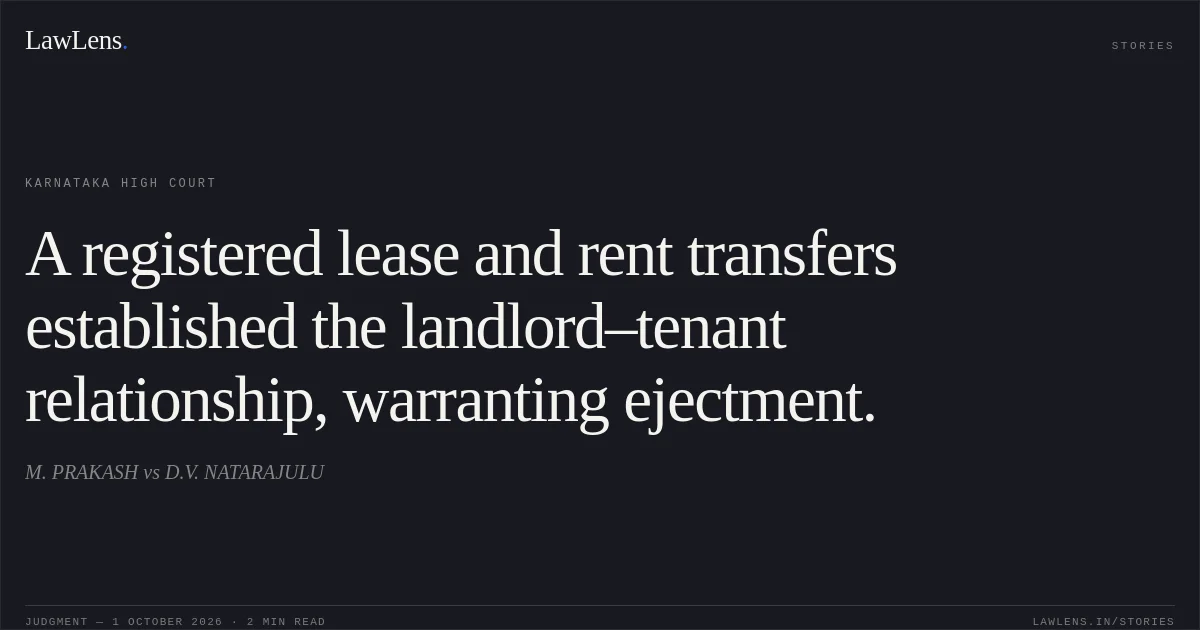
Source reference: p. 2–5, 9–10The Small Causes Court found a landlord–tenant relationship, held the tenancy had been terminated, and decreed ejectment and monetary relief.
Source reference: p. 2–5, 9–10The petitioner challenged that decree under Section 18 of the Small Cause Court Act.
Source reference: p. 2–5, 9–10Issues
1. Whether the respondents established a landlord–tenant relationship with the petitioner, despite his denial of the lease and claim that the property was joint-family property.
Source reference: p. 5–8, 11–132. Whether the tenancy was validly terminated by notice and the respondents were entitled to ejectment and occupational charges.
Source reference: p. 8–10, 133. Whether the Small Causes Court’s judgment and decree warranted interference in revision.
Source reference: p. 11–14Law Applied
The revision was brought under Section 18 of the Small Cause Court Act, which provides the procedural basis for the High Court’s revisional consideration.
Source reference: p. 2The Court referred to Section 106 of the Transfer of Property Act in assessing the quit notice and accepted the trial court’s finding that the notice complied with that provision.
Source reference: p. 9The Court also relied on the evidence of the registered lease, attornment, rent transfers, ownership documents and notice service to determine the tenancy and entitlement to possession; it cited no precedent.
Source reference: p. 6–9, 12–13Reasoning
The Court found that the respondents had produced a registered lease, documents supporting their ownership, evidence of attornment, and bank records showing transfers corresponding to the contractual rent.
Source reference: p. 7–9, 11–13The petitioner’s admission that he had transferred money to the first respondent’s account, together with his failure to explain those transfers, supported the finding that rent had been paid.
Source reference: p. 7–9, 11–13The Court also accepted the evidence of service of the quit notice and noted that the petitioner had not replied.
Source reference: p. 7–9, 11–13His joint-family-property and fraud assertions did not displace the tenancy evidence in this ejectment proceeding; the earlier partition suit he had filed had been dismissed for non-prosecution, and he had produced no evidence sufficient to undermine the trial court’s findings.
Source reference: p. 7–9, 11–13Holding
The High Court held that the petitioner had shown no ground for revisional interference and dismissed the civil revision petition.
The trial court’s decree for possession, arrears of rent, occupational charges and continuing monthly charges therefore remained undisturbed; all interlocutory applications were closed.
Source reference: p. 10, 13–14Acts & Sections Cited
2 provisions across 2 statutes referred to in this judgment. Each provision opens on LawLens.
Presidency Small Cause Courts Act, 18821
Transfer of Property Act, 18821
Original Court PDF
M. PRAKASHvsD.V. NATARAJULU
Click to open original judgment
Original judgment, available to read, download and summarize on LawLens.in