Facts
The plaintiff claimed to have purchased the southern half portion of a residential house from defendant No. 3 through registered sale deed dated 20 May 1993 (Exhibit P-1), allegedly with possession delivered to him.
Source reference: paras. 9–10The plaintiff asserted that on 24 December 1994 the defendants placed additional locks on the property, following which the police took custody of the keys and the plaintiff was deprived of his business premises.
Source reference: para. 9He instituted a suit for declaration of title, mandatory and permanent injunctions, and subsequently amended the plaint to seek recovery of possession.
Source reference: paras. 1, 9, 13The defendants denied execution of the sale deed, delivery of possession, and the correctness of the property description.
Source reference: para. 10At the initial stage, however, they did not specifically plead that the signatures on the sale deed were forged. Such a plea was introduced later by amendment.
Source reference: paras. 10–15The Additional District Judge, Umaria, decreed the suit on 30 April 1997. Defendants Nos. 3 and 5 challenged that decree in the present first appeal.
Source reference: para. 1Issues
Whether the registered sale deed dated 20 May 1993 was proved and whether the defendants established that it was forged, fraudulent, or otherwise incapable of transferring title.
Source reference: paras. 10–18Whether the description and boundaries of the half portion sold under Exhibit P-1 and reproduced in the plaint were sufficiently definite to support a decree for declaration and possession.
Source reference: paras. 2, 5, 19–20Whether defendant No. 3 possessed sufficient title to sell the disputed half portion of the house, notwithstanding the alleged rights of defendant No. 5 and other family members.
Source reference: paras. 3, 21–23Law Applied
Order VI Rule 4 of the Code of Civil Procedure requires specific material particulars where fraud, forgery, misrepresentation, or similar misconduct is pleaded.
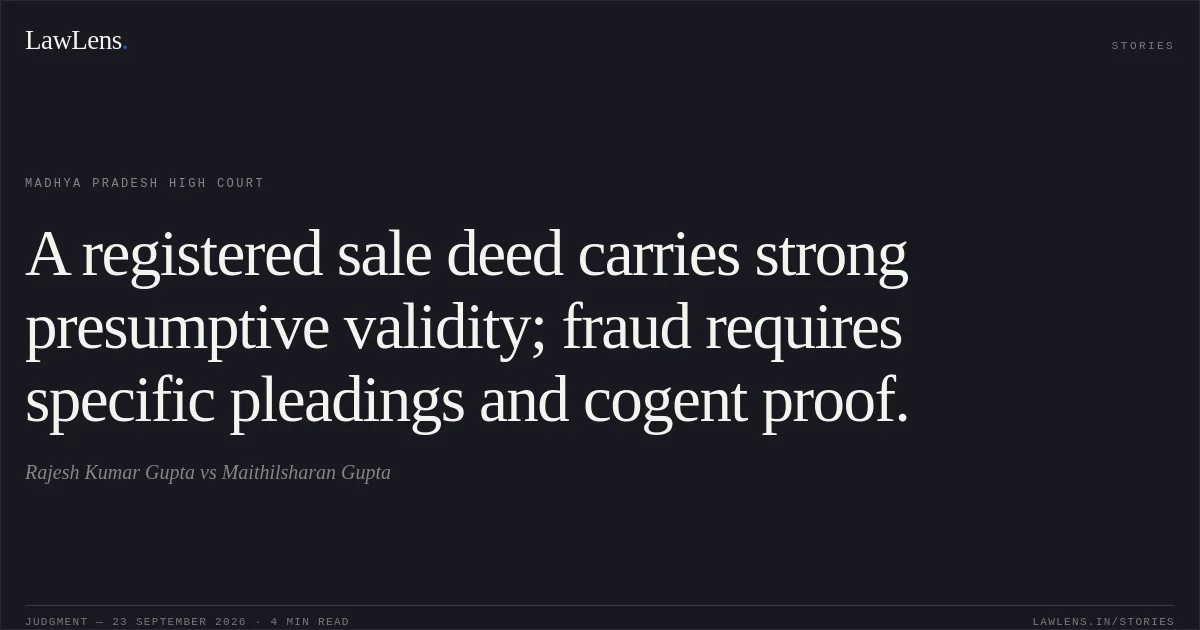
Source reference: para. 11A registered sale deed carries a strong presumption of validity and genuineness; the burden lies on the person challenging it to rebut that presumption through clear pleadings and cogent evidence.
Source reference: para. 17The Court relied on Prem Singh v. Birbal, (2006) 5 SCC 353, Jamila Begum v. Shami Mohd., (2019) 2 SCC 727, Rattan Singh v. Nirmal Gill, (2021) 15 SCC 300, and Hemalatha v. Tukaram, (2026) 5 SCC 168.
Source reference: para. 17The Court also accepted that a trial court may compare disputed signatures with admitted signatures under the Evidence Act without necessarily obtaining a handwriting-expert opinion, where the comparison is sufficiently clear.
Source reference: para. 17A property description is legally adequate where the map and boundaries identify the subject matter with reasonable certainty.
Source reference: paras. 19–20The burden of proving that the vendor lacked title likewise rested on the defendants asserting such lack of title.
Source reference: paras. 21–23Reasoning
The High Court held that the defendants’ original written statement merely denied execution of the sale deed and did not allege forgery or fraud with the particulars required by Order VI Rule 4 CPC.
Source reference: paras. 12–16The later insertion of a plea that the signatures were not theirs was treated as an afterthought, particularly because it was introduced in response to an amendment concerning possession rather than execution of the deed.
Source reference: paras. 12–16Exhibit P-1 was a registered instrument, and the trial court had compared the signatures appearing on it with the defendants’ signatures on the written statement and vakalatnama, finding them to be similar.
Source reference: para. 17Defendant No. 3 also failed to deny the signatures or allege fraud in his examination-in-chief.
Source reference: para. 17The Court therefore found that the defendants had not displaced the presumption supporting the registered deed.
Source reference: para. 18The objection to the property description failed because the sale deed contained a map identifying the eastern road, southern house of Mohammad Jaleel, western agricultural land of Ram Khelan, and the vendor’s retained house on the north; these features clearly identified the southern half sold to the plaintiff.
Source reference: paras. 19–20Finally, defendant No. 3’s own evidence indicated that he derived title from his real mother, whereas defendant No. 5 was his stepmother and the other alleged heirs were stepsiblings.
Source reference: paras. 21–23The Court consequently found no adequate basis to conclude that defendant No. 3 lacked exclusive title to the sold portion.
Source reference: paras. 21–23Holding
The High Court answered all issues against defendants Nos. 3 and 5.
It held that Exhibit P-1 was a valid and sufficiently proved registered sale deed, that the property description was definite, and that defendant No. 3 had not been shown to lack title to the transferred portion.
Source reference: paras. 18–23Finding no error or perversity in the trial court’s decree for declaration and possession, the Court confirmed the judgment dated 30 April 1997 and dismissed the first appeal.
Source reference: para. 24Acts & Sections Cited
1 provisions across 1 statute referred to in this judgment. Each provision opens on LawLens.
Code of Civil Procedure, 19081
Original Court PDF
Rajesh Kumar GuptavsMaithilsharan Gupta
Click to open original judgment
Original judgment, available to read, download and summarize on LawLens.in