Facts
Krishna Rao executed a registered sale deed dated 19 March 2010 in favour of the appellants for stated consideration of ₹1,21,50,000. He later sued to have the deed declared null and void, alleging that it was sham and nominal, unsupported by consideration, and procured through fraud and undue influence by the first appellant, an advocate known to him.
Source reference: pp. 4–7, 30–32After Krishna Rao’s death, his wife and children were brought on record; a claimant under an alleged Will was also involved in the proceedings.
Source reference: pp. 4–7, 30–32The appellants separately sued to recover possession of a portion of the property occupied by Krishna Rao’s wife.
Source reference: pp. 7–8The Single Judge declared the sale deed null and void and not binding on the plaintiffs, granted related injunctive and possession relief, and awarded damages for use and occupation; the appellants’ possession suit was dismissed.
Source reference: p. 10The appellants challenged those decisions and also the rejection of their application under Section 47 CPC, which alleged that the original suit had abated.
Source reference: pp. 11–12Issues
Whether the registered sale deed dated 19 March 2010 was a genuine and valid transaction supported by consideration and binding on the respondents
Source reference: p. 26Whether the alleged lease dated 2 April 2009 was established and whether the decree in C.S. No. 925 of 2010 should be set aside
Source reference: p. 26Whether the appellants were entitled to recover possession and whether dismissal of their possession suit should be set aside
Source reference: p. 26Whether the order rejecting the appellants’ Section 47 CPC application should be set aside, including on the ground that the original suit had abated
Source reference: pp. 26, 30–32Law Applied
The Court stated that non-payment of consideration, by itself, does not render a completed sale void; however, where the parties dispute whether a genuine sale transaction occurred, the court must assess the entire oral and documentary evidence and surrounding circumstances.
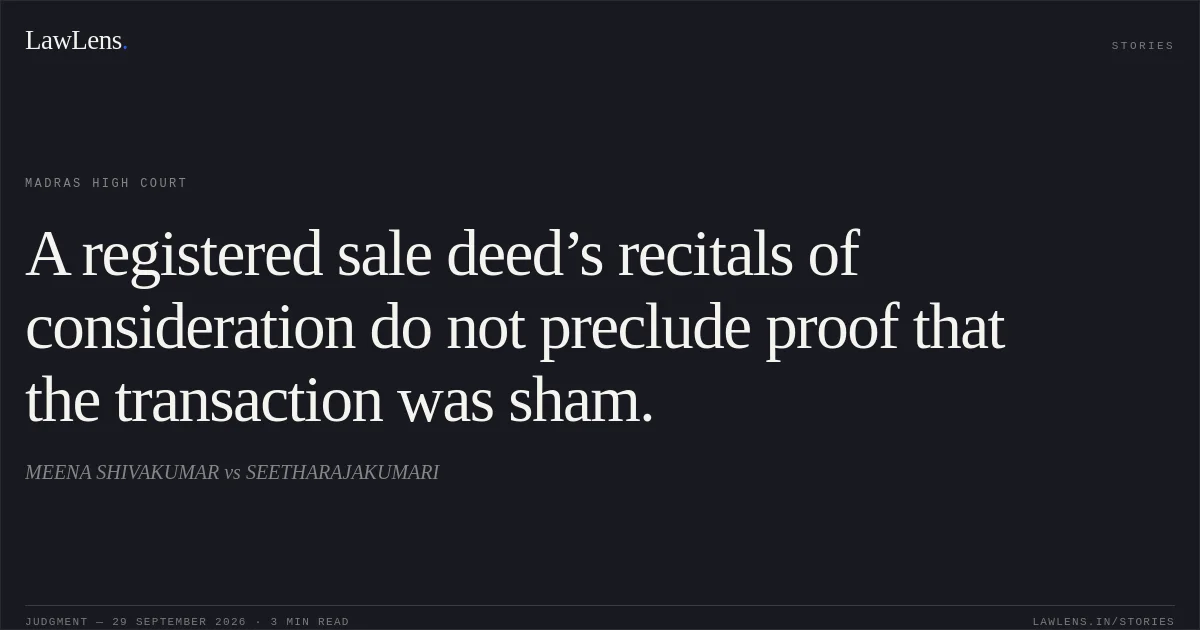
Source reference: p. 27A registered instrument’s execution does not, by itself, settle the separate question whether the transaction it records was genuine.
Source reference: pp. 27–28Mutation of revenue records does not, by itself, confer title.
Source reference: p. 29On abatement, the Court applied the procedural framework concerning substitution of legal representatives, referring to the prescribed 90-day period and the applications made to bring parties on record; it also considered the appellants’ Section 47 CPC challenge.
Source reference: pp. 30–32Reasoning
The Court rejected the argument that the registered deed’s recitals acknowledging payment conclusively established a genuine sale. It found that the Single Judge had considered the asserted sources and payment of the substantial consideration and that the finding of inadequate proof was not perverse or based on material misappreciation.
Source reference: pp. 27–28The evidence that the first appellant had acted as an advocate for Krishna Rao, together with the circumstances surrounding execution, supported the finding that the transaction was sham and nominal; the lease documents and later revenue mutations did not establish the genuineness of the sale or payment of the consideration.
Source reference: pp. 28–30Because the deed was held null and void and not binding on the plaintiffs, the appellants could not rely on it to establish a right to retain possession.
Source reference: p. 30The abatement objection also failed: an application to implead a claimant as legal representative was filed within the prescribed period and allowed, and Krishna Rao’s wife and children were subsequently brought on record; the later dispute over the Will and transposition of the claimant did not invalidate the suit.
Source reference: pp. 30–32Holding
The Court held that the appellants had not established that the sale deed represented a genuine sale supported by the recited consideration, and that the abatement challenge lacked merit.
It dismissed O.S.A. Nos. 74 and 75 of 2025 and O.S.A. No. 126 of 2026, confirmed the decrees in C.S. No. 925 of 2010 and Tr.C.S. No. 768 of 2013 and the challenged order in the execution proceedings, made no order as to costs, and closed the connected miscellaneous petitions.
Source reference: p. 34Acts & Sections Cited
5 provisions across 3 statutes referred to in this judgment. Each provision opens on LawLens.
Code of Civil Procedure, 19081
Transfer of Property Act, 18822
Limitation Act, 19632
Original Court PDF
MEENA SHIVAKUMARvsSEETHARAJAKUMARI
Click to open original judgment
Original judgment, available to read, download and summarize on LawLens.in