Facts
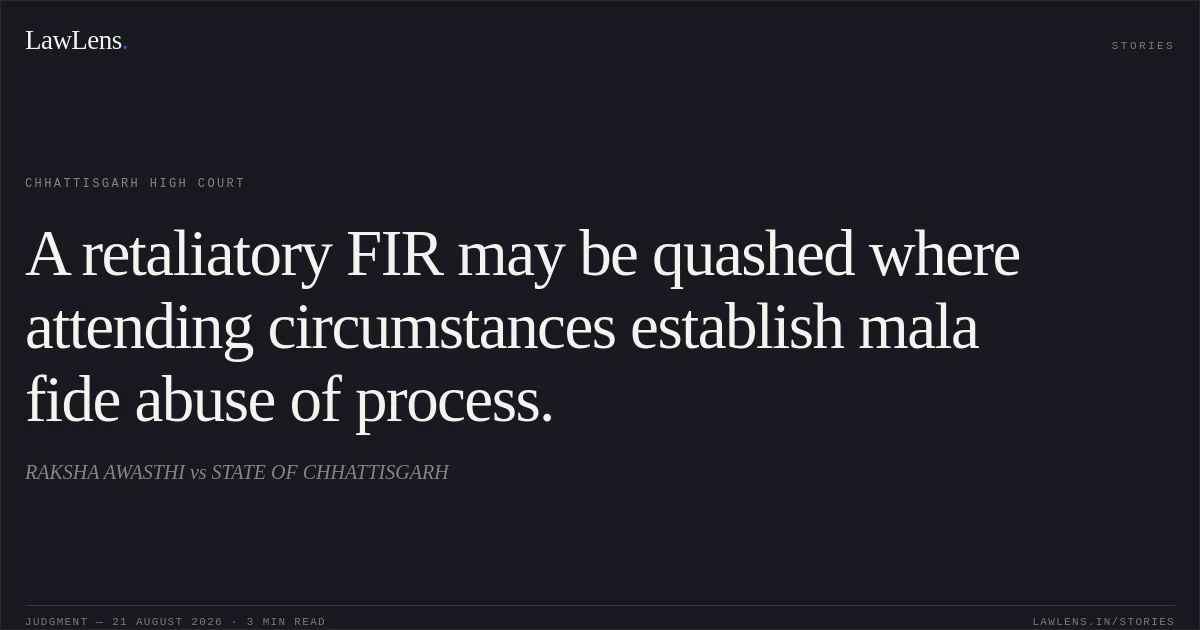
The petitioners in the connected petitions were a daughter and mother who challenged FIR No. 312/2025, registered on 21 June 2025 at Police Station City Kotwali, Rajnandgaon, for offences under Sections 296 and 351(2) of the Bharatiya Nyaya Sanhita, 2023, and Sections 3(1)(R) and 3(1)(S) of the Scheduled Castes and the Scheduled Tribes (Prevention of Atrocities) Act, 1989.
Source reference: para. 6The FIR arose from an alleged incident at approximately 6:00 p.m. on 20 June 2025, in which the petitioners allegedly used caste-related abuses against the complainant and her husband and threatened them near their pan shop.
Source reference: para. 6The petitioners contended that the FIR was a false and malicious counterblast to earlier complaints and criminal proceedings initiated by them and their family members against the complainant’s side in connection with a property dispute.
Source reference: paras. 6–7The State opposed quashing, submitting that the FIR disclosed cognizable offences and that investigation had produced prima facie material implicating the petitioners.
Source reference: para. 8Issues
1. Whether FIR No. 312/2025 and the consequential criminal proceedings against the petitioners disclosed a case warranting interference under Article 226 of the Constitution to prevent abuse of process and secure the ends of justice?
Source reference: paras. 10–172. Whether the surrounding circumstances—including the prior property-related dispute, alleged earlier proceedings, unexplained delay in registration of the FIR, and material relied upon by the petitioners—demonstrated that the prosecution was maliciously instituted with an ulterior motive?
Source reference: paras. 15–173. Whether the alleged facts prima facie established the essential ingredients of the offences under Sections 296 and 351(2) of the BNS and Sections 3(1)(R) and 3(1)(S) of the SC/ST Act?
Source reference: paras. 6, 9, 17Law Applied
The Court exercised its extraordinary jurisdiction under Article 226 of the Constitution to determine whether continuation of the criminal proceedings would constitute abuse of process or result in failure of justice.
Source reference: para. 11Applying State of Haryana v. Bhajan Lal, 1992 Supp (1) SCC 335, the Court held that quashing may be justified where criminal proceedings are manifestly attended with mala fides or maliciously instituted with an ulterior motive to wreak vengeance.
Source reference: para. 11Relying on Manoj Kumar Sharma v. State of Chhattisgarh, (2016) 9 SCC 1, and Rajiv Thapar v. Madan Lal Kapoor, (2013) 3 SCC 330, the Court recognised that sterling, unimpeachable and effectively unrefuted material produced by the accused may justify quashing.
Source reference: para. 12Under Salib @ Shalu @ Salim v. State of Uttar Pradesh, 2023 INSC 687, where mala fide or vexatious prosecution is alleged, the Court may examine not only the FIR but also the attending circumstances and material collected during investigation.
Source reference: para. 13Randheer Singh v. State of U.P., (2021) 14 SCC 626, reaffirmed that criminal proceedings cannot be used as an instrument of harassment.
Source reference: para. 14Reasoning
The Court found that the FIR had been lodged against the background of an existing property dispute and earlier criminal proceedings between the parties.
Source reference: paras. 15–16The alleged incident occurred at about 6:00 p.m., but the FIR was registered only at 4:05 a.m. the following morning.
Source reference: para. 15Given the complainant’s alleged presence at the police station and the short distance between the police station and the place of occurrence, the State failed to provide a satisfactory explanation for the delay.
Source reference: para. 15The Court also considered the CCTV footage and other material relied upon by the petitioners in support of their allegation of an ulterior motive and police-complainant collusion.
Source reference: para. 16Applying the Bhajan Lal categories and the principles in Manoj Kumar Sharma, Salib, and Randheer Singh, the Court held that the circumstances, taken cumulatively, indicated that the proceedings had been initiated for an ulterior purpose.
Source reference: para. 17The pendency of investigation was therefore not treated as an absolute bar to intervention.
Source reference: para. 16Holding
The Court answered the issues in favour of the petitioners and held that continuation of FIR No. 312/2025 would amount to abuse of the process of law.
Both WPCR Nos. 466/2025 and 475/2025 were allowed.
Source reference: para. 19FIR No. 312/2025 dated 21 June 2025, registered at Police Station City Kotwali, Rajnandgaon, for offences under Sections 296 and 351(2) of the BNS and Sections 3(1)(R) and 3(1)(S) of the SC/ST Act, together with all consequential proceedings insofar as they related to the petitioners, was quashed.
Source reference: para. 19Acts & Sections Cited
3 provisions across 2 statutes referred to in this judgment. Each provision opens on LawLens.
Scheduled Castes and the Scheduled Tribes (Prevention of Atrocities) Act, 19891
Bharatiya Nyaya Sanhita, 20232
Original Court PDF
RAKSHA AWASTHIvsSTATE OF CHHATTISGARH
Click to open original judgment
Original judgment, available to read, download and summarize on LawLens.in