Facts
The petitioners, police constables attached to SIPCOT Police Station, were charged with demanding and receiving a bribe in connection with the release of a mini-lorry allegedly carrying banned gutkha products.
Source reference: paras. 1–2, pp. 3–5The disciplinary case relied principally on retracted confession statements and the recovery of ₹3,10,000 from Nazil’s residence. Nazil maintained that the money was the balance of ₹11 lakh withdrawn from his bank account shortly before the recovery; the alleged payer, Dinesh, was not examined as a witness.
Source reference: paras. 14–18, pp. 12–14The disciplinary authority dismissed both constables, and the appellate and reviewing authorities upheld the dismissals. They challenged those decisions under Article 226.
Source reference: paras. 1–2, pp. 3–5; paras. 14–18, pp. 12–14Issues
Whether the disciplinary findings against Nazil were perverse or unsupported by evidence, particularly given the bank withdrawal evidence, the non-examination of Dinesh, and reliance on a retracted confession.
Source reference: paras. 14–23, pp. 12–16Whether the evidence against Suresh—including the confession statement and telephone call records—was sufficient to sustain the disciplinary finding against him.
Source reference: paras. 5, 24–26, pp. 7, 17–18Whether the High Court’s limited judicial-review jurisdiction permitted interference with the dismissal orders on these facts.
Source reference: paras. 11–12, pp. 10–12Law Applied
Under Article 226, judicial review of disciplinary proceedings is not an appeal on the merits: the Court ordinarily does not substitute its own findings where some evidence supports the disciplinary conclusion, but may intervene where the finding is perverse or unsupported by evidence; interference with penalty is also limited unless it is shockingly disproportionate.
Source reference: para. 11, pp. 10–11The Court drew these principles from B.C. Chaturvedi v. Union of India, (1995) 6 SCC 749; Deputy General Manager (Appellate Authority) v. Ajai Kumar Srivastava, (2021) 2 SCC 61; and Indian Oil Corporation v. Ajit Kumar Singh, 2023 LiveLaw (SC) 478.
Source reference: para. 11, pp. 10–11Although the strict rules of the Indian Evidence Act do not apply to disciplinary proceedings, the decision must still rest on material capable of supporting the finding, consistently with natural justice.
Source reference: paras. 9, 12, pp. 9, 11–12The Court also referred to the Evidence Act’s concept of proof as belief or probability sufficient for a prudent person, and observed that the alleged conduct involved cognizable offences for which registration of an FIR was warranted.
Source reference: paras. 9, 20, pp. 9, 15Reasoning
The Court found that the charge against Nazil was specifically receipt of ₹3,10,000 as a bribe, not possession of disproportionate assets. The bank statement showing a recent withdrawal of ₹11 lakh was not seriously disputed, yet the disciplinary finding treated the recovered cash as bribe money largely because Nazil had made no withdrawals during the preceding months.
Source reference: paras. 14–21, pp. 12–16The Court considered that inference inadequate, particularly because there was no evidence of the demand or payment, Dinesh was neither cited nor examined, and the alleged vehicle and contraband were not independently identified or investigated.
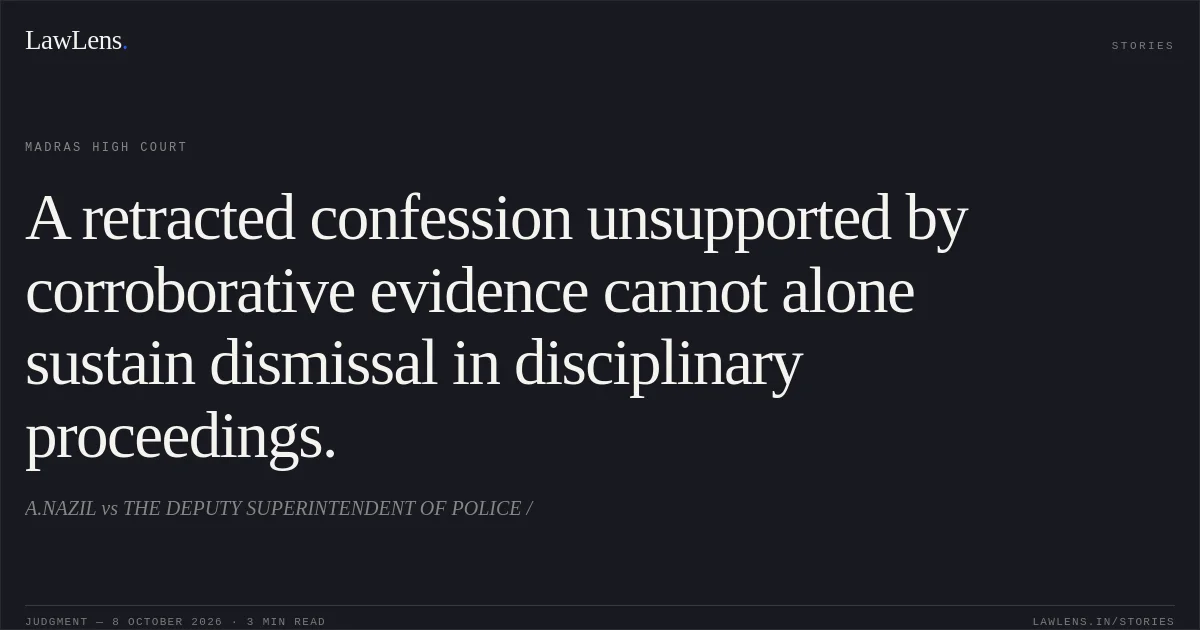
Source reference: paras. 14–21, pp. 12–16It further held that the retracted confession could not safely sustain the finding without corroboration, given the absence of an FIR concerning the alleged contraband offence and the other evidentiary omissions.
Source reference: paras. 22–23, pp. 16–17As to Suresh, the confession was the only substantive material, while the call records showed communication between colleagues working at the same station and residing in the same locality; the Court considered that insufficient, without more, to establish misconduct.
Source reference: paras. 24–26, pp. 17–18The resulting findings were therefore perverse and amenable to judicial review.
Source reference: para. 26, p. 18Holding
The Court held that the disciplinary findings against both petitioners were perverse and unsupported by the available evidence.
It quashed the dismissal orders and the appellate and review orders, and directed the respondents to reinstate the petitioners with continuity of service, back wages, and other attendant benefits within eight weeks of receiving the order.
Source reference: paras. 26–28, pp. 18–19The writ petitions were allowed; the connected miscellaneous petitions were closed, with no order as to costs.
Source reference: paras. 26–28, pp. 18–19Original Court PDF
A.NAZILvsTHE DEPUTY SUPERINTENDENT OF POLICE /
Click to open original judgment
Original judgment, available to read, download and summarize on LawLens.in