Facts
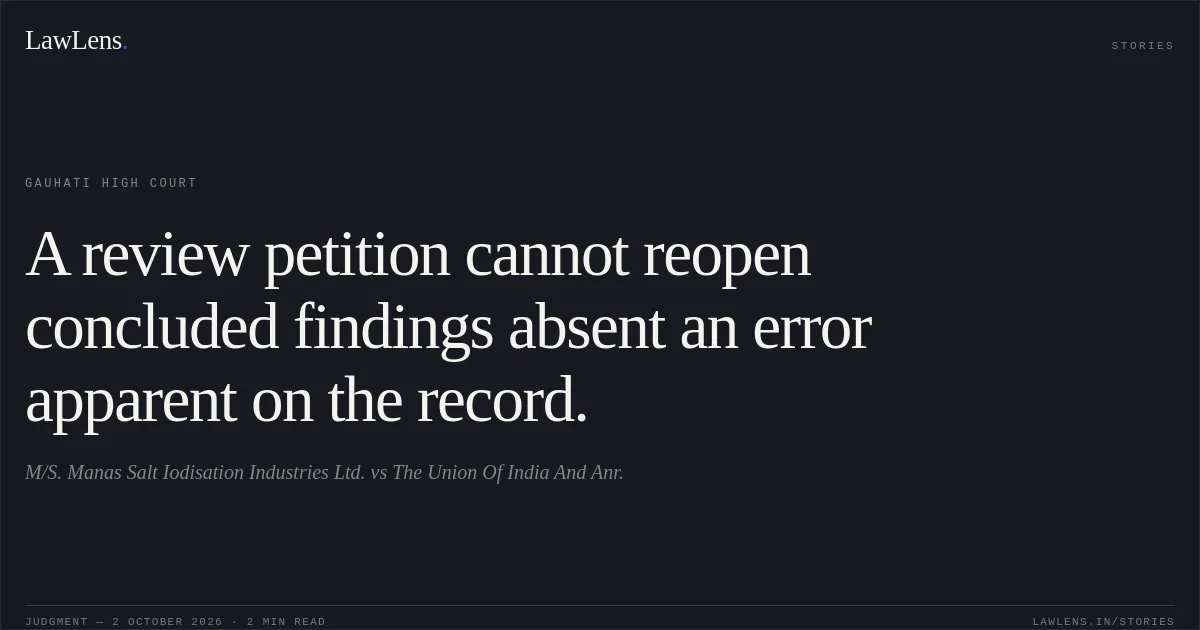
The petitioner sought review of the Gauhati High Court’s judgment dated 10 February 2025 in MFA No. 27 of 2016, which had set aside the Railway Claims Tribunal’s award and remanded the matter for reconsideration of the freight-concession claim.
Source reference: p. 2–3The underlying claim concerned a 2008 salt consignment from Halvad to Dikom. The petitioner had also sought a refund of terminal charges, contending that the stations were not among the 50 stations identified in the Railway Board’s letter dated 5 June 2007.
Source reference: p. 4–5, 9–12The petitioner argued that the Court had overlooked the 5 June 2007 letter and later decisions addressing the 50 stations; the Railway opposed review as an impermissible appeal in disguise.
Source reference: p. 12–17Issues
Whether the judgment dated 10 February 2025 contained an error apparent on the face of the record, or another sufficient ground for review, concerning terminal charges.
Source reference: p. 18–20, 26–30Whether the Railway Board’s letter dated 5 June 2007 and the decisions concerning the 50 specified stations supplied a basis to review the judgment and remit the terminal-charge issue to the Tribunal.
Source reference: p. 26–30Law Applied
Section 114 and Order XLVII, Rule 1 of the Code of Civil Procedure, 1908 permit review on specified grounds, including discovery of new and important matter despite due diligence, an error apparent on the face of the record, or another sufficient reason.
Source reference: p. 18–20Under Kamlesh Verma v. Mayawati, (2013) 8 SCC 320, review is not an appeal in disguise: it does not permit reappreciation of evidence or reconsideration merely because another view is possible; the error must be apparent and not require a process of reasoning to discover it.
Source reference: p. 18–20The Court also invoked the coordinate-bench rule discussed in National Insurance Co. Ltd. v. Pranay Sethi, (2017) 16 SCC 680: a bench of equal strength is bound by an earlier coordinate-bench decision and cannot take a contrary view without referring the matter to a larger bench.
Source reference: p. 29–30Reasoning
The Court held that the judgment under review had addressed terminal charges, including the effect of Rates Circular No. 92/2007 and the 2015 decision in MFA No. 100 of 2011.
Source reference: p. 23–27It rejected the argument that the 5 June 2007 letter remained operative, reasoning that the later circular superseded the relevant earlier instructions.
Source reference: p. 26–27It further found that the petitioner had not established that the 2024 decisions concerning the 50 specified stations involved the same circulars and issues; without the necessary pleadings and supporting material, those decisions did not demonstrate an error in the judgment under review.
Source reference: p. 27–30The Court also considered itself bound by the earlier coordinate-bench ruling in MFA No. 100 of 2011 and concluded that the petitioner had not shown any recognised ground for review.
Source reference: p. 29–31Holding
The Court dismissed the review petition, finding no error apparent, new matter warranting review, or other sufficient reason under Order XLVII, Rule 1 CPC.
It imposed costs of ₹5,000, payable to the Gauhati High Court Legal Services Committee within four weeks.
Source reference: p. 32Acts & Sections Cited
3 provisions across 3 statutes referred to in this judgment. Each provision opens on LawLens.
Code of Civil Procedure, 19081
Railway Claims Tribunal Act, 19871
Railways Act, 19891
Original Court PDF
M/S. Manas Salt Iodisation Industries Ltd.vsThe Union Of India And Anr.
Click to open original judgment
Original judgment, available to read, download and summarize on LawLens.in