Facts
The complainant alleged that the respondent-accused had abducted his daughter and repeatedly sexually assaulted her.
Source reference: p. 1–3The prosecution asserted that she was 17 years and 9 months old at the time.
Source reference: p. 1–3The trial court acquitted the accused of offences under Sections 363, 366 and 376(2)(n) of the IPC and Sections 4 and 6 of the POCSO Act, finding the prosecution had not proved her age or the alleged offences beyond reasonable doubt.
Source reference: p. 1–3The complainant appealed against the acquittal under Section 413 of the BNSS.
Source reference: p. 8Issues
1. Whether the prosecution proved that the victim was a minor at the time of the incident, so as to attract the POCSO Act
Source reference: p. 5–62. Whether the evidence established that the accused abducted the victim and committed rape or penetrative sexual assault against her will
Source reference: p. 5–63. Whether the trial court’s acquittal was perverse or otherwise warranted appellate interference
Source reference: p. 7–8Law Applied
The Court considered the charged offences under Sections 363, 366 and 376(2)(n) of the IPC and Sections 4 and 6 of the POCSO Act, and the appeal against acquittal under Section 413 of the BNSS.
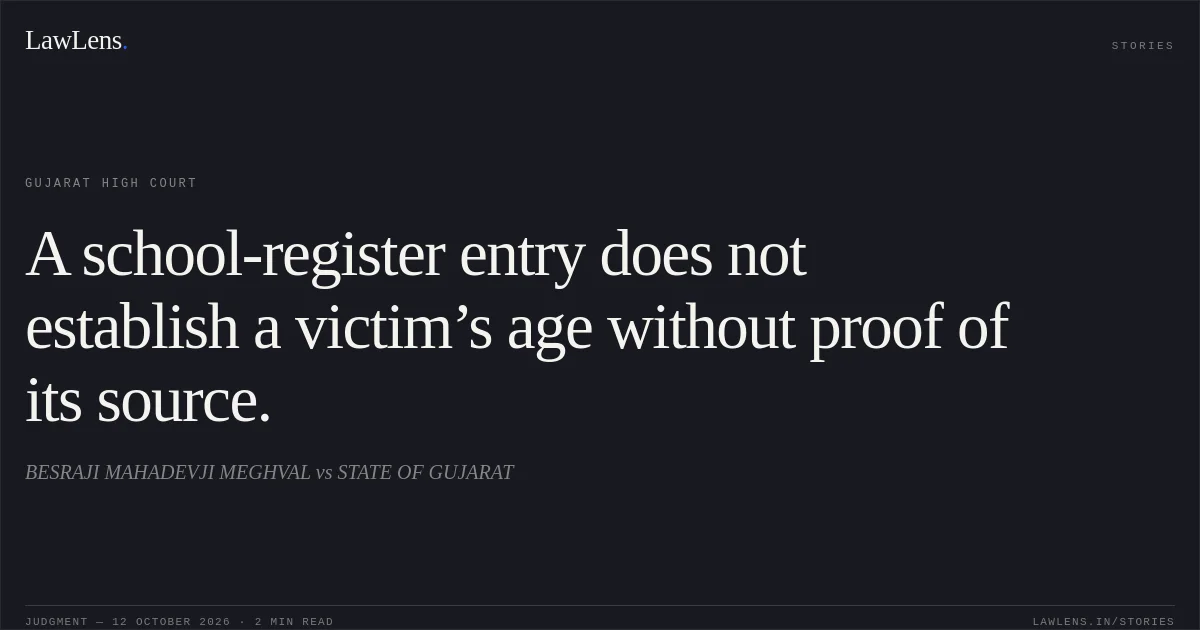
Source reference: p. 1, 3Relying on Birka Shiva v. State of Telangana, 2025 INSC 863, it stated that a school or birth-register entry may be admissible under Section 35 of the Evidence Act, but its probative value depends on proof of authenticity and the source of the underlying information; merely marking a document as an exhibit does not prove its contents.
Source reference: p. 6The Court also applied the principle that an acquittal reinforces the presumption of innocence and should not be disturbed where the trial court’s view is a reasonable and possible one; it cited Tulasareddi @ Mudakappa & Anr. v. State of Karnataka & Ors., 2026 INSC 67.
Source reference: p. 7Reasoning
The school-register extract and birth certificate were not supported by evidence establishing the source of the date-of-birth entry; the school witness could not identify the supporting admission document, and the victim’s mother gave a different place of birth from that recorded in the school documents.
Source reference: p. 5The Court therefore upheld the trial court’s finding that minority had not been proved.
Source reference: p. 5It further noted that the victim said she willingly left with the accused, stayed with him for over a month, had a phone but did not contact her family, and had stated in her Magistrate’s statement and medical history that the accused had not acted against her will.
Source reference: p. 5–6In light of the unproved age and this evidence, the Court accepted the trial court’s view that the relationship was consensual and that the prosecution had not established abduction or non-consensual sexual assault.
Source reference: p. 5–6Finding the acquittal to be a reasonable view rather than a perverse one, it declined to interfere.
Source reference: p. 7–8Holding
The Court held that the prosecution had not proved the victim’s minority or the charged offences beyond reasonable doubt, and that no ground existed to disturb the acquittal.
The appeal was dismissed and the trial court’s judgment and order dated 25 March 2026 were confirmed.
Source reference: p. 8Acts & Sections Cited
10 provisions across 4 statutes referred to in this judgment. Each provision opens on LawLens.
Indian Penal Code, 18603
Bharatiya Nagarik Suraksha Sanhita, 20233
Code of Criminal Procedure, 19732
Original Court PDF
BESRAJI MAHADEVJI MEGHVALvsSTATE OF GUJARAT
Click to open original judgment
Original judgment, available to read, download and summarize on LawLens.in