Facts
The petitioner was appointed as a Junior Assistant in the Tamil Nadu Civil Supplies Corporation (TNCSC) on 2 January 1976 and was later promoted as Superintendent.
Source reference: no citationIn February 1997, a Vigilance and Anti-Corruption inspection at Seelanaickenpatti Godown revealed that 26 bags of rice intended for Government hostels had not been delivered, besides certain shortages in other consignments.
Source reference: no citationThe petitioner was issued a charge memo dated 15 December 1997 alleging collusion with the lorry Helper, R. Kannaiyan.
Source reference: no citationAn enquiry conducted pursuant to that charge memo concluded on 11 May 1998 that the charges against the petitioner were not proved and that he had been falsely implicated; however, no final order was passed for approximately 13 years.
Source reference: pp.3–4Kannaiyan was permitted to retire without departmental punishment in 2009, while the petitioner was suspended on the date of his superannuation, 31 August 2010.
Source reference: no citationA second charge memo dated 28 February 2011 was then issued in respect of the same occurrence, containing altered allegations of conspiracy, fabrication of records and misappropriation.
Source reference: pp.4–6The petitioner’s requests for material documents were not complied with, and the second enquiry found the charges proved.
Source reference: pp.4–6A penalty of stoppage of increment for three years with cumulative effect was imposed on 16 October 2014 and confirmed in appeal on 31 October 2016.
Source reference: pp.4–6Meanwhile, in the connected criminal case, the petitioner was acquitted on 24 November 2014 on the same facts.
Source reference: p.5He therefore challenged both departmental orders and sought settlement of his service and retirement benefits.
Source reference: no citationIssues
1. Whether the respondents could initiate and conclude a second departmental enquiry on the same occurrence after the first enquiry had found the charges not proved and after an unexplained delay of approximately 13 years.
Source reference: pp.6–7, 142. Whether the disciplinary proceedings were vitiated by violation of natural justice, including failure to furnish the enquiry report and requested documents and failure to provide a proper opportunity to contest the charges.
Source reference: p.73. Whether the punishment imposed after the petitioner’s superannuation was legally sustainable under the applicable TNCSC Service Regulations.
Source reference: p.64. Whether the appellate order confirming the punishment was liable to be set aside as non-speaking and whether the petitioner was entitled to settlement of his service and retirement benefits.
Source reference: p.14Law Applied
The Court applied the principles of natural justice governing disciplinary proceedings, including the requirement that a disciplinary authority disagreeing with an enquiry officer must record reasons, communicate the disagreement and afford the delinquent an opportunity to respond.
Source reference: pp.6–7It further held that an enquiry report relied upon for imposing a major penalty must be furnished to the delinquent employee, and that denial of relevant documents necessary for the defence may vitiate the enquiry.
Source reference: p.7Relying on T. Kamaraj v. The Registrar General, High Court, Madras, 2026 MHC 3843, the Court distinguished a permissible de novo enquiry ordered because of a procedural error from an impermissible second enquiry conducted afresh on the same charges.
Source reference: pp.8–10Under State of A.P. v. N. Radhakrishnan, (1998) 4 SCC 154, unexplained and abnormal delay in disciplinary proceedings must be assessed with reference to prejudice, the nature of the charges and the circumstances of the delay; delay causing prejudice may vitiate the proceedings.
Source reference: p.11Applying P.V. Mahadevan v. M.D., T.N. Housing Board, (2005) 6 SCC 154, the Court held that unexplained protraction of disciplinary proceedings, particularly after retirement, should not be permitted where it causes serious mental and financial prejudice to the employee.
Source reference: pp.12–14The Court also referred to C. Nataraja Pillai v. TNCSC, 2003 (3) L.L.N. 1082, concerning the maintainability of disciplinary action after retirement.
Source reference: p.6Reasoning
The Court found that the first enquiry had already concluded in the petitioner’s favour in 1998, but the disciplinary authority neither passed a final order nor recorded a lawful disagreement with that report.
Source reference: pp.4, 7, 14Instead, after an unexplained lapse of approximately 13 years, the respondents issued a second charge memo concerning the same incident, altered the imputations and omitted the principal co-delinquent, who had been allowed to retire without punishment.
Source reference: pp.4, 7, 14This was not a procedurally justified de novo enquiry from the point of an identified error, but an impermissible fresh enquiry into the same matter.
Source reference: pp.4, 7, 14The subsequent enquiry was independently unfair because vital documents sought by the petitioner were not supplied, some witnesses were unavailable or deceased, and the enquiry report was not furnished before punishment was imposed.
Source reference: pp.5, 7The delay substantially prejudiced the petitioner, particularly because the proceedings were pursued after his superannuation and without any satisfactory explanation.
Source reference: p.14The petitioner’s acquittal in the criminal case on the same factual foundation further reinforced the infirmity in the departmental action, while the appellate authority’s failure to address the grounds raised in appeal rendered its order non-speaking.
Source reference: p.14Holding
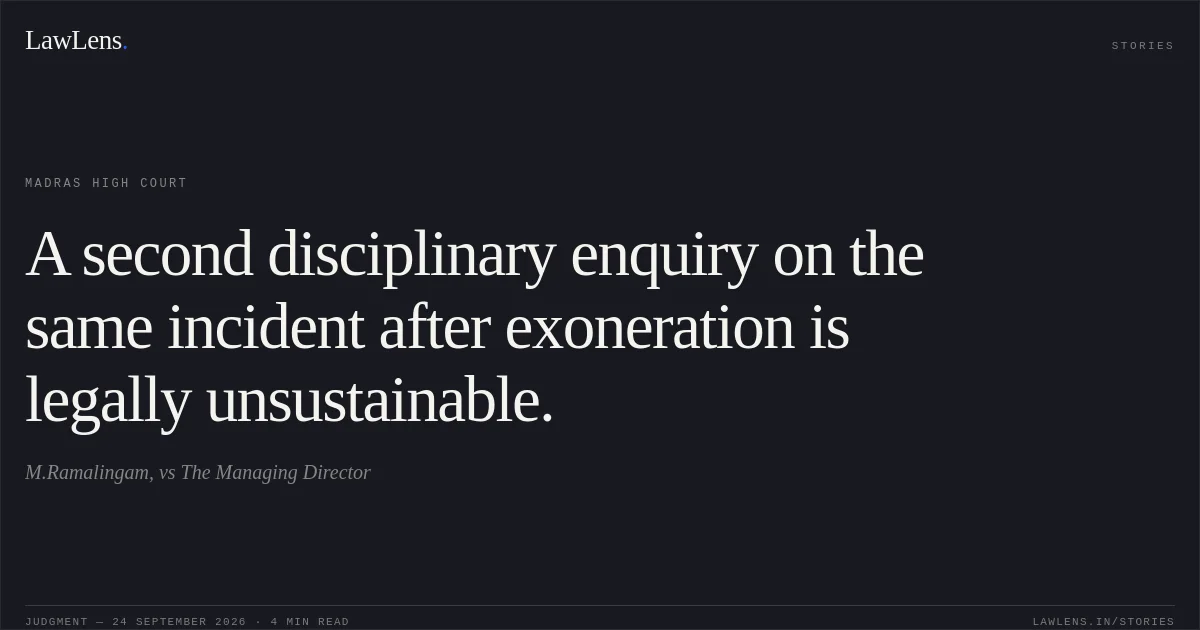
The Court held that the second departmental proceedings and the punishment founded upon them were legally unsustainable because they involved an impermissible second enquiry, unexplained and prejudicial delay, denial of natural justice, and a non-speaking appellate order.
The orders of the General Manager dated 16 October 2014 and the Managing Director dated 31 October 2016 were quashed.
Source reference: p.15The respondents were directed to settle and disburse all pending retirement and service benefits of the petitioner, if not already settled, within twelve weeks from receipt of the order.
Source reference: p.15The writ petition was allowed without costs.
Source reference: p.15Acts & Sections Cited
2 provisions across 1 statute referred to in this judgment. Linked provisions open on LawLens.
Prevention of Corruption Act, 19882
Original Court PDF
M.Ramalingam,vsThe Managing Director
Click to open original judgment
Original judgment, available to read, download and summarize on LawLens.in