Facts
The petitioner, a Grade-II Bench Clerk, faced departmental disciplinary proceedings concerning the alleged disappearance of 97 case bundles and five original promissory notes from the Court hall of the Subordinate Court, Dharapuram.
Source reference: p.2A charge memo was issued on 8 September 2015.
Source reference: p.2In the first enquiry, the Enquiry Officer found that the charge regarding the missing bundles was not proved, but held the petitioner responsible for dereliction of duty and negligence.
Source reference: p.2The disciplinary authority rejected and “scrapped” the first enquiry report as allegedly haphazard and ordered a fresh enquiry by appointing a different Enquiry Officer and Presenting Officer.
Source reference: pp.2–3, 7–8The second Enquiry Officer re-examined the same witnesses and documents and found all charges proved.
Source reference: pp.3, 8On that basis, the petitioner was dismissed from service on 27 March 2023.
Source reference: pp.3, 8On appeal, the Registrar General modified the dismissal to stoppage of increment for one year with cumulative effect, principally by comparing the punishment with that imposed on the co-delinquent, Muthulakshmi.
Source reference: pp.3–4, 8The petitioner challenged the appellate order dated 13 June 2025, contending that the second enquiry was impermissible and that the disciplinary procedure violated the Tamil Nadu Civil Services (Discipline and Appeal) Rules.
Source reference: p.4Issues
1. Whether the disciplinary authority could discard the first enquiry report and conduct a second, fresh enquiry on the same charge memo and set of charges?
Source reference: pp.5–82. Whether the disciplinary authority was required to proceed by recording disagreement with the first Enquiry Officer’s findings and giving the petitioner an opportunity to respond, rather than ordering an entirely fresh enquiry?
Source reference: p.63. Whether the impugned appellate order imposing stoppage of increment for one year with cumulative effect could be sustained when it was founded on a procedurally impermissible second enquiry?
Source reference: pp.8–9Law Applied
The Court applied the Tamil Nadu Civil Services (Discipline and Appeal) Rules and the governing principles of departmental enquiries.
Source reference: no citationTwo domestic enquiries on the same charge memo and on the same set of charges are impermissible.
Source reference: p.6A disciplinary authority may disagree with an Enquiry Officer’s findings, but must record reasons for its disagreement and issue a show-cause notice inviting the delinquent employee’s further explanation.
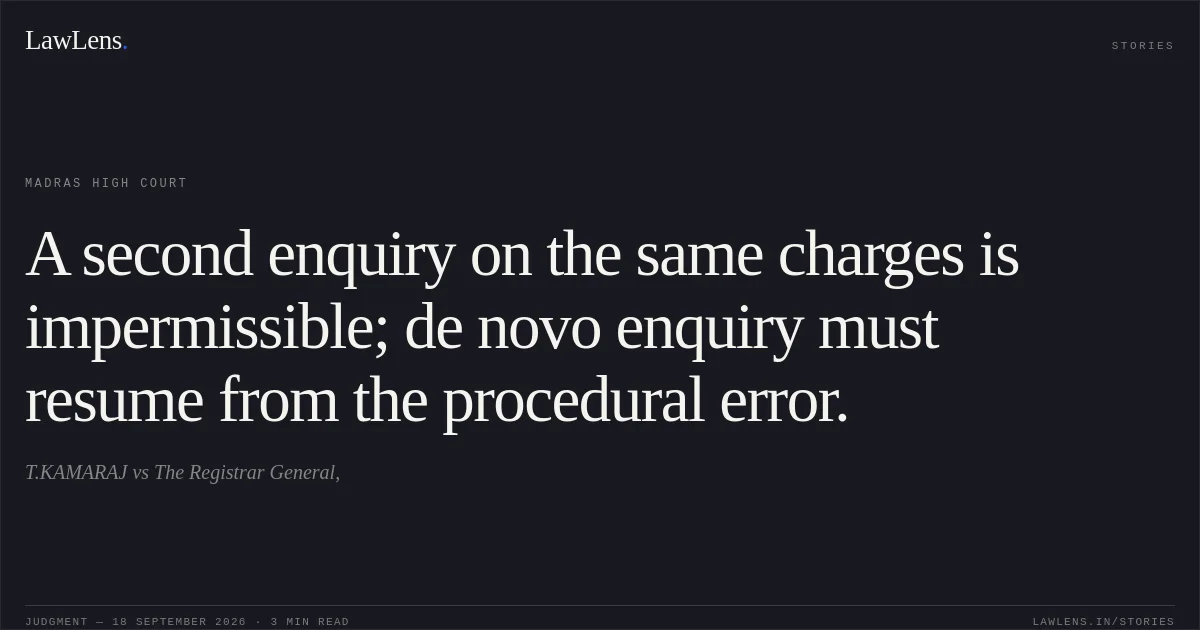
Source reference: p.6A de novo enquiry is permissible only where there is a procedural or substantial error in the original enquiry, and it must recommence from the stage at which the error occurred; it cannot ordinarily involve scrapping the entire report and conducting a completely fresh enquiry.
Source reference: pp.6–7The Court further distinguished a lawful de novo enquiry from an impermissible second enquiry undertaken to re-examine the same evidence in its entirety.
Source reference: p.7Reasoning
The Court found that the disciplinary authority did not merely disagree with the first Enquiry Officer’s conclusions.
Source reference: pp.5, 7–8Instead, it described the report as haphazard, set it aside in entirety, appointed a new Enquiry Officer and Presenting Officer, and directed a fresh enquiry into the same charges.
Source reference: pp.5, 7–8This action exceeded the authority’s power to record a dissenting view and obtain the petitioner’s explanation.
Source reference: no citationNo specific procedural or substantial error requiring recommencement from a particular stage was identified; rather, the entire first enquiry was replaced.
Source reference: no citationThe second enquiry therefore amounted to a prohibited re-enquiry, notwithstanding its description as a “de novo” enquiry.
Source reference: pp.6–8Since the subsequent dismissal and appellate punishment were founded on that impermissible second enquiry, the disciplinary and appellate process could not be sustained.
Source reference: no citationThe Court also observed that the appellate authority’s modification of punishment, based principally on parity with the co-delinquent, did not cure the underlying procedural defect.
Source reference: p.8Holding
The Court held that the second enquiry conducted on the same charges, after the entire first enquiry report had been discarded, was impermissible.
It consequently set aside the Registrar General’s order dated 13 June 2025 imposing stoppage of increment for one year with cumulative effect and allowed the writ petition without costs.
Source reference: p.9Although the petition also sought pay and allowances for the period between dismissal and reinstatement, the operative order expressly records only that the impugned punishment order was set aside; no separate direction regarding back wages or pay and allowances was issued.
Source reference: p.9Original Court PDF
T.KAMARAJvsThe Registrar General,
Click to open original judgment
Original judgment, available to read, download and summarize on LawLens.in