Facts
Respondents 2 and 3 filed a private complaint in PCR No. 1175/2020 alleging offences against the petitioners.
Source reference: p. 3; para. 3The Magistrate noted that the complaint was supported by an affidavit in compliance with Priyanka Srivastava v. State of U.P. and referred it for investigation under Section 156(3) of the Code of Criminal Procedure, 1973 (“CrPC”).
Source reference: p. 3; para. 3The petitioners sought to quash the complaint, the referral order and the resulting FIR, contending, among other things, that the referral order lacked application of mind and that the complaint was defective because the second named complainant had not signed it.
Source reference: pp. 4–7; paras. 4–5They also raised factual defences concerning the parties’ financial dealings and the third petitioner’s residence in the United States.
Source reference: pp. 5–7; para. 5Issues
Whether the Magistrate’s order referring the complaint for investigation under Section 156(3) CrPC was liable to be quashed for lack of application of mind.
Source reference: pp. 8–10; paras. 7–10Whether the alleged defect that the second named complainant had not signed the complaint warranted quashing the complaint and the referral order.
Source reference: pp. 8–9; paras. 7–9Whether the petitioners’ factual defence concerning the underlying transaction could be considered in a petition challenging a pre-cognizance referral for investigation.
Source reference: pp. 9–10; para. 9Law Applied
Section 156(3) CrPC empowers a Magistrate, before taking cognizance, to refer a complaint disclosing cognizable offences to the police for investigation.
Source reference: pp. 9–10; paras. 8–10At that stage, the Magistrate is to consider the complaint and determine whether investigation is warranted; the court need not adjudicate the accused’s factual defence as though deciding the merits of the allegations.
Source reference: pp. 9–10; paras. 8–10The Magistrate’s order recorded that the complaint was supported by an affidavit in compliance with Priyanka Srivastava v. State of U.P., AIR 2015 SC 1758, and that cognizable, non-bailable offences were disclosed.
Source reference: p. 3; para. 3The High Court considered the challenge under Section 482 CrPC, but held that the grounds raised did not justify interference with the pre-cognizance referral.
Source reference: p. 10; para. 10Reasoning
The High Court examined the referral order and found that the Magistrate had considered the complaint’s contents, noted the supporting affidavit and formed the view that cognizable offences were disclosed and investigation was appropriate.
Source reference: pp. 8–10; paras. 7–9Although the second complainant was named in the cause title, only the first complainant had signed the prayer and verification, and an affidavit accompanied the complaint; the Court did not treat this circumstance as sufficient to quash the referral.
Source reference: p. 8; para. 7The petitioners’ claims about the debt, documents and the third petitioner’s lack of involvement concerned the merits and were matters for investigation, including consideration by the Investigating Officer.
Source reference: pp. 9–10; para. 9The Court therefore declined to assess those factual disputes at the pre-cognizance stage.
Source reference: p. 10; para. 10Holding
The Court dismissed the criminal petition.
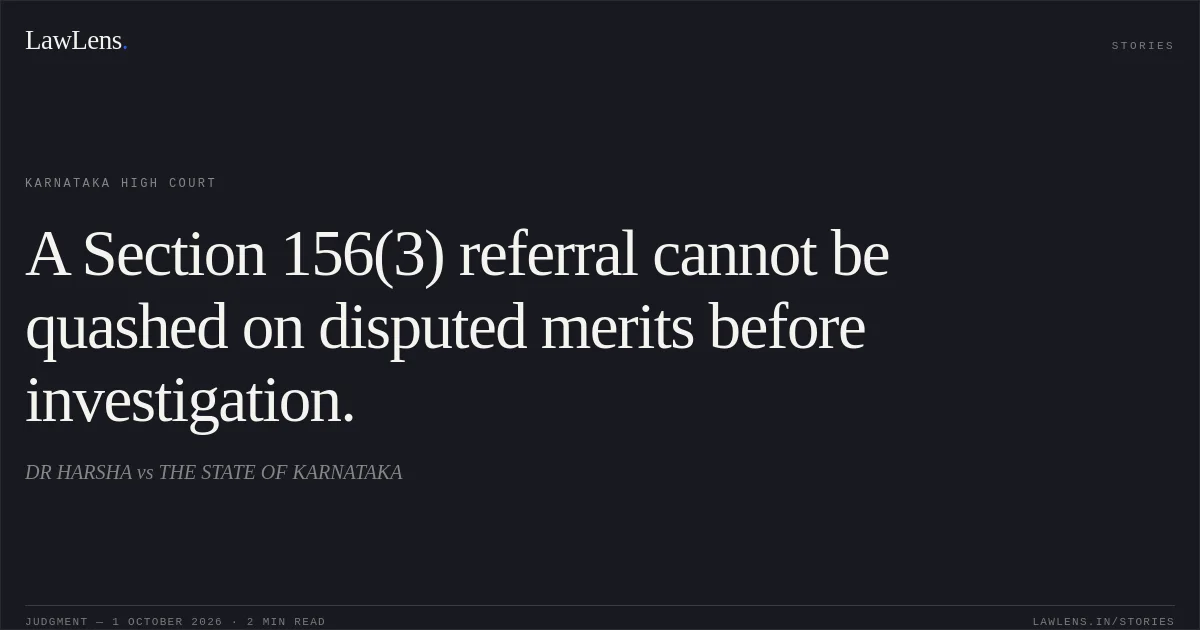
It declined to quash the private complaint, the Magistrate’s order under Section 156(3) CrPC or the resulting FIR, holding that the challenged order was a pre-cognizance referral made after the Magistrate considered the complaint and found that investigation was warranted.
Source reference: p. 11; para. 10Acts & Sections Cited
7 provisions across 2 statutes referred to in this judgment. Each provision opens on LawLens.
Code of Criminal Procedure, 19733
Indian Penal Code, 18604
Original Court PDF
DR HARSHAvsTHE STATE OF KARNATAKA
Click to open original judgment
Original judgment, available to read, download and summarize on LawLens.in