Facts
The petitioner, the Principal of Saraswati Vidya Mandir, initiated complaint proceedings alleging that the accused persons entered the school after a meeting, broke the locks of the office and classroom, destroyed school documents, removed furniture and other articles, and threatened to kill him if he continued operating the school.
Source reference: paras. 3–4He also alleged a subsequent attempt on his life.
Source reference: paras. 3–4The complaint was referred to the police and registered as Kahalgaon P.S. Case No. 343 of 2014 under Sections 452, 379, 506 and 120-B of the IPC.
Source reference: paras. 2, 7After investigation, the police submitted a final form/closure report.
Source reference: paras. 2, 7The petitioner’s protest petition was dismissed by the Chief Judicial Magistrate under Section 203 Cr.P.C.
Source reference: paras. 2, 7The criminal revision against that dismissal was dismissed by the Sessions Judge, Bhagalpur, on 17 September 2018.
Source reference: para. 2The petitioner thereafter invoked Section 482 Cr.P.C. before the High Court, seeking quashing of the revisional order and the Magistrate’s dismissal order.
Source reference: no citationIssues
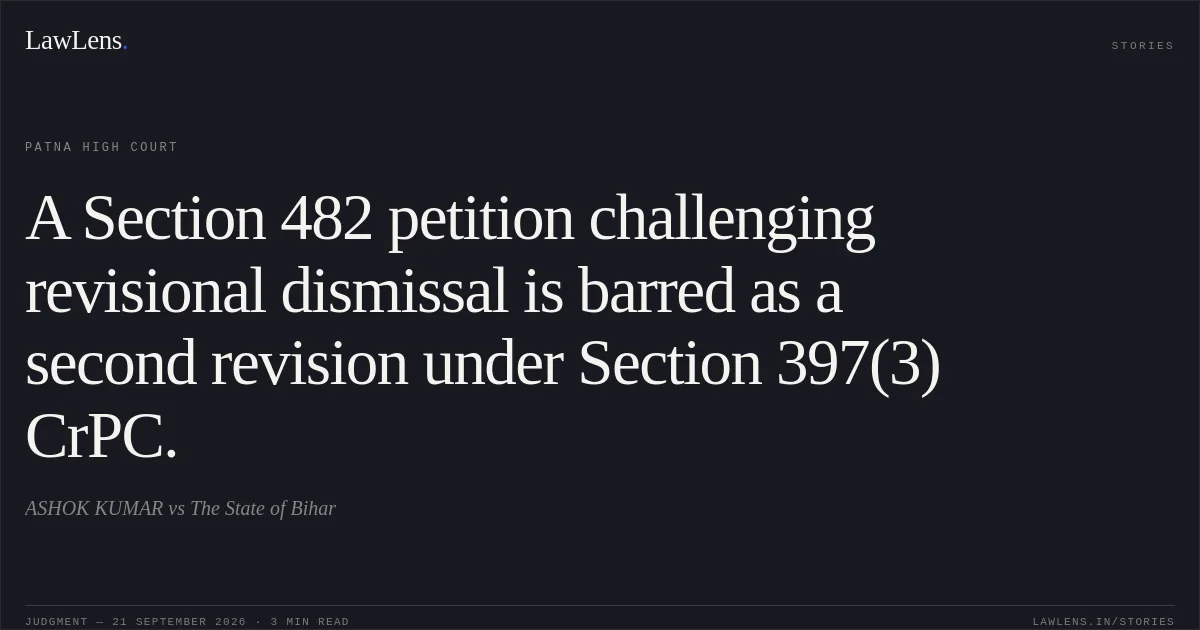
Whether a petition under Section 482 Cr.P.C. challenging the dismissal of a criminal revision can be entertained when it effectively amounts to a second criminal revision barred by Section 397(3) Cr.P.C.
Source reference: paras. 6, 9–10Whether the orders dismissing the protest-cum-complaint under Section 203 Cr.P.C. and the subsequent criminal revision were so perverse or legally unsustainable as to warrant exercise of the High Court’s inherent jurisdiction under Section 482 Cr.P.C.
Source reference: paras. 2, 5–9Law Applied
The Court applied Section 203 Cr.P.C., under which a Magistrate may dismiss a complaint where, after considering the complainant’s statement and the result of inquiry or investigation, there is insufficient ground for proceeding.
Source reference: no citationSection 397(3) Cr.P.C. bars a second revision by the same person before the High Court or another court after a revision has been disposed of.
Source reference: paras. 9–10Section 482 Cr.P.C. preserves the High Court’s inherent powers, but such jurisdiction cannot ordinarily be used to circumvent the statutory bar on a second revision and may be exercised against a revisional order only in exceptional cases involving perversity or manifest illegality.
Source reference: paras. 9–10The Court relied on Kailash Verma v. Punjab State Civil Supplies Corporation, (2005) 2 SCC 571, regarding the limited exercise of inherent jurisdiction against revisional orders.
Source reference: paras. 9–10Reasoning
The High Court noted that the police had submitted a closure report and that the petitioner’s protest petition had thereafter been considered and dismissed under Section 203 Cr.P.C.
Source reference: paras. 7–8The petitioner challenged that dismissal through a criminal revision, which was also dismissed by the Sessions Court.
Source reference: paras. 7–8Although the petitioner contended that the Magistrate had improperly rejected the allegations merely because the dispute arose from a land dispute, the High Court found no basis to treat the impugned orders as completely perverse or legally unsustainable.
Source reference: paras. 5–9The proposed Section 482 petition sought substantially the same relief as a second revision and therefore attracted the bar under Section 397(3) Cr.P.C.
Source reference: paras. 10–11The inherent jurisdiction could not be invoked merely to re-examine the merits of the allegations or bypass the statutory prohibition.
Source reference: no citationHolding
The Court held that the petition under Section 482 Cr.P.C. was, in substance, a second criminal revision on the same issue and was barred by Section 397(3) Cr.P.C.
No exceptional perversity or legal infirmity warranting interference was established.
Source reference: para. 11The petition was accordingly dismissed, and a copy of the judgment was directed to be transmitted to the trial court.
Source reference: para. 11Acts & Sections Cited
6 provisions across 2 statutes referred to in this judgment. Each provision opens on LawLens.
Code of Criminal Procedure, 19733
Indian Penal Code, 18603
Original Court PDF
ASHOK KUMARvsThe State of Bihar
Click to open original judgment
Original judgment, available to read, download and summarize on LawLens.in