Facts
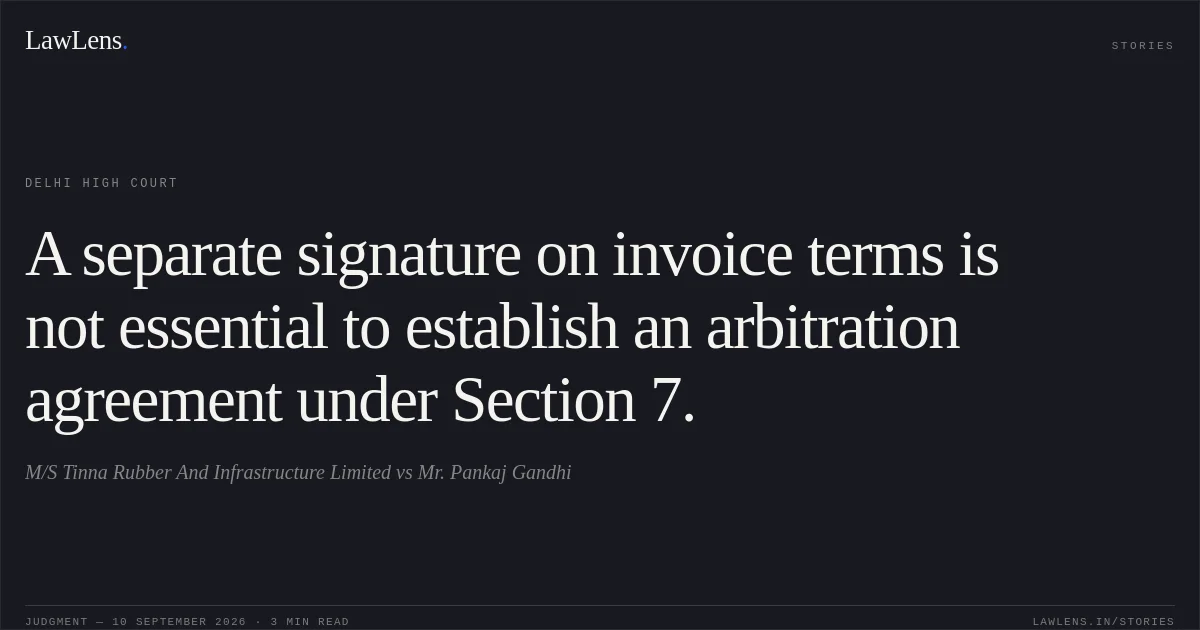
The Petitioner filed a petition under Section 11 of the Arbitration and Conciliation Act, 1996 (“the Act”) seeking appointment of an arbitrator pursuant to Clause 18 of the terms and conditions of sale printed on the reverse/overleaf of invoices issued to the Respondent.
Source reference: p.1, para.1The Petitioner contended that the Respondent received and acted upon the invoices, accepted the supplied goods, and made part-payments without contemporaneously objecting to the terms and conditions or the arbitration clause.
Source reference: pp.1–2, paras.2–4The Respondent opposed the petition, asserting that the invoices were single-page documents without any arbitration clause and that the terms relied upon by the Petitioner appeared on separate papers which were neither supplied to nor signed or accepted by him.
Source reference: p.2, paras.5–6The Court was therefore required to determine, at the Section 11 stage, whether an arbitration agreement prima facie existed between the parties.
Source reference: p.3, paras.9–10Issues
1. Whether Clause 18 of the terms and conditions printed on the reverse/overleaf of the invoices constituted an arbitration agreement under Section 7 of the Act, despite the absence of a separate signature or express acceptance by the Respondent.
Source reference: pp.3–4, paras.10–162. Whether the Respondent’s objections regarding incorporation, acceptance, and validity of the invoice terms required detailed adjudication by the Court at the Section 11 stage or should be left to the arbitral tribunal under Section 16 of the Act.
Source reference: pp.3–5, paras.12, 15–163. Whether a sole arbitrator ought to be appointed to adjudicate the disputes between the parties.
Source reference: p.5, paras.17–20Law Applied
The Court applied Sections 7 and 11(6) of the Arbitration and Conciliation Act, 1996.
Source reference: no citationSection 7 requires an arbitration agreement to be in writing but does not invariably require a separately signed arbitration clause; the parties’ intention may be gathered from the written record, surrounding conduct, and documentary material.
Source reference: p.4, para.15At the Section 11 referral stage, the Court’s examination is confined to the prima facie existence of an arbitration agreement and does not extend to detailed adjudication of the underlying claims, defences, or evidentiary disputes.
Source reference: p.3, para.12Questions concerning the substantive validity, incorporation, or applicability of the arbitration agreement may ordinarily be determined by the arbitral tribunal under the doctrine of kompetenz-kompetenz embodied in Section 16.
Source reference: p.4, para.15The Court relied on *M/s Triom Hospitality v. M/s J.S. Hospitality Services Pvt. Ltd.*, 2025 SCC OnLine Del 8647, which held that Section 7 does not mandate a separate signature on the arbitration clause and that deeper evidentiary questions may be left to the arbitral tribunal.
Source reference: p.4, para.15Reasoning
The Court found that Clause 18 was contained in the terms and conditions forming part of the invoices and that the Petitioner had placed material showing that the Respondent received and acted upon those invoices, accepted the goods, and made part-payments.
Source reference: p.4, para.13Although the Respondent disputed receiving or accepting the reverse-side terms and relied on the absence of a separate signature, the Court held that such absence was not, by itself, determinative of the non-existence of an arbitration agreement.
Source reference: pp.3–4, paras.11, 14Applying the limited prima facie scrutiny applicable under Section 11, the Court held that the written arbitration clause and the parties’ conduct were sufficient to satisfy the requirement of an arbitration agreement under Section 7.
Source reference: pp.4–5, paras.13, 16Any detailed determination regarding incorporation of the terms or the Respondent’s jurisdictional and arbitrability objections was left to the arbitral tribunal.
Source reference: p.5, para.21Holding
The Court held that a prima facie arbitration agreement existed between the parties notwithstanding the absence of a separately signed arbitration clause.
The petition was allowed, and Ms. Mansvini Jain, Advocate, was appointed as the sole arbitrator to adjudicate the disputes.
Source reference: p.5, paras.17–18The arbitrator was directed to enter upon the reference within two weeks, furnish the requisite disclosures under Section 12(2), and conduct the proceedings under the rules and aegis of the Delhi International Arbitration Centre.
Source reference: p.5, paras.18–20The parties were permitted to raise all objections, including arbitrability and jurisdiction, before the arbitrator, and the petition was disposed of accordingly.
Source reference: pp.5–6, paras.21–24Acts & Sections Cited
4 provisions across 1 statute referred to in this judgment. Each provision opens on LawLens.
Arbitration and Conciliation Act, 19964
Original Court PDF
M/S Tinna Rubber And Infrastructure LimitedvsMr. Pankaj Gandhi
Click to open original judgment
Original judgment, available to read, download and summarize on LawLens.in