Facts
The petitioners were charge-sheeted for offences under Sections 306, 498A and 114 of the Indian Penal Code.
Source reference: para. 3; p. 2While their discharge application was pending, the Sessions Court, acting on an application by the Public Prosecutor, ordered the post-mortem doctor to be examined before charge was framed.
Source reference: paras. 3, 6; pp. 2–3, 4The stated purpose was to determine whether the case warranted a charge under Section 302 or Section 306 IPC, given that the post-mortem report recorded death by complete hanging.
Source reference: paras. 3, 6; pp. 2–3, 4The doctor’s evidence was recorded at Exhibit 18.
Source reference: paras. 3, 6; pp. 2–3, 4The petitioners challenged the order dated 13 January 2020 permitting that evidence to be recorded.
Source reference: paras. 3, 6; pp. 2–3, 4Issues
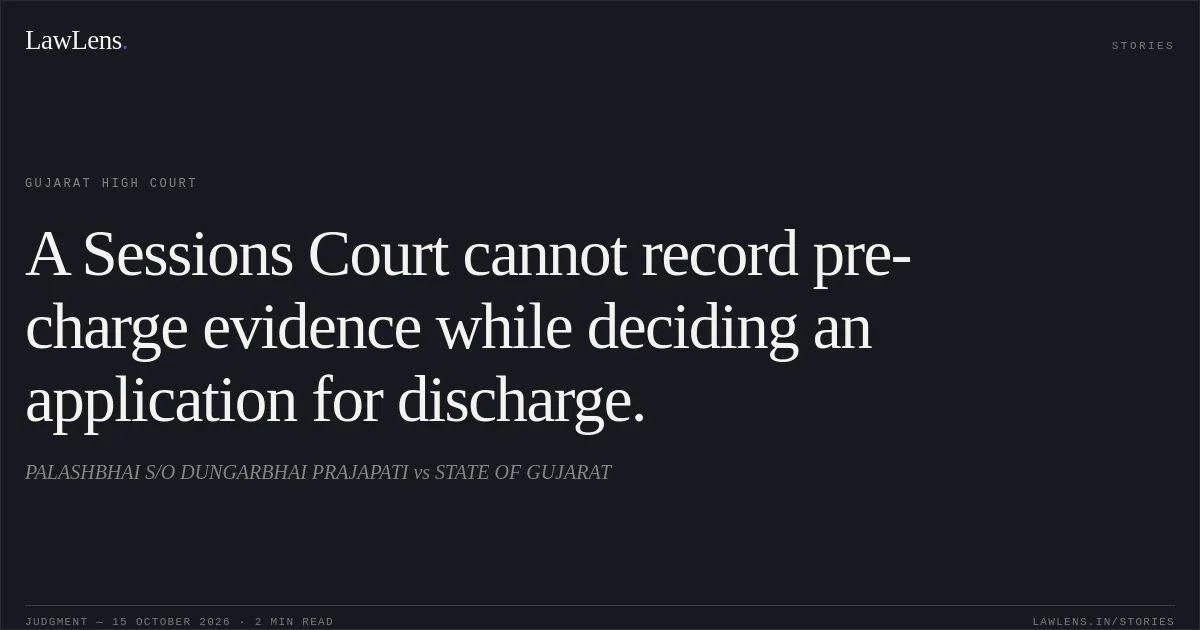
1. Whether a Sessions Court may record pre-charge evidence while deciding an application for discharge.
Source reference: para. 8; p. 72. Whether the post-mortem doctor’s evidence recorded at that stage could be retained on the trial court record.
Source reference: para. 9; p. 8Law Applied
Under Sections 227 and 228 of the Code of Criminal Procedure, at the discharge or charge-framing stage the Sessions Judge considers the case record and documents submitted with it, hears the prosecution and accused, and decides whether there is sufficient ground to proceed or ground to presume that an offence has been committed.
Source reference: para. 8; pp. 6–7The Code prescribes no procedure for recording pre-charge evidence at the stage of deciding discharge; the court’s consideration at that stage is confined to material collected during investigation and filed with the charge-sheet. If subsequent material warrants it, a charge may be altered at the appropriate stage.
Source reference: para. 8; pp. 6–7Reasoning
The Sessions Court ordered the doctor’s examination to clarify whether the death called for a charge under Section 302 or Section 306 IPC.
Source reference: paras. 6, 8; pp. 4, 7The High Court held that this inquiry could not be undertaken by recording evidence while deciding discharge: the Sessions Court had to determine the application from the investigation material accompanying the charge-sheet, applying Sections 227 and 228 CrPC.
Source reference: paras. 6, 8; pp. 4, 7Any later basis for invoking Section 302 could be addressed through alteration of the charge at the appropriate stage.
Source reference: paras. 6, 8; pp. 4, 7Holding
The High Court allowed the petition and quashed the Sessions Court’s order dated 13 January 2020 below Exhibit 11.
It directed that the post-mortem doctor’s evidence recorded at Exhibit 18 be discarded from the trial court record.
Source reference: para. 9; p. 8Acts & Sections Cited
8 provisions across 3 statutes referred to in this judgment. Each provision opens on LawLens.
Indian Penal Code, 18603
Code of Criminal Procedure, 19734
KARNATAKA STATE MINORITIES COMMISSION ACT, 19941
Original Court PDF
PALASHBHAI S/O DUNGARBHAI PRAJAPATIvsSTATE OF GUJARAT
Click to open original judgment
Original judgment, available to read, download and summarize on LawLens.in