Facts
The appellant was prosecuted for allegedly sexually assaulting a 17-year-old girl on 10 November 2018.
Source reference: no citationThe prosecution case was that he first subjected her to sexual acts in a lane and thereafter took her into his grandmother’s house, removed her clothing and committed penetrative sexual assault, while also threatening her with death if she disclosed the incident.
Source reference: para. 9The victim’s complaint was recorded at the Government Medical College Hospital, Asaripallam, and an FIR was registered under Section 376 of the IPC and Sections 5(l) and 6 of the POCSO Act.
Source reference: paras. 2–3The victim, her parents, the investigating officers, and the medical officer were examined, and the medical evidence stated that sexual intercourse could not be ruled out, although no semen or spermatozoa were detected.
Source reference: paras. 10–15The Special Court convicted the appellant under Sections 5(l) and 6 of the POCSO Act and Section 506(i) of the IPC, sentencing him to twenty years’ rigorous imprisonment under the POCSO Act and one year’s rigorous imprisonment under Section 506(i) IPC, with fines.
Source reference: paras. 4–6The appellant challenged the conviction and sentence before the High Court.
Source reference: no citationIssues
Whether the conviction and sentence imposed by the Trial Court were sustainable on the evidence on record?
Source reference: para. 8Whether the appellant’s conduct constituted aggravated penetrative sexual assault under Sections 5(l) and 6 of the POCSO Act, or only penetrative sexual assault under Sections 3 and 4 of the Act?
Source reference: para. 16Whether the conviction under Section 506(i) of the IPC should be interfered with?
Source reference: para. 17Law Applied
The Court applied Section 3 of the POCSO Act, which defines penetrative sexual assault, and Section 4, which prescribes punishment for that offence.
Source reference: para. 16It considered Section 5(l), which treats the commission of penetrative sexual assault more than once or repeatedly as aggravated penetrative sexual assault, punishable under Section 6 of the POCSO Act.
Source reference: para. 16The Court also applied Section 506(i) of the IPC concerning criminal intimidation, and Section 428 of the Cr.P.C. concerning set-off of the period of imprisonment already undergone.
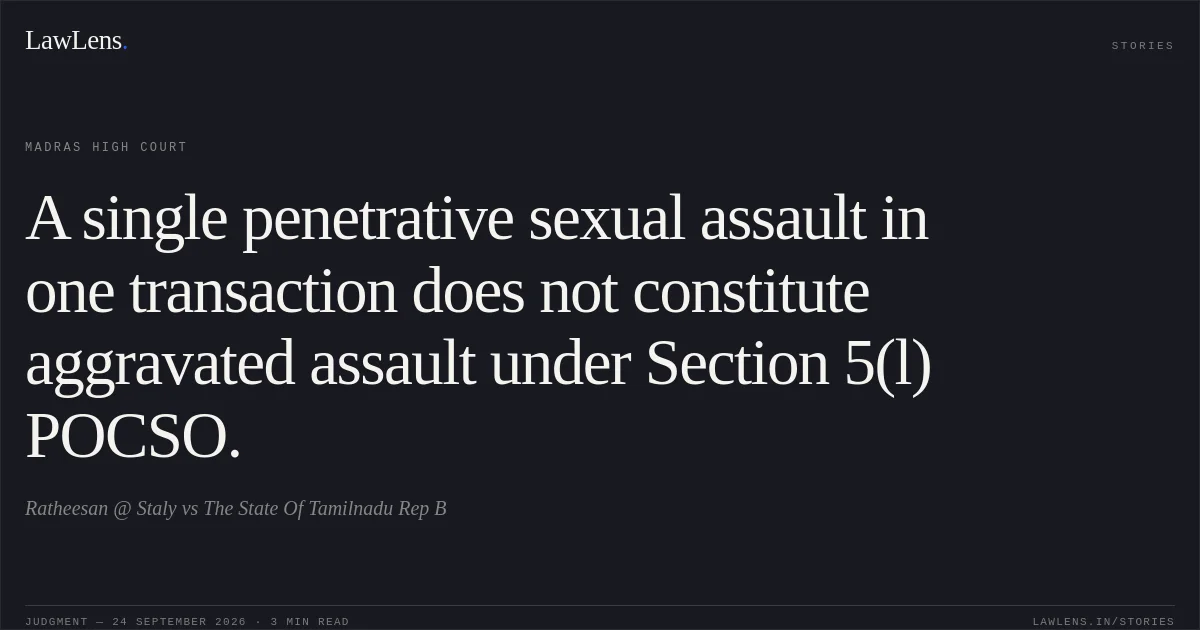
Source reference: para. 17The governing principle was that conviction for aggravated penetrative sexual assault requires proof of the aggravating circumstance alleged; a single act of penetration occurring during one transaction does not, by itself, satisfy Section 5(l).
Source reference: para. 16Reasoning
The High Court accepted the victim’s testimony regarding the occurrence and found that it established one act of penetrative sexual assault inside the grandmother’s house.
Source reference: paras. 10, 16Although the victim stated that the appellant had pressed his private part against hers in the lane, she did not state that penetration or insertion occurred at that stage.
Source reference: para. 16The Court therefore distinguished the earlier sexual acts from the subsequent penetrative assault and held that the evidence disclosed only one act of penetration during the same transaction.
Source reference: para. 16Consequently, the statutory requirement for aggravated penetrative sexual assault under Section 5(l) was not established, and the conviction under Section 6 could not be sustained.
Source reference: para. 16However, the evidence proved penetrative sexual assault punishable under Sections 3 and 4 of the POCSO Act.
Source reference: para. 16The threat attributed to the appellant supported the separate conviction under Section 506(i) IPC, which the Court upheld.
Source reference: para. 17Holding
The appeal was partly allowed.
The conviction and sentence under Sections 5(l) and 6 of the POCSO Act were set aside.
Source reference: para. 17The appellant was instead convicted under Section 4 read with Section 3 of the POCSO Act and sentenced to seven years’ rigorous imprisonment with a fine of ₹1,000, with three months’ simple imprisonment in default.
Source reference: para. 17The conviction and sentence under Section 506(i) IPC—one year’s rigorous imprisonment with a fine of ₹1,000—were sustained.
Source reference: para. 17Both sentences were directed to run concurrently, and the period already undergone was ordered to be set off under Section 428 Cr.P.C.; any excess fine paid was directed to be refunded.
Source reference: para. 17Acts & Sections Cited
11 provisions across 4 statutes referred to in this judgment. Each provision opens on LawLens.
Bharatiya Nagarik Suraksha Sanhita, 20231
Indian Penal Code, 18602
Code of Criminal Procedure, 19734
Original Court PDF
Ratheesan @ StalyvsThe State Of Tamilnadu Rep B
Click to open original judgment
Original judgment, available to read, download and summarize on LawLens.in