Facts
The plaintiff and the first defendant, who had married in 2008, were named jointly as purchasers of the suit house site.
Source reference: p. 2–3The plaintiff claimed that she and her mother contributed to its purchase and that the parties jointly obtained a housing loan to construct a house; she sought partition of a one-half share.
Source reference: p. 2–3The first defendant maintained that he alone funded the purchase and construction and that the plaintiff’s name was included in the sale deed only as a name lender.
Source reference: p. 4–5The trial court dismissed the suit, finding that the plaintiff had not contributed to the property or construction. She appealed.
Source reference: p. 5Issues
Whether the suit site was jointly purchased by the plaintiff and the first defendant, or whether the plaintiff was only a name lender.
Source reference: p. 13Whether the plaintiff proved that the site’s market value was Rs.5,00,000 and that she and her mother contributed Rs.3,00,000 towards its purchase.
Source reference: p. 13Whether the plaintiff proved that the housing loan was repaid from her income as well.
Source reference: p. 13Whether the plaintiff was entitled to a one-half share and whether the trial court’s decree warranted appellate interference.
Source reference: p. 13Law Applied
Under Order VIII Rules 3 and 4 CPC, denials of material factual allegations must be specific and not evasive; under Rule 5(1), an allegation not properly denied may be treated as admitted, subject to the court’s discretion under the proviso to require proof.
Source reference: p. 17–18Applying Valliammal (D) by LRs v. Subramaniam, (2004) 7 SCC 233, the court stated that the party alleging a benami transaction bears the burden of proving it; relevant considerations include the source of purchase money, possession and conduct concerning the property, the parties’ relationship, motive, and custody of title deeds, with the source of funds and motive being particularly important.
Source reference: p. 14–16The court also relied on Thangam v. Navamani Ammal, 2024 INSC 164, on the requirements for specific admission and denial and the court’s discretion under Order VIII Rule 5(1).
Source reference: p. 18–23Reasoning
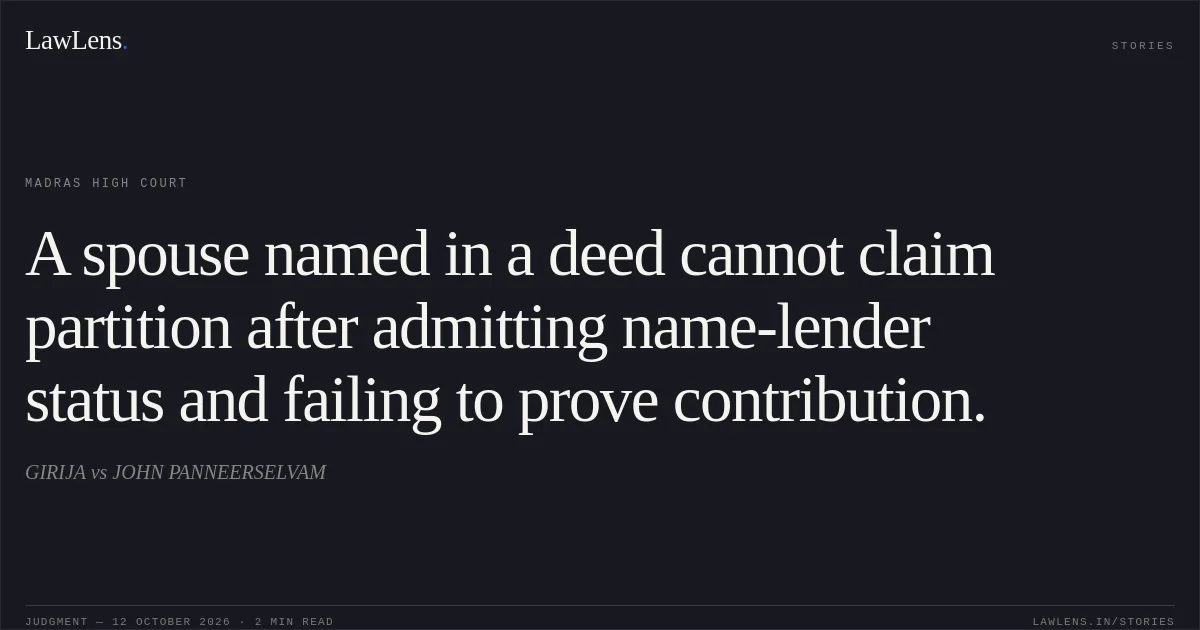
The court accepted that the sale deed named both parties but found that the plaintiff admitted in evidence that her name had been included because she was the first defendant’s wife; it treated this admission as supporting his name-lender case.
Source reference: p. 16–17The deed recorded consideration of Rs.1,47,100, and the first defendant produced evidence of a Rs.3,00,000 personal loan; the plaintiff did not produce evidence, including testimony from the vendor, to establish her asserted Rs.5,00,000 valuation or her and her mother’s alleged contributions.
Source reference: p. 24As to construction, the plaintiff produced no evidence of loan repayments from her income, while the first defendant’s bank statements showed EMI payments from his salary account and his witnesses supported his evidence of family assistance.
Source reference: p. 25–27The court therefore found the plaintiff’s case unproved and declined to disturb the trial court’s findings.
Source reference: p. 27Holding
The court answered the issues against the plaintiff, held that she had not established entitlement to a one-half share, and dismissed the appeal.
The trial court’s judgment and decree dismissing the partition suit were confirmed, with no order as to costs.
Source reference: p. 27Acts & Sections Cited
1 provisions across 1 statute referred to in this judgment. Each provision opens on LawLens.
Code of Civil Procedure, 19081
Original Court PDF
GIRIJAvsJOHN PANNEERSELVAM
Click to open original judgment
Original judgment, available to read, download and summarize on LawLens.in