Facts
The petitioner, Chief Medical and Health Officer, Bemetara, was suspended under Rule 9(1)(a) of the Chhattisgarh Civil Services (Classification, Control and Appeal) Rules, 1966, following allegations of inappropriate language and physical contact with women employees.
Source reference: para. 1He alleged that the complaint was retaliatory, arising after he initiated proceedings against certain Community Health Officers, and challenged the inquiry as biased and procedurally unfair.
Source reference: para. 2The State opposed the writ petition, submitting that the suspension was appealable under Rule 23 and that the allegations involved factual matters for departmental proceedings.
Source reference: para. 3The petitioner had not pursued the statutory appeal before approaching the High Court.
Source reference: paras. 5, 12Issues
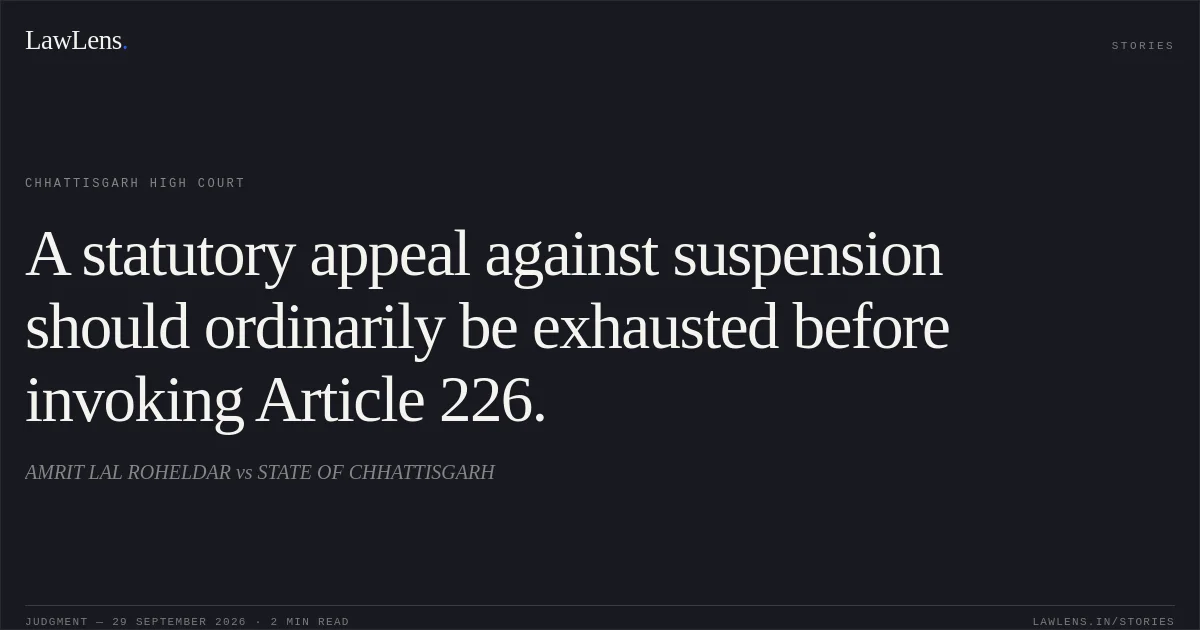
1. Whether the writ petition challenging the suspension order should be entertained when the petitioner had not exhausted the statutory appeal under Rule 23 of the CCA Rules.
Source reference: paras. 5, 12–142. Whether the suspension order disclosed a ground for judicial review under Article 226, such as lack of authority, mala fides, arbitrariness, or non-application of mind.
Source reference: paras. 8, 11, 14–15Law Applied
Rule 9 of the CCA Rules authorises suspension in the circumstances specified therein, and Rule 23(iii) expressly provides an appeal against an order of suspension.
Source reference: paras. 6, 12Suspension is an interim measure, not a punishment; its validity is assessed in light of the nature and gravity of the allegations, the available material, the public interest, and the need to protect an inquiry, and it must not be mala fide, arbitrary, or for an ulterior purpose (State of Orissa v. Bimal Kumar Mohanty, (1994) 4 SCC 126; Ashok Kumar Aggarwal, as referred to in the judgment).
Source reference: paras. 7, 10Judicial review of suspension is limited and does not ordinarily extend to deciding disputed factual allegations.
Source reference: paras. 8, 10–11Where an effective statutory remedy is available, the High Court should ordinarily not entertain a writ petition before that remedy is pursued (Union of India v. Major General Shri Kant Sharma, (2015) 6 SCC 773).
Source reference: para. 13Reasoning
The Court found that Rule 23 provided the petitioner with a statutory appeal against his suspension, which he had not filed.
Source reference: paras. 12–14He did not establish that the suspending authority lacked competence or demonstrate an exceptional basis to bypass that remedy.
Source reference: para. 14The allegations’ merits, including the petitioner’s claim of retaliation and procedural bias, were not for determination in the writ proceedings at the suspension stage; the Court found no demonstrated mala fides or arbitrariness warranting intervention.
Source reference: paras. 8, 11, 15Holding
The High Court declined to interfere with the suspension order dated 15 September 2026 and disposed of the writ petition, leaving the petitioner at liberty to appeal to the State Government under Rule 23 of the CCA Rules.
It expressly stated that it had not determined the merits and that any appellate authority must decide the appeal independently and in accordance with law.
Source reference: para. 17Acts & Sections Cited
1 provisions across 1 statute referred to in this judgment. Each provision opens on LawLens.
General Clauses Act, 18971
Original Court PDF
AMRIT LAL ROHELDARvsSTATE OF CHHATTISGARH
Click to open original judgment
Original judgment, available to read, download and summarize on LawLens.in