01Facts
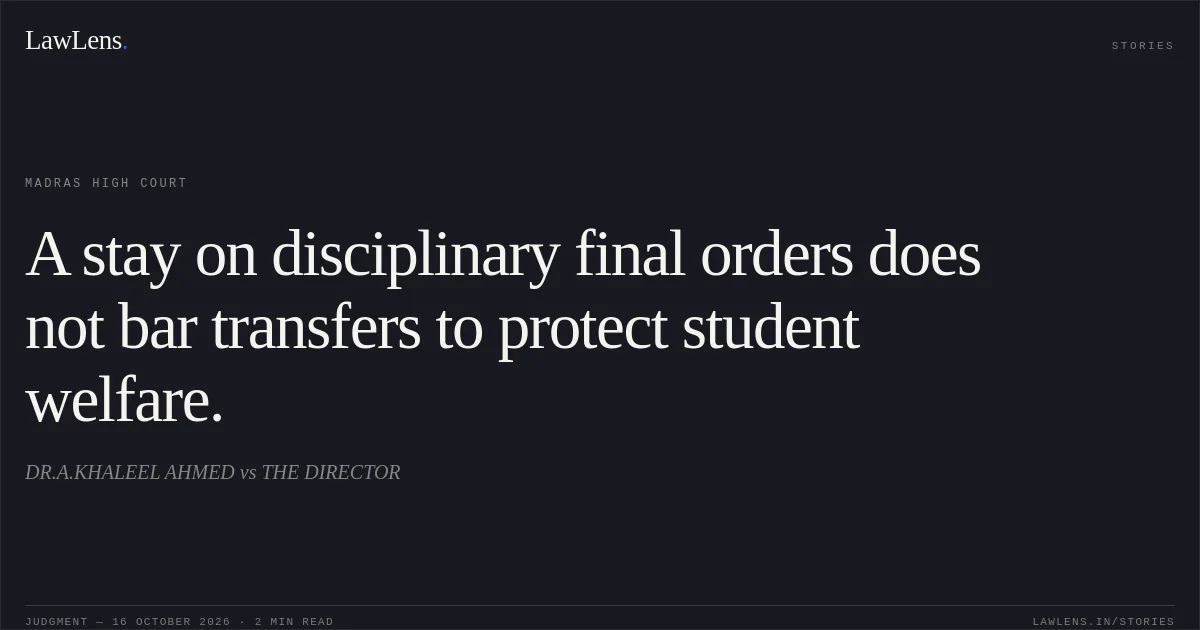
The petitioner, a Lecturer at the Government Unani Medical College, challenged his transfer from Chennai to Ramanathapuram and the consequential relieving order.
¶ 1, 3–6He alleged that the transfer was punitive and had been made at the instigation of the fourth respondent, in the context of disciplinary proceedings against him and a pending writ petition.
¶ 1, 3–6The respondents maintained that the transfer was an administrative measure to safeguard the students’ welfare and ensure a conducive educational environment.
¶ 1, 3–6The Court found that the interim order in the earlier proceedings restrained only the passing of a final disciplinary order; it did not stay the charge memorandum or the enquiry proceedings.
¶ 9–1002Issues
i.1. Whether the petitioner’s transfer was punitive or otherwise unlawful, warranting interference under Article 226.
¶ 16–18ii.2. Whether the interim restraint on passing a final disciplinary order prevented the authorities from transferring the petitioner for administrative reasons.
¶ 9–10, 1603Law Applied
A transfer is ordinarily an incidence of service, and an employee has no vested right to remain posted at a particular place.
¶ 11–13Courts generally do not interfere with administrative transfer orders made by a competent authority for public interest or administrative reasons, except where the order violates mandatory statutory rules or is vitiated by mala fides; a person against whom mala fides are alleged must be impleaded in a personal capacity.
¶ 11–13In Shilpi Bose v. State of Bihar, AIR 1991 SC 532, the Supreme Court held that transfers made in public interest or for administrative reasons should not ordinarily be interfered with, absent violation of mandatory rules or mala fides.
¶ 13In Tushar D. Bhatt v. State of Gujarat, (2009) 11 SCC 678, the Supreme Court reaffirmed that transfer is an incidence of service and is governed by administrative exigencies.
¶ 14The Court also applied the principle that an interim order restraining the final outcome of disciplinary proceedings does not, by itself, curtail the authorities’ administrative powers to protect the institution and its students.
¶ 9–10, 16–1704Reasoning
The Court rejected the petitioner’s claim that the transfer was punitive.
¶ 8–10It noted that the charge memorandum alleging inappropriate behaviour towards a female student had not been stayed; only the passing of the final order had been restrained.
¶ 8–10In light of the complaints and the respondents’ stated administrative purpose of ensuring a safe and conducive environment for students, the Court considered the transfer a permissible administrative measure, not a consequence barred by the interim order.
¶ 16–18It found no infirmity warranting judicial review.
¶ 1805Holding
The Court held that the transfer was not shown to be punitive or otherwise unlawful, and that the interim restraint on passing a final disciplinary order did not prevent the authorities from taking appropriate administrative measures.
¶ 16–18The writ petition was dismissed, the connected miscellaneous petition was closed, and no costs were awarded.
¶ 19Original Court PDF
DR.A.KHALEEL AHMEDvsTHE DIRECTOR
Click to open original judgment
Original judgment, available to read, download and summarize on LawLens.in