Facts
The petitioner was appointed as an Anganwadi Worker on 05.12.2007 and was posted at Anganwadi Centre, Baans Kheda, Tehsil Badarwas, District Shivpuri.
Source reference: p.2, para. 2Allegations were made regarding her absence, non-operation of the Anganwadi Centre, failure to make entries in the Poshan Tracker application, non-compliance with supervisory directions, and lack of cooperation in electoral SIR work.
Source reference: p.2, para. 2A show-cause notice was issued, and the petitioner contended that it was not properly served and that termination followed without adequate time or opportunity to respond.
Source reference: p.2, para. 2Her services were terminated by order dated 24.11.2025, which recorded the alleged acts of dereliction and concluded that she had failed to perform her duties.
Source reference: pp.2–4, para. 4The petitioner’s appeal was rejected on 25.06.2026.
Source reference: p.2, para. 2She challenged both orders under Article 226 of the Constitution, principally on the ground that the termination order was stigmatic and had been passed without a charge-sheet or regular departmental inquiry.
Source reference: pp.1–2, paras. 1–2Issues
Whether the termination order, which attributed dereliction of duty and other acts of misconduct to the petitioner, was stigmatic in nature and could lawfully be passed without conducting a regular departmental inquiry.
Source reference: pp.4–7, paras. 5–7Whether the termination and appellate orders were liable to be quashed for violation of principles of natural justice and the applicable State guidelines governing removal of Anganwadi Workers.
Source reference: pp.8–11, paras. 8–12Whether the petitioner was entitled to reinstatement and consequential benefits, including back wages.
Source reference: pp.11–12, paras. 13–14Law Applied
The Court applied Article 226 of the Constitution and the principles of natural justice, holding that a termination order founded on allegations of misconduct or dereliction of duty and containing adverse findings affecting an employee’s future prospects is stigmatic and ordinarily requires a charge-sheet, a fair inquiry, and an effective opportunity of defence.
Source reference: pp.4–7, paras. 5–7Relying on Khem Chand v. Union of India, AIR 1958 SC 300, the Court reiterated that reasonable opportunity includes notice of the charges, an opportunity to contest the allegations and cross-examine witnesses, and an opportunity to make a representation against the proposed punishment.
Source reference: pp.4–5, para. 6The Court followed Rahul Tripathi v. Rajeev Gandhi Shiksha Mission, 2001 (3) MPLJ 616; Jitendra v. State of M.P., 2008 (4) MPLJ 670; Malkhan Singh Malviya v. State of M.P., ILR (2018) MP 660; and related decisions holding that a stigmatic termination based on misconduct cannot be sustained without inquiry.
Source reference: pp.4–7, paras. 5–9It also applied the State Government’s guidelines dated 23.05.2025, particularly Clause G-1-1, which required a proper inquiry and hearing before removal of an Anganwadi Worker or Helper.
Source reference: pp.8–11, para. 11On relief, the Court relied on Bibhudatta Mohanty v. Union of India, (2002) 4 SCC 16, and the principle of “no work, no pay”.
Source reference: p.11, paras. 13–14Reasoning
The Court examined the language of the termination order and found that it did not merely bring the petitioner’s engagement to an end simpliciter; instead, it recorded specific findings that she had failed to operate the Anganwadi Centre regularly, maintain required records and entries, comply with directions, attend meetings, and discharge her duties.
Source reference: pp.2–4, paras. 4, 7These findings attributed misconduct and professional dereliction to the petitioner and therefore cast a stigma affecting her future prospects.
Source reference: pp.2–4, paras. 4, 7Although notices and explanations had been exchanged, the respondents had neither issued a formal charge-sheet nor conducted a regular inquiry in which the petitioner could effectively contest the evidence, examine or cross-examine witnesses, and present her defence.
Source reference: pp.4–8, paras. 5–7, 10, 12The procedure therefore failed both the requirements of natural justice and the specific safeguards in Clause G-1-1 of the 23.05.2025 policy, which required inquiry and hearing before removal.
Source reference: pp.8–11, para. 11Since the original termination was invalid, the appellate order affirming it could not stand.
Source reference: p.12, para. 14The Court consequently set aside both orders, while preserving the State’s liberty to initiate fresh proceedings in accordance with law.
Source reference: p.12, para. 14Holding
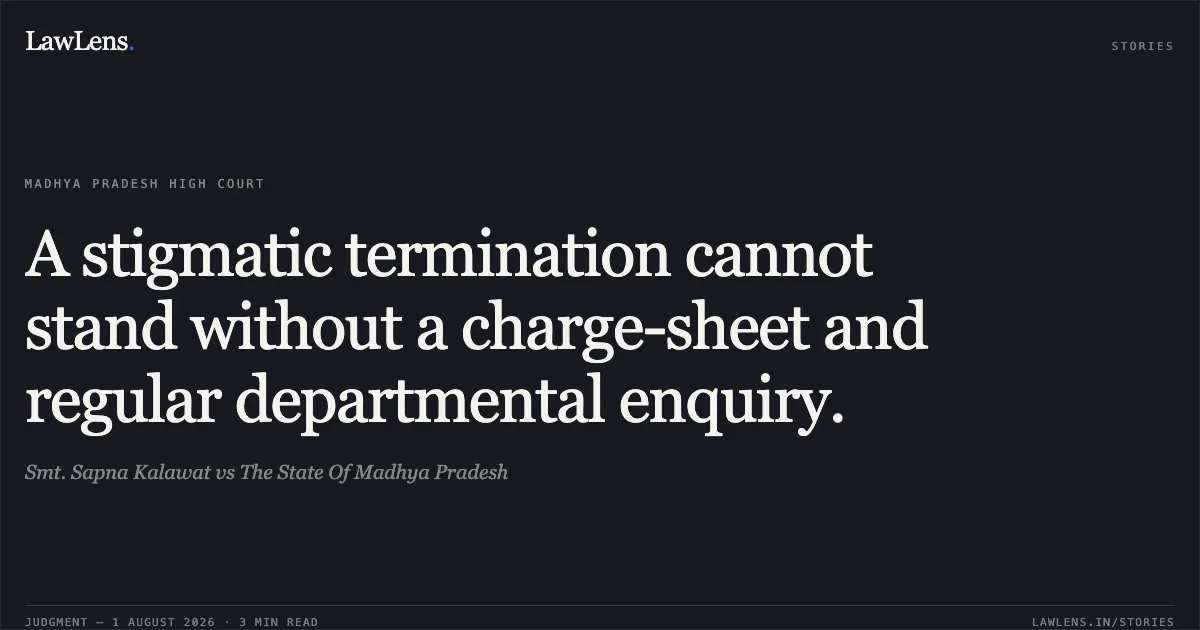
The Court held that the termination order dated 24.11.2025 was stigmatic and legally unsustainable because it was passed without a charge-sheet, regular departmental inquiry, and adequate opportunity of hearing.
The termination order and the appellate rejection order dated 25.06.2026 were quashed.
Source reference: p.12, para. 14(i)The respondents were directed to reinstate the petitioner forthwith with consequential benefits, but without back wages on the principle of “no work, no pay”.
Source reference: p.12, para. 14(ii)The State was granted liberty to proceed against the petitioner afresh in accordance with law, if considered necessary.
Source reference: p.12, para. 14(iii)Original Court PDF
Smt. Sapna KalawatvsThe State Of Madhya Pradesh
Click to open original judgment
Original judgment, available to read, download and summarize on LawLens.in