Facts
The petitioner was appointed as an Anganwadi Worker on 5 October 2007 and served for approximately ten years.
Source reference: para. 2A show-cause notice was issued alleging absence from the Anganwadi Centre, failure to reside at the designated headquarters, and neglect of duties.
Source reference: para. 2The petitioner contended that an earlier show-cause notice dated 28 June 2016 had already resulted in forfeiture of one month’s salary and was impermissibly relied upon again for termination.
Source reference: para. 2By order dated 18 January 2017, the competent authority terminated her services on allegations of repeated absence, disobedience of official directions, carelessness, and indifference towards governmental welfare schemes; no regular departmental enquiry was conducted.
Source reference: paras. 5–6The petitioner’s appeal was allowed on 30 August 2017, but the second appellate authority, by order dated 4 December 2018, set aside the appellate order and restored the termination.
Source reference: para. 2The petitioner challenged both orders under Article 226 of the Constitution.
Source reference: no citationDuring the pendency of the petition, she continued in service pursuant to an interim order dated 3 January 2019.
Source reference: para. 15Issues
Whether termination founded on allegations of misconduct, and expressed in stigmatic terms, could be imposed without issuing a charge-sheet and conducting a regular departmental enquiry.
Source reference: paras. 6, 8–9, 13–14Whether the termination order dated 18 January 2017 and the second appellate order dated 4 December 2018 were contrary to the State Government’s policy dated 10 July 2007 governing removal of Anganwadi Workers.
Source reference: para. 12Whether the petitioner was entitled to reinstatement and consequential benefits, subject to the respondents’ liberty to initiate fresh proceedings in accordance with law.
Source reference: para. 15Law Applied
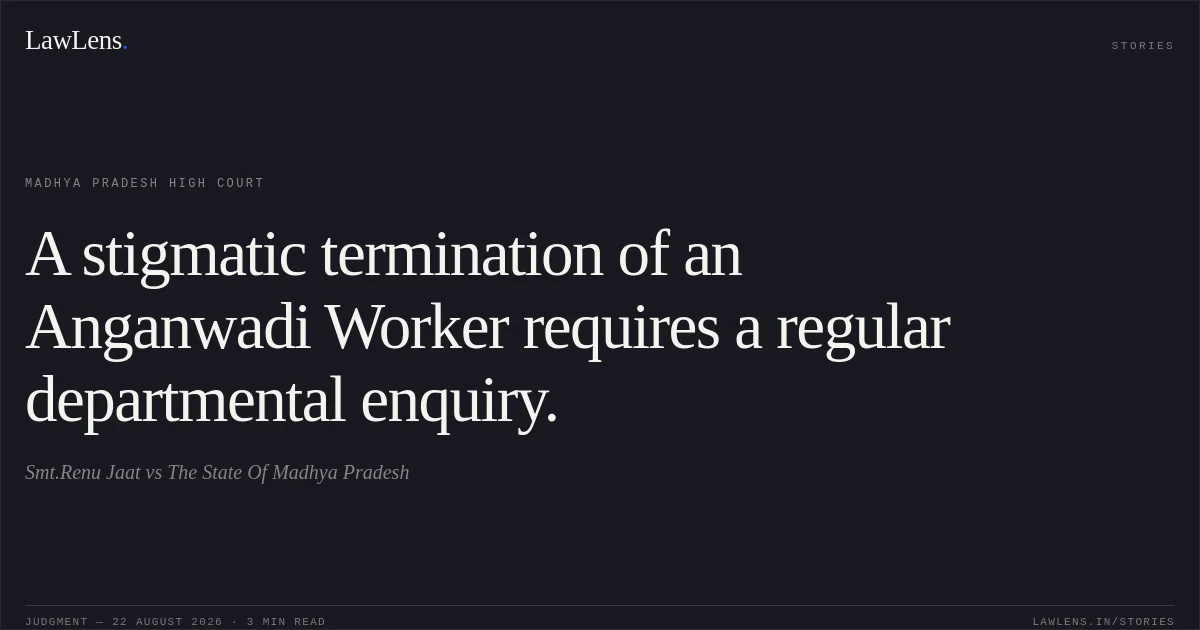
A termination order that is founded on allegations of misconduct and casts stigma upon an employee’s conduct, character, or work cannot ordinarily be passed without a proper departmental enquiry and observance of natural justice.
Source reference: paras. 7–10The Court relied on Rahul Tripathi v. Rajeev Gandhi Shiksha Mission, 2001 (3) MPLJ 616; Jitendra v. State of M.P., 2008 (4) MPLJ 670; and Malkhan Singh Malviya v. State of M.P., ILR (2018) MP 660, which establish that a stigmatic termination entails serious consequences and requires an enquiry.
Source reference: para. 7Under Khem Chand v. Union of India, AIR 1958 SC 300, reasonable opportunity includes notice of the charges, an opportunity to contest the allegations and cross-examine witnesses, and an opportunity to make a representation against the proposed punishment after the enquiry.
Source reference: para. 7The State Government’s policy dated 10 July 2007 permits removal of an Anganwadi Worker for negligent performance only after giving an opportunity of hearing and finding the worker guilty in an enquiry.
Source reference: para. 12A prior show-cause notice or preliminary fact-finding exercise does not substitute for the regular enquiry required where termination is punitive and stigmatic.
Source reference: paras. 8, 11, 13–14Reasoning
The termination order did not merely discontinue the petitioner’s engagement simpliciter; it recorded findings that she was repeatedly absent, disobedient, careless, indifferent, and responsible for depriving beneficiaries of ICDS services.
Source reference: para. 5These findings constituted imputations of misconduct and made the order stigmatic.
Source reference: no citationSince the respondents relied upon alleged instances of absence and prior reports to impose the severest consequence of removal, they were required to issue a proper charge-sheet and conduct a regular departmental enquiry affording the petitioner the procedural safeguards identified in Khem Chand.
Source reference: paras. 7–10The Court further found that the State policy itself contemplated removal only after an opportunity of hearing and an enquiry establishing guilt.
Source reference: para. 12The admitted absence of any regular enquiry therefore rendered the termination legally unsustainable, and the second appellate authority erred in upholding it.
Source reference: paras. 13–15Holding
The Court held that the termination order dated 18 January 2017 was stigmatic, non-speaking, and passed without the mandatory departmental enquiry and adequate opportunity of hearing.
It consequently quashed the termination order and the second appellate order dated 4 December 2018.
Source reference: para. 15Because the petitioner had continued in service under the interim order dated 3 January 2019, no separate order of reinstatement was necessary.
Source reference: para. 15She was held entitled to all consequential benefits.
Source reference: para. 15The State was granted liberty to proceed against her afresh in accordance with law, if so advised.
Source reference: para. 15The writ petition was accordingly disposed of.
Source reference: para. 16Original Court PDF
Smt.Renu JaatvsThe State Of Madhya Pradesh
Click to open original judgment
Original judgment, available to read, download and summarize on LawLens.in