Facts
The plaintiff filed a suit for partition of property among the legal heirs of the original owner
Source reference: p. 3, para. 6(ii)Ms. Sheeba (the appellant) filed an application under Order I Rule 10 of the CPC for impleadment, claiming to be in possession of the suit property
Source reference: p. 2, para. 3(iii)The appellant is admittedly not a legal heir and has already filed an independent civil suit (No. 822/2025) for declaration and injunction regarding her claims
Source reference: p. 3, para. 5-6On May 21, 2026, the Judicial Registrar dismissed her impleadment application
Source reference: p. 1, para. 1The appellant challenged this dismissal via O.A. 161/2026, contending the order was non-speaking and failed to consider her possession
Source reference: p. 1-2, para. 3Issues
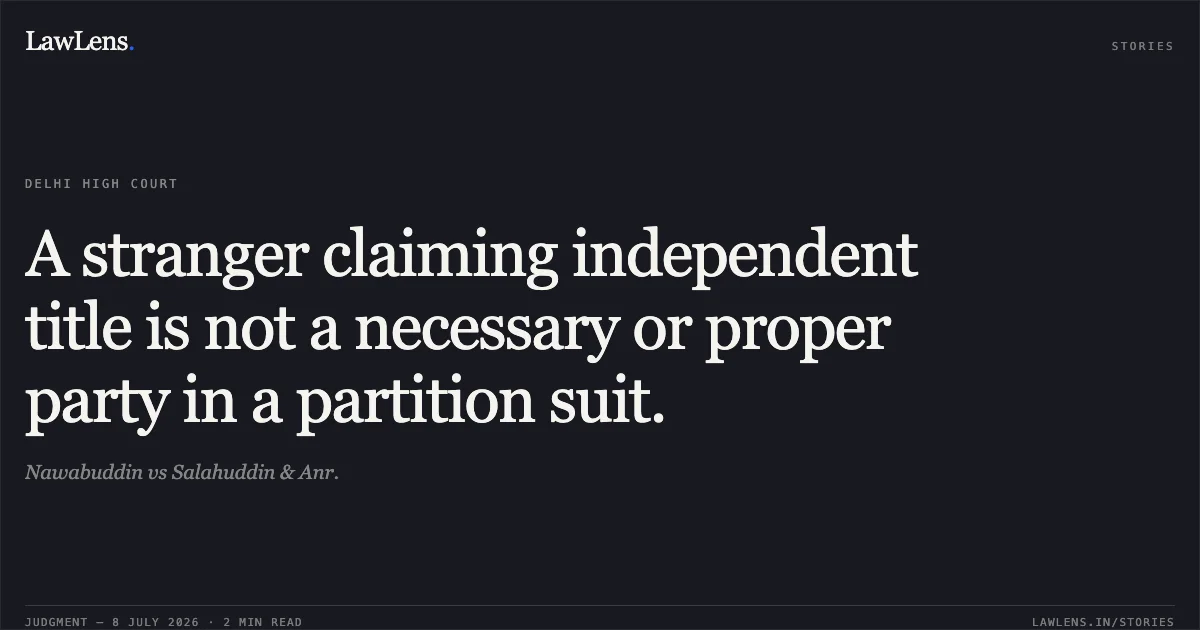
1. Whether a stranger claiming independent title/possession is a necessary or proper party in a partition suit exclusively between legal heirs.
Source reference: p.3, para. 82. Whether the failure to implead a third party with independent claims constitutes an infirmity in the trial of a partition suit.
Source reference: p.3, para. 8; p.6, para. 9Law Applied
The court applied Order I Rule 10(2) of the Code of Civil Procedure (CPC) regarding the court's discretion to add or strike out parties
Source reference: p. 5, para. 8It relied on the "Necessary and Proper Party" tests: a necessary party is one without whom no effective decree can be passed, while a proper party is one whose presence enables complete adjudication
Source reference: p.3, para. 9The Court cited Nazra Khatoon v. Mohd. Zafar Ors. (2025) and S.N. Arora v. Brokers Brokers Pvt. Ltd. to establish that strangers whose impleadment would enlarge the scope of litigation from a partition suit into a title suit should not be joined
Source reference: p. 4, para. 5; p. 6, para. 9It further referenced J.J. Lal Pvt. Ltd. v. M.R. Murali and Kasturi v. Iyyamperumal, affirming that parties with independent claims should seek relief in separate proceedings
Source reference: p. 4, para. 6-7Reasoning
The Court reasoned that the suit is strictly for partition among the stakeholders/legal heirs of the original owner
Source reference: p. 3, para. 6Since the appellant admitted she is not a legal heir, her presence is not required to adjudicate the inter se partition between the actual heirs
Source reference: p. 3, para. 6(iii)The Court found that impleading a "rank outsider" claiming independent rights would improperly change the complexion of the suit and widen its scope from a simple partition matter to a complex title dispute
Source reference: p. 3, para. 8; p. 6, para. 9The Court noted that the appellant's rights are already being litigated in her independent suit (No. 822/2025), and the vacation of her interim injunction there suggests her interests are sufficiently protected or addressed in that forum
Source reference: p. 3, para. 6(iv); p. 6, para. 10Thus, the Registrar’s order was found to be reasoned and legally sound
Source reference: p. 3, para. 8Holding
The Court dismissed the appeal (O.A. 161/2026), holding that the appellant is neither a necessary nor a proper party to the partition suit
The Court affirmed that while the appellant is free to pursue her independent civil suit, such claims cannot impinge upon or delay the partition suit between the legal heirs
Source reference: p. 6, para. 11The order of the Judicial Registrar dated May 21, 2026, was upheld
Source reference: p. 3, para. 8Original Court PDF
NawabuddinvsSalahuddin & Anr.
Click to open original judgment
Original judgment, available to read, download and summarize on LawLens.in