Facts
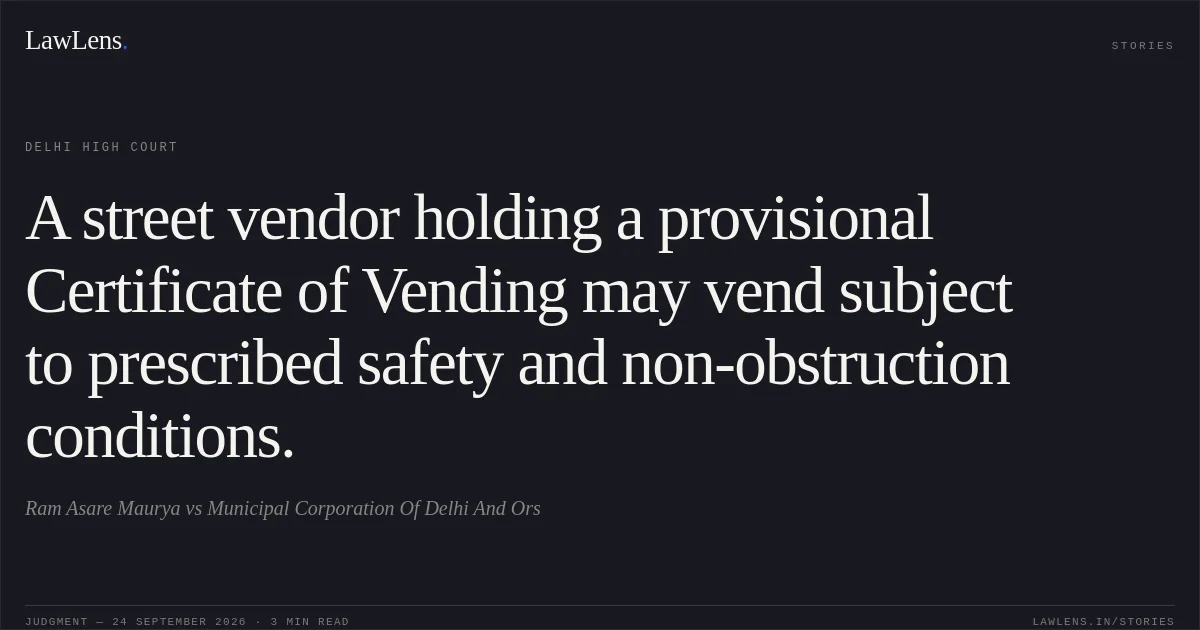
The Petitioner, a street vendor operating a tea stall, claimed to have been vending for several years at the footpath/open space near A-14, Pamposh Enclave, Greater Kailash, South Zone, Ward S-86, New Delhi.
Source reference: paras. 2–5, pp. 1–2He possessed a provisional Certificate of Vending (CoV), URI:1504740, under the category “Food/Snack with gas cylinder/fire,” but alleged that MCD officials and the Delhi Police were preventing him from vending and harassing him.
Source reference: paras. 2–5, pp. 1–2The MCD contended that he was operating as a stationary vendor in a residential area and that his vend had caused congestion and traffic obstruction, including during the BRICS Summit.
Source reference: paras. 7–8, p. 3On examining the photograph of the vend, the Court observed that no food or snacks were visible and that a gas cylinder had been placed on the footpath, which was impermissible.
Source reference: para. 9, p. 3Issues
Whether the Petitioner, holding a provisional CoV under the category “Food/Snack with gas cylinder/fire,” should be permitted to continue vending from the designated site, subject to compliance with statutory and CoV conditions.
Source reference: paras. 4–5, 10–12, pp. 1–4Whether the Petitioner’s vending activities could be regulated to prevent obstruction to pedestrians, traffic congestion, and risks arising from the use of a gas cylinder.
Source reference: paras. 7–9, 11–12, pp. 3–5Whether such permission would remain subject to the vending plan, if any, formulated by the Town Vending Committee under Section 21 of the Street Vendors (Protection of Livelihood and Regulation of Street Vending) Act, 2014.
Source reference: para. 13, p. 5Law Applied
The Court exercised its jurisdiction under Article 226 of the Constitution to regulate the Petitioner’s vending activities in light of his provisional CoV.
Source reference: para. 2, p. 1It applied the conditions contained in the provisional CoV, including obligations relating to hygiene, public health, non-obstruction of pedestrian and vehicular movement, prohibition on unauthorised activity, prohibition against blocking footpaths or vending on roads, and the bar on permanent or temporary construction.
Source reference: para. 11, pp. 3–5The Court also applied the Delhi Street Vendors (Protection of Livelihood and Regulation of Street Vending) Scheme, 2019, which the CoV required the vendor to follow.
Source reference: para. 11, p. 5For a vendor operating under the “Food/Snack with gas cylinder/fire” category, the Court prescribed additional safeguards concerning the use of only a small gas cylinder, restriction to a space causing no obstruction, maintenance of cleanliness, and prevention of sub-letting or creation of third-party interests.
Source reference: para. 12, pp. 5–6The directions were made subject to any vending plan prepared by the Town Vending Committee under Section 21 of the 2014 Act, without creation of vested rights.
Source reference: para. 13, p. 6The Court relied on its analogous directions in Rajendra Singh v. Commissioner of Police & Ors., W.P.(C) 15082/2025, order dated 2 February 2026; Mohd. Badruddin v. Municipal Corporation of Delhi & Ors., W.P.(C) 19391/2025, order dated 8 January 2026; and Rihana v. MCD & Ors., W.P.(C) 1609/2026, order dated 5 February 2026.
Source reference: para. 10, p. 3Reasoning
The Court balanced the Petitioner’s entitlement to operate under his provisional CoV against the MCD’s legitimate concerns regarding obstruction, traffic congestion, hygiene, and the unsafe placement of a gas cylinder.
Source reference: paras. 9–12, pp. 3–6Although the photograph did not demonstrate actual vending of food or snacks and showed a gas cylinder occupying the footpath, the Court did not direct an outright prohibition.
Source reference: paras. 9–12, pp. 3–6Instead, it permitted the vend subject to strict compliance with the CoV and additional safeguards: only a small gas cylinder could be used; the Petitioner had to remain within a defined space; pedestrian and vehicular movement could not be obstructed; cleanliness and a dustbin had to be maintained; and no permanent or temporary structure, sub-letting, or third-party interest could be created.
Source reference: paras. 9–12, pp. 3–6The Court additionally relaxed the 30-minute restriction applicable to mobile vendors under Condition 11 of the CoV, while retaining all other conditions.
Source reference: para. 12(d), p. 5Holding
The Court held that the Petitioner could continue vending, subject to the conditions of the provisional CoV and the additional safeguards imposed by the Court.
Condition No. 11 of the CoV was held inapplicable to him, but all other CoV conditions remained binding.
Source reference: para. 12(d), p. 5The Petitioner’s vending activities were directed not to be disturbed so long as he complied with those conditions.
Source reference: para. 14, p. 6The directions remained subject to any vending plan formulated by the Town Vending Committee under Section 21 of the 2014 Act, and no vested rights could be claimed.
Source reference: para. 13, p. 6The writ petition and pending applications were accordingly disposed of.
Source reference: para. 15, p. 6Acts & Sections Cited
1 provisions across 1 statute referred to in this judgment. Each provision opens on LawLens.
Street Vendors (Protection of Livelihood and Regulation of Street Vending) Act, 20141
Original Court PDF
Ram Asare MauryavsMunicipal Corporation Of Delhi And Ors
Click to open original judgment
Original judgment, available to read, download and summarize on LawLens.in