Facts
The complainant alleged that, owing to a friendly relationship, the applicant-accused borrowed ₹4,70,250 as a hand loan for business purposes and agreed to repay it within four to five months.
Source reference: para. 2The accused subsequently issued a cheque dated 8 July 2008 for the loan amount. The cheque was dishonoured for “insufficient funds.” Despite receipt of the statutory demand notice dated 21 August 2008, the accused neither replied nor paid the cheque amount, resulting in a complaint under Section 138 of the Negotiable Instruments Act, 1881 (“NI Act”).
Source reference: para. 2The accused denied any liability and asserted that the cheque had been issued to Reddy Investment Finance Company and had reached the complainant without authority.
Source reference: para. 3The Judicial Magistrate First Class, Junnar, convicted the accused under Section 138 of the NI Act on 26 April 2012 and sentenced him to six months’ simple imprisonment with compensation of ₹4,70,250 and, in default, two months’ simple imprisonment.
Source reference: para. 1The Additional Sessions Judge dismissed the accused’s appeal on 24 December 2014 and confirmed the conviction.
Source reference: para. 5In revision under Sections 397 and 401 of the Code of Criminal Procedure, 1973 (“CrPC”), the accused challenged the concurrent findings and contended that the statutory presumption had been rebutted, particularly by evidence concerning the complainant’s financial capacity and the alleged delivery of the cheque to a finance company.
Source reference: paras. 6–8Issues
Whether the accused had rebutted the presumption under Section 139 of the NI Act that the cheque was issued towards a legally enforceable debt or liability?
Source reference: paras. 7.1–7.8, 11–16Whether the complainant’s alleged lack of financial capacity, absence of income-tax or account-book entries, and the cash nature of the transaction rendered the alleged loan legally unenforceable?
Source reference: paras. 7.2, 7.5–7.6, 15–18Whether the High Court, in revisional jurisdiction, should interfere with the concurrent findings of conviction recorded by the courts below?
Source reference: paras. 19–20Law Applied
The Court applied Sections 138 and 139 of the NI Act: dishonour of a cheque for insufficiency of funds constitutes an offence upon satisfaction of the statutory conditions, while Section 139 raises a rebuttable presumption that the cheque was issued for discharge of a debt or liability.
Source reference: paras. 1, 11The accused may rebut this presumption on a standard of preponderance of probabilities and may rely upon the complainant’s evidence without necessarily entering the witness box, as recognised in Basalingappa v. Mudibasappa, (2019) 5 SCC 418, Dattatraya v. Sharanappa, (2024) 8 SCC 573, and Mahendra Gulabchand Kochar v. Sakharam Ramdas Patil, 2009 SCC OnLine Bom 493.
Source reference: para. 11Non-reflection of a transaction in books of account or income-tax returns, and alleged violation of Sections 269SS or 271AAD of the Income-tax Act, 1961, do not by themselves render the transaction unenforceable under Section 138, as held in Prakash Madhukarrao Desai v. Dattatraya Sheshrao Desai, (2023) 5 Mh.L.J. 709.
Source reference: para. 15The complainant is not required to prove financial capacity at the threshold; such proof becomes relevant when the accused raises a specific and substantiated challenge to the complainant’s capacity, as explained in Ashok Singh v. State of Uttar Pradesh, 2025 SCC OnLine SC 706, and Tedhi Singh v. Narayan Dass Mahant, (2022) 6 SCC 735.
Source reference: paras. 17–17.1Finally, under Sections 397 and 401 CrPC, revisional interference with concurrent findings is limited, and re-appreciation of evidence is ordinarily impermissible absent perversity, illegality, or material irregularity, as held in State v. Manimaran, (2019) 13 SCC 670.
Source reference: para. 19Reasoning
The Court held that the accused’s defence that the cheque had been issued to Reddy Investment Finance Company was unsupported because neither Mr. Pedri Mannar Reddy nor any representative of that company was examined.
Source reference: para. 13The defence therefore remained a bare assertion and did not rebut the statutory presumption.
Source reference: para. 13The complainant’s evidence also indicated a connection between the parties through the accused’s brother and their common association with Chandipura Peth, making the accused’s denial of acquaintance implausible.
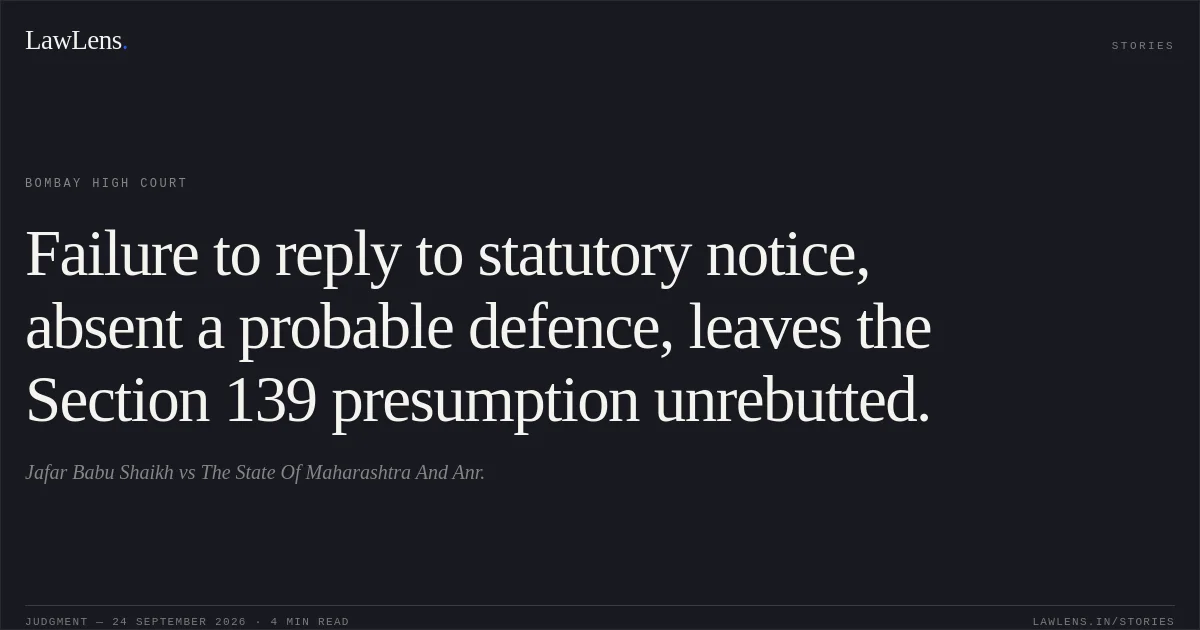
Source reference: para. 14The accused had received the demand notice but failed to reply, thereby failing to raise contemporaneously any specific defence regarding absence of liability or the complainant’s financial incapacity.
Source reference: paras. 10, 14, 18The objections regarding the complainant’s income, absence of books of account, lack of income-tax records, and cash advancement were insufficient to displace the presumption under Section 139.
Source reference: para. 18The Magistrate had also recorded that receipts evidencing withdrawals from recurring deposits were produced at Exhibits 58 to 61, which supported the complainant’s ability to advance the amount.
Source reference: para. 18On the totality of the evidence, the accused failed to establish a probable defence.
Source reference: para. 16Since both courts below had concurrently found the accused guilty, and no perversity or legal infirmity was demonstrated, the High Court declined to re-appreciate the evidence in revision.
Source reference: paras. 16, 19–20Holding
The High Court answered the issues against the accused.
It held that the presumption under Section 139 of the NI Act had not been rebutted and that the complainant’s alleged financial incapacity, non-disclosure of the transaction in income-tax records, and cash nature of the loan did not invalidate the legally enforceable liability.
Source reference: paras. 16–18The Criminal Revision Application was dismissed and the Rule was discharged.
Source reference: para. 21The complainant was permitted to withdraw the ₹1,18,000 deposited by the accused in the Sessions Court, with accrued interest, if any.
Source reference: para. 22The accused’s bail bond and surety were cancelled, and he was granted four weeks’ time to surrender before the concerned police station.
Source reference: para. 23Acts & Sections Cited
5 provisions across 2 statutes referred to in this judgment. Each provision opens on LawLens.
Code of Criminal Procedure, 19733
Negotiable Instruments Act, 18812
Original Court PDF
Jafar Babu ShaikhvsThe State Of Maharashtra And Anr.
Click to open original judgment
Original judgment, available to read, download and summarize on LawLens.in