Facts
The petitioner, a Rajasthan Police employee who served as Manager of the Police Cooperative Upabhoka Bhandar, was charged with twelve financial irregularities allegedly committed between 1994 and 1998.
Source reference: p. 2–4Following a departmental inquiry in which 34 witnesses were examined and 256 documents exhibited, the Disciplinary Authority dismissed him from service and directed recovery of ₹1,04,984 with interest from his retiral benefits.
Source reference: p. 2–4The appellate and reviewing authorities affirmed those orders
Source reference: p. 2–4The petitioner challenged the proceedings on grounds including vague charges, non-supply of records, denial of a fair opportunity, inadequate consideration by the authorities, and disproportionate punishment.
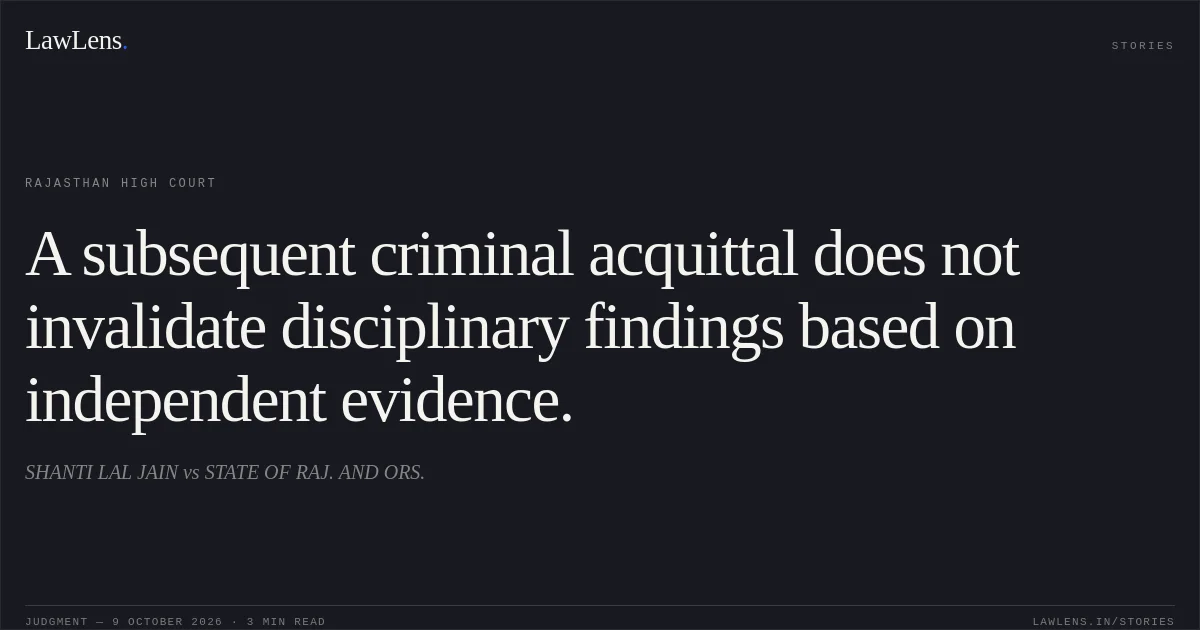
Source reference: p. 5–11He also relied on his acquittal in the related criminal case in 2024
Source reference: p. 5–11The State maintained that the inquiry was fair, the findings were supported by evidence, and the acquittal did not invalidate the disciplinary outcome
Source reference: p. 12–14Issues
1. Whether the charges were vague or the inquiry was vitiated by non-supply of documents or other violations of natural justice
Source reference: p. 152. Whether the inquiry findings were unsupported by evidence or perverse, and what effect the subsequent criminal acquittal had on the disciplinary findings
Source reference: pp. 15, 29–313. Whether the Disciplinary, Appellate, or Reviewing Authorities failed to apply their minds or give adequate reasons
Source reference: pp. 15, 31–324. Whether dismissal and recovery were liable to be set aside as disproportionate
Source reference: pp. 15, 32–33Law Applied
Under Rule 16 of the Rajasthan Civil Services (Classification, Control and Appeal) Rules, 1958, a charged employee must be allowed reasonable access to relevant official records and witness statements to prepare a defence; denial warrants interference where it causes demonstrable prejudice, rather than merely a technical irregularity
Source reference: pp. 17–19A charge must give sufficient particulars to enable the employee to understand and answer the allegations, but need not set out all supporting evidence
Source reference: p. 16Departmental misconduct is assessed on the preponderance of probabilities, whereas criminal guilt must be proved beyond reasonable doubt; acquittal does not, by itself, extinguish disciplinary findings
Source reference: pp. 29–31Under Article 226, the Court does not reappreciate evidence as an appellate court and may interfere on recognised grounds such as procedural or natural-justice violations, findings based on no evidence, perversity, or shockingly disproportionate punishment
Source reference: pp. 28–29, 32–33The Court relied, among other authorities, on State Bank of Patiala v. S.K. Sharma concerning prejudice from procedural irregularity
Source reference: p. 18State of Madhya Pradesh v. Akhilesh Jha on adequate particulars in charges
Source reference: p. 16S. Janaki Iyer v. Union of India on prejudice from non-supply of documents
Source reference: pp. 20–23Union of India v. P. Gunasekaran on the limits of judicial review
Source reference: p. 28Union of India v. Indraj on repayment not erasing proved misconduct.
Source reference: pp. 24–27, 33Reasoning
The Court found that the charge-sheet identified the nature and substance of the alleged financial irregularities, and that the petitioner understood the case sufficiently to participate in the inquiry and cross-examine witnesses.
Source reference: pp. 16–17Although he had requested documents, the Court held that he had not adequately identified the records needed or shown how their non-supply caused specific prejudice; his participation and cross-examination further supported that conclusion.
Source reference: pp. 18–20The Court considered the audit material, accounts, departmental records, oral evidence, and the petitioner’s reply acknowledging irregularities sufficient to support the findings on the applicable civil standard of proof; it declined to reweigh that evidence under Article 226.
Source reference: pp. 23–29The later acquittal did not displace the departmental findings because the proceedings applied different standards and the petitioner had not shown that the criminal court conclusively found the underlying conduct did not occur.
Source reference: pp. 29–31The Court also found no fundamental failure of consideration by the disciplinary authorities and held that dismissal was not shockingly disproportionate given the financial misconduct and the trust attached to the petitioner’s responsibilities in a disciplined force.
Source reference: pp. 31–33Holding
The Court answered the issues against the petitioner, finding no sufficient ground to interfere with the inquiry, the disciplinary findings, or the punishment.
It dismissed the writ petition, upheld the dismissal and recovery direction, disposed of any pending applications, and made no order as to costs.
Source reference: pp. 34–35Acts & Sections Cited
3 provisions across 1 statute referred to in this judgment. Each provision opens on LawLens.
Indian Penal Code, 18603
Original Court PDF
SHANTI LAL JAINvsSTATE OF RAJ. AND ORS.
Click to open original judgment
Original judgment, available to read, download and summarize on LawLens.in