01Facts
The petitioners, teachers appointed to secondary-grade vacancies in a minority aided school between 1998 and 1999, sought approval of their appointments as Middle Grade Graduate Teachers under G.O. Ms. No. 79 dated 14 June 2002, with salary and consequential benefits.
¶ 2–3, 7–9The school’s proposal for approval was not accepted in 2002.
¶ 21–22The petitioners did not challenge that decision at the time; they later sought parity with other teachers through representations made in 2012 and 2016, which were rejected in 2015 and 2016.
¶ 21–22They then filed this writ petition in 2017 to quash the rejection orders and obtain approval from 14 June 2002.
prayer · ¶ 2202Issues
i.Whether the petitioners’ later representations and the orders rejecting them created a fresh cause of action, despite the non-approval of their appointments having been known to them since 2002.
¶ 21–25ii.Whether the petitioners’ claim for approval could be rejected for delay and laches, without determining its merits under G.O. Ms. No. 79.
¶ 28–3003Law Applied
In C. Jacob v. Director of Geology and Mining, the Supreme Court held that a representation, or an order passed on it, does not create a fresh cause of action or revive a stale or dead claim.
¶ 24In State of Uttar Pradesh v. Arvind Kumar Srivastava, the Court held that persons who acquiesce in an alleged wrongful action and approach the court only after others succeed may be treated as fence-sitters, and their claims may be dismissed for delay, laches, or acquiescence.
¶ 27Applying these principles, a writ court may decline relief where the underlying claim was not challenged within a reasonable time and subsequent representations do not revive it.
¶ 23–25, 29–3004Reasoning
The petitioners knew by 2002 that their request for approval under G.O. Ms. No. 79 had not been accepted, but did not challenge that outcome within a reasonable period.
¶ 21, 25Their representations in 2012 and 2016, and the later rejection orders, did not revive the original claim or provide an independent cause of action.
¶ 23–25Nor did the proceedings concerning other teachers create an automatic entitlement to parity; the petitioners had remained inactive and sought relief years after the original non-approval.
¶ 26–28The Court therefore treated the claim as stale and declined to examine whether the petitioners were otherwise entitled to approval under G.O. Ms. No. 79.
¶ 3005Holding
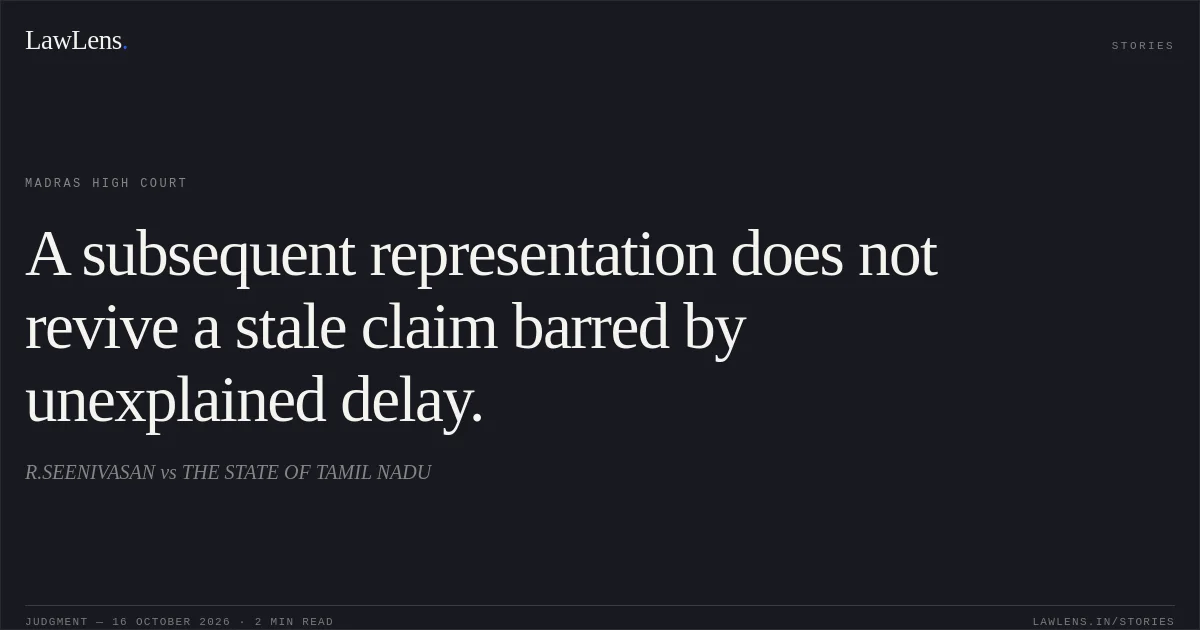
The Court held that the petitioners’ claim was barred by inordinate and unexplained delay and laches.
¶ 30–31It dismissed the writ petition without examining the merits of their claim for approval under G.O. Ms. No. 79; no costs were ordered, and the connected miscellaneous petition was closed.
¶ 30–31Original Court PDF
R.SEENIVASANvsTHE STATE OF TAMIL NADU
Click to open original judgment
Original judgment, available to read, download and summarize on LawLens.in