Facts
The appellant, Abhishek Yadav, married Shivani Yadav on 21 April 2019, and their daughter, Avya, was born on 30 August 2022.
Source reference: paras. 3–6The child remained with the appellant until 29 November 2023, when Shivani and Avya were taken to Shivani’s parental home by her brothers for medical treatment.
Source reference: paras. 3–6Shivani subsequently died on 29 February 2024 while undergoing treatment for tuberculous meningitis with hydrocephalus.
Source reference: paras. 3–6The appellant thereafter sought custody of Avya from her maternal grandfather and filed proceedings under Section 25 of the Guardians and Wards Act, 1890, read with Section 6 of the Hindu Minority and Guardianship Act, 1956.
Source reference: paras. 3–6, 11The trial court dismissed the appellant’s custody claim but granted visitation rights to him and his parents to meet Avya every Monday between 10 a.m. and 5 p.m.
Source reference: para. 2Issues
Whether the welfare of the minor child would be best served by granting her custody to the appellant-father or by continuing her custody with the maternal respondents?
Source reference: para. 10(1)Whether, despite being the child’s natural guardian under Section 6 of the Hindu Minority and Guardianship Act, 1956, the appellant was unfit to receive her custody?
Source reference: para. 10(2)Whether the trial court’s judgment and decree was unreasoned and non-speaking for failure to decide the relevant issues with reasons?
Source reference: para. 10(3)Law Applied
The Court applied Section 6 of the Hindu Minority and Guardianship Act, 1956, under which the father is the natural guardian of a Hindu minor, subject always to the paramount consideration of the minor’s welfare.
Source reference: para. 22Sections 7 and 17 of the Guardians and Wards Act, 1890, require the court to determine guardianship and custody with the child’s welfare as the controlling consideration.
Source reference: paras. 20–21, 34The Court relied on Mausami Moitra Ganguli v. Jayant Ganguli, (2008) 7 SCC 673, for the principle that stability, security, education, and overall development are material aspects of welfare.
Source reference: para. 19The Court relied on Lahari Sakharmuri v. Sobhan Kodali, AIR 2019 SC 2881, for factors including maturity, mental stability, education, moral character, financial sufficiency, and the child’s relationship with the parent.
Source reference: para. 20The Court relied on Tejaswini Gaud v. Shekhar Jagdish Prasad Tewari, (2019) 7 SCC 42, for the rule that temporary custody with maternal relatives due to exceptional circumstances does not, by itself, justify denying custody to a fit natural parent.
Source reference: para. 30The Court relied on Gautam Kumar Das v. NCT of Delhi, (2024) 10 SCC 588, for the proposition that the welfare of a minor ordinarily includes living with the natural family where the natural guardian is neither unfit nor neglectful.
Source reference: para. 31The Court also applied Order XX Rule 5 of the Code of Civil Procedure, 1908, which requires the court to state findings and reasons on each issue framed.
Source reference: para. 35Reasoning
The Court found that although Avya had lived with the respondents for approximately two years and nine months, her continued custody with the maternal family did not conclusively establish that her long-term welfare would be better served there.
Source reference: paras. 11, 17The appellant’s family was found to be comparatively more educated and financially stable, and the appellant had no significant dependants other than the minor child.
Source reference: paras. 12–17In contrast, the maternal grandfather was approximately 62 years old, financially dependent on his sons, and the respondents themselves acknowledged that Avya alternated between the grandfather’s home and that of her maternal aunt, who had five children of her own.
Source reference: paras. 12–17Given Avya’s young age, the Court held that she was not capable of forming an intelligent preference regarding custody.
Source reference: para. 18The allegations that the appellant had abused Shivani or caused her death were not supported by sufficient evidence.
Source reference: paras. 24–29The Court noted the absence of any police complaint during the approximately four-and-a-half years of marriage, the dismissal of the respondents’ application under Section 175(3) of the BNSS, and medical records indicating that Shivani died from tuberculous meningitis, brain-stem herniation, and shock, rather than an alleged head injury.
Source reference: paras. 24–29Consequently, the appellant was not shown to be unfit under Section 6 of the 1956 Act.
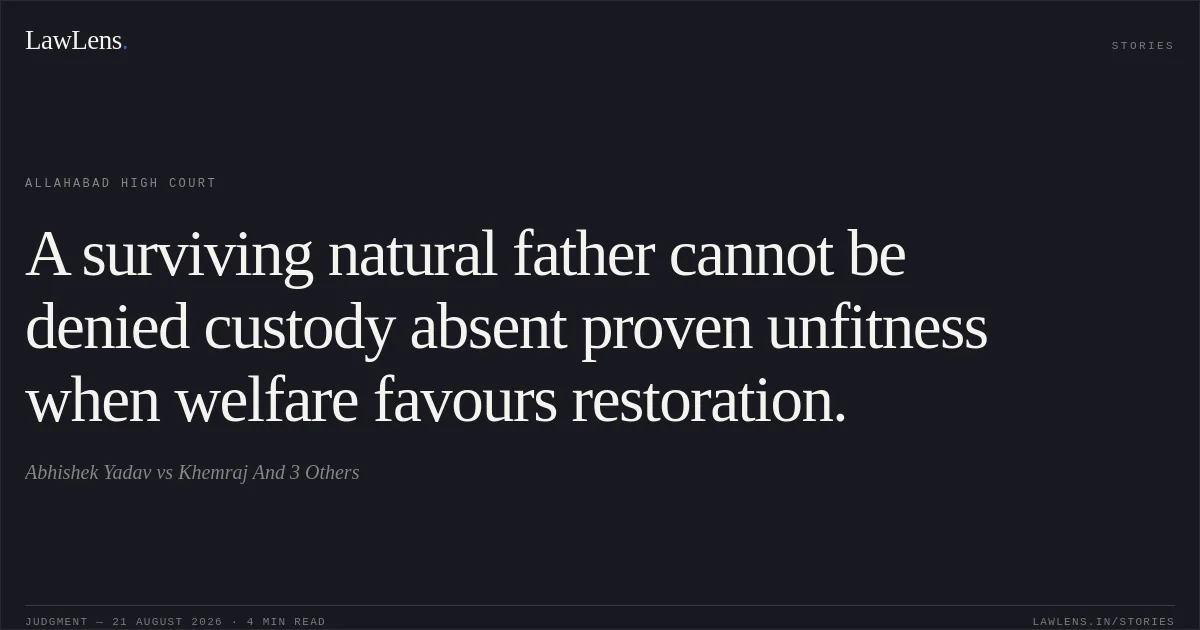
Source reference: paras. 24–29Applying the principles in Tejaswini Gaud and Gautam Kumar Das, the Court held that the respondents’ temporary or subsequent caregiving role could not defeat the custody claim of the only surviving natural guardian.
Source reference: paras. 30–32The Court further held that the trial court had failed to give reasoned findings on the child’s welfare and the appellant’s alleged unfitness.
Source reference: paras. 33–39Its reliance on Somprabha Rana v. State of Madhya Pradesh was found misplaced because that case involved materially different facts, including the unnatural death of the mother and criminal proceedings against the father.
Source reference: paras. 33–39Holding
The appeal was allowed.
The High Court set aside the judgment and decree dated 31 May 2025, holding that the appellant was the child’s natural guardian, had not been shown to be unfit, and that Avya’s welfare would be best served in the custody of her father.
Source reference: paras. 21, 32, 39–40The respondents were directed to hand over Avya’s custody to the appellant within one month.
Source reference: para. 40In view of the child’s prolonged residence with the respondents, they were granted visitation rights to meet her from 2 p.m. to 5 p.m. at the District Legal Services Authority, Prayagraj; the parties were permitted to approach the trial court for alteration of the visitation venue.
Source reference: para. 40Acts & Sections Cited
4 provisions across 3 statutes referred to in this judgment. Each provision opens on LawLens.
Guardians and Wards Act, 18902
Hindu Minority and Guardianship Act, 19561
Bharatiya Nagarik Suraksha Sanhita, 20231
Original Court PDF
Abhishek YadavvsKhemraj And 3 Others
Click to open original judgment
Original judgment, available to read, download and summarize on LawLens.in