Facts
The petitioners challenged the order dated 29 August 2013 passed by the Assistant Settlement Officer, Bhubaneswar, in Objection Case No. 3865 of 2013, whereby their objection under Section 12 of the Odisha Survey and Settlement Act, 1958 was rejected and the disputed land was directed to be recorded in the Government Khata.
Source reference: p.2, para.2The land originally formed part of Government Plot No. 502 in Khata No. 359 of Mouza Ogalapada. In WLL Case No. 2723 of 1973, an extent of Ac.1.000 was settled in favour of Narayan Naik under the Odisha Government Land Settlement Act, 1962, and the Record of Rights was published in his name.
Source reference: p.2, para.3Narayan Naik subsequently sold the land to Rabindra Kumar Baliarsingh in 1982.
Source reference: p.3, para.3.1A suo motu revision under Section 7-A(3) of the Government Land Settlement Act was initiated to examine the validity of the settlement. After remand and fresh enquiry, the Tahasildar, Bhubaneswar, upheld the lease in favour of Narayan Naik by order dated 30 July 1990. That order was not challenged and attained finality.
Source reference: p.3, paras.3.2–3.3Rabindra Kumar Baliarsingh later sold Ac.0.200 decimals to Sasmita Panda in 1990, who in turn sold the land to the petitioners in 2006. The petitioners obtained conversion of the land to Gharabari kisam under Section 8-A of the Odisha Land Reforms Act.
Source reference: p.4, para.4During subsequent settlement proceedings, although the preliminary Record of Rights was published in the petitioners’ names, the recorded area was reduced. Their objection seeking correction of the area and map was rejected by the Assistant Settlement Officer, who instead directed recording of the land in the Government Khata.
Source reference: p.4, para.5The writ petition had earlier been disposed of along with connected cases. On appeal, the Supreme Court set aside the common judgment and remanded the matters, directing the High Court to examine each case independently, including the availability and exhaustion of remedies under Sections 12-A and 15(b) of the Settlement Act.
Source reference: pp.5–6, para.8The State contended that the final Record of Rights had already been published on 30 November 2013 and that the petitioners had not availed the statutory remedies.
Source reference: p.7, paras.10.2–10.3Issues
1. Whether the Assistant Settlement Officer acted without jurisdiction in rejecting the petitioners’ objection under Section 12 of the Odisha Survey and Settlement Act, 1958 and directing that the land be recorded in the Government Khata?
Source reference: pp.2, 7–8, paras.2, 6, 10.2–10.32. Whether the petitioners’ writ petition was maintainable despite their failure to pursue the appellate or revisional remedies under Sections 12-A and 15(b) of the Settlement Act?
Source reference: pp.6–8, paras.8, 10–10.33. Whether the Tahasildar was competent under Rule 34 of the Odisha Survey and Settlement Rules, 1962 to correct the final Record of Rights and record the purchased land in the petitioners’ names?
Source reference: p.8, para.10.4Law Applied
The Court considered Article 226/227 of the Constitution, which permits judicial review of jurisdictional errors and issuance of appropriate directions; Section 12 of the Odisha Survey and Settlement Act, 1958, concerning objections to the preliminary Record of Rights; Section 12-A, providing an appellate remedy before finalisation of the Record of Rights; and Section 15(b), providing a post-finalisation remedy.
Source reference: pp.2, 6–8, paras.2, 8, 10–10.3The Court also applied Rule 34 of the Odisha Survey and Settlement Rules, 1962, under which the Tahasildar may correct the Record of Rights pursuant to the direction of a competent court.
Source reference: p.8, para.10.4The validity of the original Government land settlement was treated as having attained finality after the Tahasildar upheld it in the remand proceeding and the order remained unchallenged.
Source reference: p.3, para.3.3The Court also followed the Supreme Court’s remand direction that each case be decided on its own facts and that the statutory-remedy questions be examined independently.
Source reference: pp.5–6, para.8Reasoning
The Court accepted the petitioners’ case that the original settlement in favour of Narayan Naik had been upheld after a fresh enquiry and had never been set aside by a competent forum.
Source reference: p.3, para.3.3Consequently, the Assistant Settlement Officer could not, in the course of deciding the petitioners’ Section 12 objection, effectively reopen and invalidate that concluded settlement on the ground that the land had not been used for the purpose for which it was leased.
Source reference: p.4, para.6Although the State argued that the impugned order was merely erroneous and could have been challenged under Sections 12-A or 15(b), the Court proceeded to exercise its writ jurisdiction and directed correction of the Record of Rights.
Source reference: pp.7–8, paras.10.2–10.4It held that even publication of the final Record of Rights in the Government’s name did not prevent correction where such correction was directed by a competent court under Rule 34.
Source reference: pp.7–8, paras.10.2–10.4Holding
The writ petition was allowed.
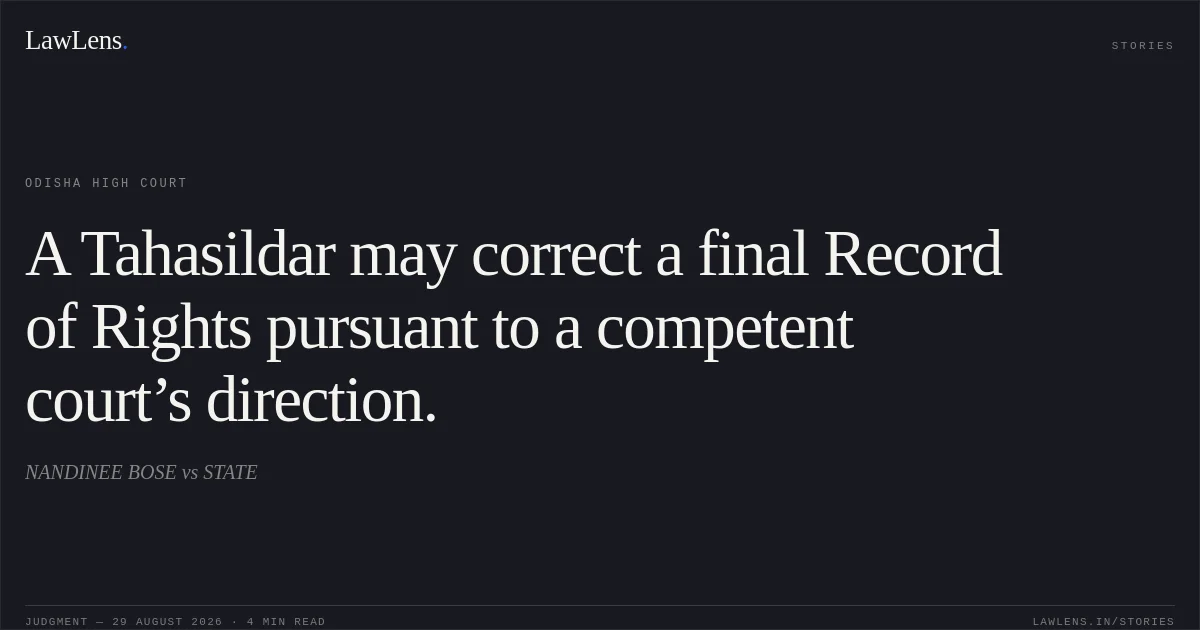
The Court directed the Tahasildar, Jatni, to correct the Record of Rights and record in the petitioners’ names the land purchased by them, notwithstanding the prior publication of the final Record of Rights in the Government’s name.
Source reference: p.8, para.10.4The correction was to be completed within eight weeks from production of a certified copy of the judgment, followed by immediate supply of the corrected Record of Rights to the petitioners.
Source reference: p.8, paras.10.4–10.5No order as to costs was made.
Source reference: p.8, para.10.5Acts & Sections Cited
7 provisions across 3 statutes referred to in this judgment. Linked provisions open on LawLens.
Orissa Survey and Settlement Act, 19585
Orissa Government Land Settlement Act, 19621
Orissa Land Reforms Act, 19601
Original Court PDF
NANDINEE BOSEvsSTATE
Click to open original judgment
Original judgment, available to read, download and summarize on LawLens.in
![A police constable cannot be removed for unauthorized absence without a Rule 359-compliant inquiry.. Mohammad Sidiq Khan vs D/o Home Ut Of Jammu & Kashmir. CAT - ['Srinagar']. LawLens](/stories/thumbnails/a-police-constable-cannot-be-removed-for-unauthorized-absence-without-a-rule-359-compliant-7b43fc316bd94f22a62676153bbc9d54.webp)
![A Review DPC lacks authority to determine or alter inter se seniority.. SAURABH KUMAR vs REVENUE. CAT - ['Patna']. LawLens](/stories/thumbnails/a-review-dpc-lacks-authority-to-determine-or-alter-inter-se-seniority-4b21640f20af46fcabdfc8273d2ce959.webp)