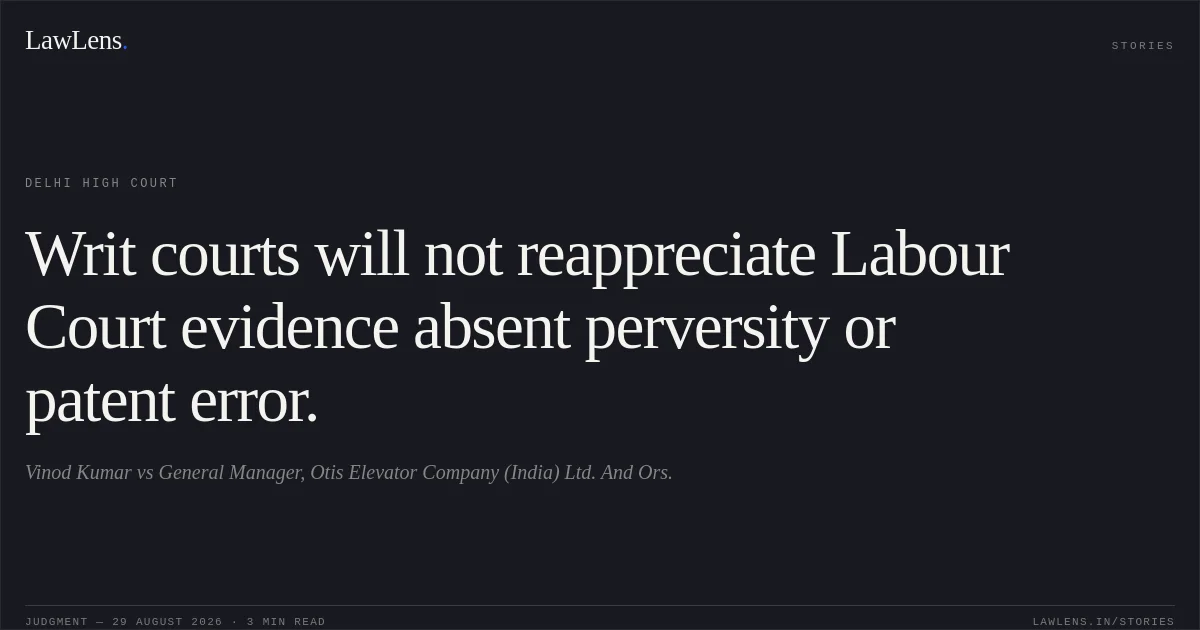
Facts
Vinod Kumar claimed that he had worked as a Helper with Otis Elevator Company (India) Ltd. from 2 May 1996 in installation, dismantling and servicing work relating to lifts, and that his services were illegally terminated on 31 December 2002 without compliance with Section 25-F of the Industrial Disputes Act, 1947.
Source reference: p.2, para. 2The management denied any employer–employee relationship and asserted that Kumar had been engaged, paid and supervised by M/s Satyam Management Service, an independent contractor engaged for installation and dismantling work.
Source reference: pp.2–3, paras. 3–4After the contractor’s agreement with Otis ended on 25 November 2002, the contractor issued Kumar a termination letter and offered wages, notice pay and retrenchment compensation.
Source reference: p.3, para. 4The Labour Court found that Kumar was an employee of Otis, relying, inter alia, on PF and ESI contributions deposited under the principal employer’s code and evidence indicating that Otis exercised control and supervision over the workmen.
Source reference: p.4, para. 5It held the termination illegal for non-compliance with Section 25-F, but awarded lump-sum compensation of ₹5,50,000 instead of reinstatement.
Source reference: p.4, para. 5Kumar challenged the denial of reinstatement, while Otis challenged the findings regarding the employer–employee relationship and illegal termination.
Source reference: pp.4–5, paras. 6–8Issues
1. Whether the Labour Court erred in finding that an employer–employee relationship existed between Vinod Kumar and Otis Elevator Company (India) Ltd., rather than between Kumar and the contractor.
Source reference: pp.5–7, paras. 10–132. Whether the finding that Kumar’s termination was illegal for non-compliance with Section 25-F of the Industrial Disputes Act, 1947 warranted interference in writ jurisdiction.
Source reference: p.7, para. 143. Whether the Labour Court erred in awarding monetary compensation instead of reinstatement with consequential benefits.
Source reference: pp.7–8, paras. 15–16Law Applied
The Court applied the supervisory jurisdiction under Articles 226 and 227 of the Constitution, under which the High Court does not act as an appellate court or ordinarily reappreciate evidence, and may interfere with factual findings only where they are based on no evidence, are perverse, or disclose an error of law apparent on the face of the record, as explained in Syed Yakoob v. K.S. Radhakrishnan, AIR 1964 SC 477.
Source reference: pp.5–6, paras. 10–11It applied Section 25-F of the Industrial Disputes Act, 1947, which requires compliance with statutory conditions precedent to retrenchment; termination without such compliance is illegal.
Source reference: p.7, para. 14The Court further held that reinstatement does not automatically follow from a finding of illegal termination and that monetary compensation may be granted instead, depending on the facts, relying on Jaipur Development Authority v. Ramsahai, (2006) 11 SCC 684; Talwara Cooperative Credit and Service Society Ltd. v. Sushil Kumar, (2008) 9 SCC 486; and Jagir Singh v. Haryana State Agriculture Marketing Board, (2009) 15 SCC 327.
Source reference: p.7, para. 15Reasoning
The Labour Court had considered the evidence led by the management and the contractor, found the contractor’s witness unreliable on material aspects, and relied on the PF and ESI records and other evidence to conclude that Otis exercised control and supervision over Kumar and the other workmen.
Source reference: p.6, para. 12The management’s challenge essentially sought a reassessment of that evidence and substitution of the Labour Court’s conclusion with another possible view. Since no perversity, absence of evidence or patent error of law was demonstrated, the High Court declined to interfere under Articles 226 and 227.
Source reference: pp.6–7, paras. 12–13Consequently, the finding that Kumar was an employee of Otis and that his termination violated Section 25-F also did not warrant interference.
Source reference: p.7, para. 14As to relief, the Court held that the Labour Court had lawfully exercised its discretion in awarding compensation rather than reinstatement, particularly because the termination dated back to 2002 and a substantial period had elapsed.
Source reference: pp.7–8, paras. 15–16Holding
The Court dismissed both cross-petitions, holding that neither the management had established any ground to disturb the finding of employer–employee relationship and illegal termination, nor had the workman shown perversity or illegality in the denial of reinstatement and award of ₹5,50,000 as compensation.
The amount deposited before the Court pursuant to the order dated 19 July 2021, together with accrued interest, was directed to be released to Vinod Kumar within four weeks.
Source reference: p.8, para. 18Any pending application was also disposed of.
Source reference: p.8, para. 19Acts & Sections Cited
1 provisions across 1 statute referred to in this judgment. Linked provisions open on LawLens.
Industrial Disputes Act, 19471
Original Court PDF
Vinod KumarvsGeneral Manager, Otis Elevator Company (India) Ltd. And Ors.
Click to open original judgment
Original judgment, available to read, download and summarize on LawLens.in
![A police constable cannot be removed for unauthorized absence without a Rule 359-compliant inquiry.. Mohammad Sidiq Khan vs D/o Home Ut Of Jammu & Kashmir. CAT - ['Srinagar']. LawLens](/stories/thumbnails/a-police-constable-cannot-be-removed-for-unauthorized-absence-without-a-rule-359-compliant-7b43fc316bd94f22a62676153bbc9d54.webp)
![A Review DPC lacks authority to determine or alter inter se seniority.. SAURABH KUMAR vs REVENUE. CAT - ['Patna']. LawLens](/stories/thumbnails/a-review-dpc-lacks-authority-to-determine-or-alter-inter-se-seniority-4b21640f20af46fcabdfc8273d2ce959.webp)