Facts
PEDA allotted the appellant a 3 MW solar project under a 2015 competitive-bidding process.
Source reference: pp. 4–7The PPA, executed on 31 March 2015, required commissioning within ten months and provided a tariff of ₹7.58/kWh.
Source reference: pp. 4–7The project’s 1 MW capacity was commissioned on 18 May 2016 and the remaining 2 MW on 15 March 2017, after the scheduled commissioning date.
Source reference: pp. 4–7The appellant sought an extension of SCOD, relying on force majeure events and delays in the readiness of the 66 kV bay.
Source reference: pp. 4–7The Commission condoned 49 days’ delay, refused to condone the balance, upheld PEDA’s entitlement to encash the performance bank guarantees and PSPCL’s entitlement to liquidated damages, and fixed the tariff for the remaining 2 MW at ₹5.09/kWh.
Source reference: pp. 4–7The appellant appealed, principally challenging that tariff determination.
Source reference: pp. 4–7Issues
1. Whether the Commission’s refusal to condone delay beyond 49 days, and its findings concerning encashment of the performance bank guarantees and liquidated damages, warranted appellate interference.
Source reference: pp. 7–12, 202. Whether the Commission could apply the ₹5.09/kWh tariff discovered in a later bidding process for projects of at least 50 MW to the appellant’s delayed 2 MW capacity, and what tariff should apply instead.
Source reference: pp. 12–19Law Applied
Article 3(C) of the Implementation Agreement provided that if the project’s COD extended beyond 31 March 2016, the stated tariff would cease to apply and the developer would have to obtain a tariff redetermination from the Commission.
Source reference: p. 14The Implementation Agreement and PPA also provided for performance bank guarantee forfeiture and liquidated damages in the event of delay.
Source reference: pp. 9–12In PSPCL v. Abundant Energy Pvt. Ltd., Appeal No. 316 of 2018, the Tribunal had affirmed a redetermined tariff of ₹5.39/kWh for that developer’s project.
Source reference: pp. 16–17The judgment identifies no separate statutory provision or general legal doctrine as the basis for its decision; it applies the relevant contractual terms and assesses tariff redetermination by reference to the record and the comparable project.
Source reference: pp. 13–19Reasoning
The Tribunal found no basis to disturb the Commission’s delay findings: the appellant did not advance submissions on the delay issue at the hearing, and the record disclosed no material warranting a contrary view.
Source reference: pp. 7–12, 20It therefore upheld the 49-day allowance, the remaining delay findings, the encashment of the bank guarantees, and liquidated damages for 361 days’ delay in commissioning the remaining 2 MW.
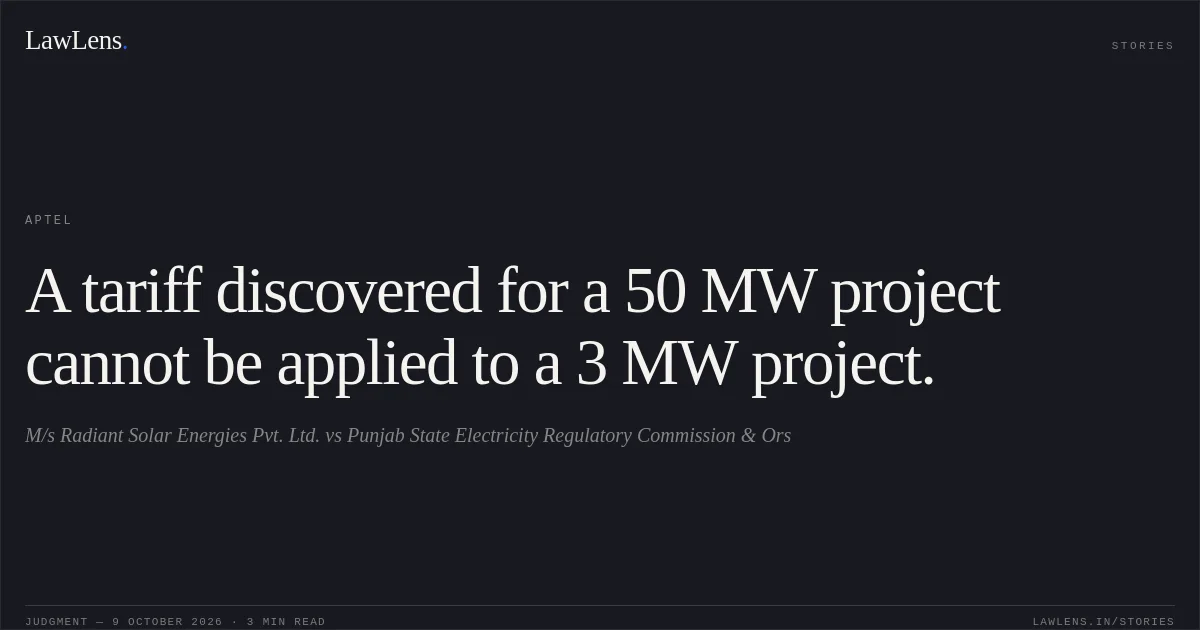
Source reference: pp. 7–12, 20On tariff, the Tribunal agreed that the ₹5.09/kWh rate was unsuitable because it had been discovered in a bidding process for a minimum 50 MW capacity, unlike the appellant’s 3 MW project.
Source reference: p. 18It considered the ₹5.39/kWh tariff affirmed for Abundant Energy, but reduced it by ₹0.10/kWh to reflect the appellant’s bid being ₹0.10/kWh lower than Abundant Energy’s bid.
Source reference: pp. 17–19PSPCL’s contention that the appellant benefited from later, lower module prices was not supported by evidence establishing the extent of any price reduction.
Source reference: pp. 17–19Holding
The appeal was partly allowed.
The Tribunal upheld the Commission’s refusal to condone delay beyond 49 days, its decision permitting PEDA to encash the performance bank guarantees, and PSPCL’s entitlement to liquidated damages for the 361-day delay relating to the remaining 2 MW.
Source reference: p. 20It set aside the ₹5.09/kWh tariff and held that the appellant was entitled to ₹5.29/kWh for power supplied to PSPCL.
Source reference: pp. 20–21PSPCL was directed to pay any resulting tariff differential within four weeks.
Source reference: pp. 20–21Original Court PDF
M/s Radiant Solar Energies Pvt. Ltd.vsPunjab State Electricity Regulatory Commission & Ors
Click to open original judgment
Original judgment, available to read, download and summarize on LawLens.in