Facts
The petitioner, initially appointed as a Technician and later promoted as Assistant Director (Physics Division) at the Forensic Science Laboratory, examined a seized truck in connection with Barachatti P.S. Case No. 302 of 2008. He prepared F.S.L. Report No. 24/2009 dated 2 February 2009, opining that the engine and chassis numbers showed no signs of erasure or tampering. The report was verified and countersigned by the then Director-in-Charge and forwarded to the concerned court
Source reference: pp. 2–3, paras. 3–4After the investigation was transferred to the CID, the accused allegedly made custodial confessions stating that fake engine and chassis numbers had been punched on the vehicle. Relying principally on the CID investigation and the Investigating Officer’s progress report, the respondents alleged that the petitioner had submitted a false report
Source reference: p. 3, para. 4A disciplinary proceeding was initiated under Rule 17 of the Bihar Government Servants (Classification, Control and Appeal) Rules, 2005. The Inquiry Officer found the charge proved. After considering the petitioner’s response to the second show-cause notice, the disciplinary authority imposed the penalties of withholding two annual increments with cumulative effect and debarring him from future promotion by order dated 9 October 2017. The petitioner’s review petition was rejected on 7 February 2018
Source reference: pp. 3–4, para. 4The petitioner challenged both orders, contending that the departmental case lacked contrary scientific evidence, that his report had been institutionally verified, that the criminal accused had ultimately been acquitted, and that the disciplinary and reviewing authorities had failed to consider his detailed defence
Source reference: pp. 4–5, paras. 5–6Issues
Whether the petitioner could be held guilty of professional misconduct on the basis of a custodial confession and the lay opinion of an Investigating Officer, without contrary scientific evidence establishing that his forensic report was deliberately false or technically improper?
Source reference: p. 5, para. 7Whether the disciplinary authority passed a valid and reasoned order in compliance with the Bihar Government Servants (CCA) Rules, 2005, particularly Rule 18, and whether the reviewing authority properly considered the petitioner’s challenge?
Source reference: p. 5, para. 7; pp. 9–14, paras. 14–17Law Applied
The Court applied Rule 17 of the Bihar Government Servants (CCA) Rules, 2005 concerning departmental inquiries, and Rule 18, which requires the disciplinary authority to consider the inquiry report, record reasons for disagreement where applicable, consider the employee’s representation, and pass a reasoned final order.
Source reference: pp. 9–11, paras. 14–15The Court also referred to Rule 27, requiring an appellate authority to examine procedural compliance, evidentiary sufficiency, and the proportionality of the penalty, and Rule 28 concerning review.
Source reference: pp. 12–14, paras. 16–17Relying on Union of India v. J. Ahmed, (1979) 2 SCC 286, the Court held that an isolated error of judgment, negligence, or failure to attain the highest standard of efficiency does not ordinarily constitute misconduct unless accompanied by blameworthy conduct or sufficiently grave culpability.
Source reference: pp. 5–7, para. 8Under Inspector Prem Chand v. Government of NCT of Delhi, (2007) 4 SCC 566, misconduct generally involves wilful or wrongful conduct and is distinct from negligence simpliciter or a mere error of judgment.
Source reference: pp. 7–8, para. 9The Court further relied on Satyendra Kumar v. State of Bihar, LPA No. 1326 of 2019, and Dr. Vijay Kumar v. State of Bihar, CWJC No. 8177 of 2015, for the principle that disciplinary, appellate, and reviewing authorities must provide reasoned consideration of the employee’s defence and cannot dispose of statutory remedies mechanically.
Source reference: pp. 11–14, paras. 16–17Reasoning
The Court found that the disciplinary case rested substantially on the Investigating Officer’s opinion and the alleged custodial confession, without any independent forensic examination, expert testimony, or alternative FSL report contradicting the petitioner’s technical findings.
Source reference: pp. 14–15, paras. 18–19The petitioner’s report had been prepared in the course of official forensic work and had been countersigned by the Director-in-Charge. In the Court’s view, a subsequent police theory or confession could not, without supporting scientific evidence, establish that the petitioner had deliberately violated technical protocols or acted with dishonest intent.
Source reference: pp. 8–10, paras. 12–13The absence of evidence of bribery, collusion, extraneous influence, or malicious intent meant that the allegation, even if treated as a technical error, did not satisfy the legal threshold of misconduct under J. Ahmed and Prem Chand.
Source reference: pp. 8–9, paras. 10–13The Court also held that the disciplinary authority’s order did not address the petitioner’s detailed technical defence and that the reviewing order was a cryptic, one-line rejection, contrary to the reasoned-decision requirements under Rules 18 and 28.
Source reference: pp. 14–15, paras. 19–21Holding
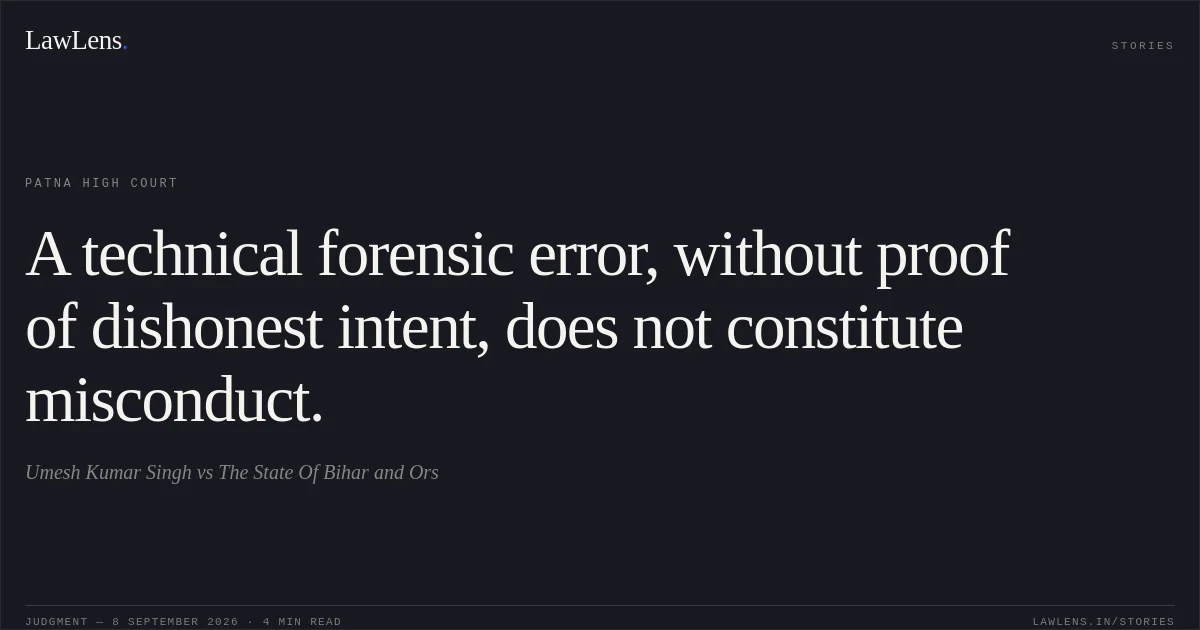
The Court held that the petitioner’s alleged technical error could not be elevated to deliberate service misconduct in the absence of contrary scientific evidence or proof of dishonest or blameworthy intent.
It quashed the punishment order dated 9 October 2017 and the reviewing order dated 7 February 2018 as legally unsustainable and violative of the applicable rules and principles of natural justice.
Source reference: pp. 15–16, paras. 21–22The respondents were directed to restore the two withheld annual increments, refix the petitioner’s pay accordingly, and release all consequential monetary benefits and salary arrears within three months of production of the certified copy of the judgment.
Source reference: p. 16, para. 22The writ petition was accordingly allowed, with no order as to costs.
Source reference: p. 16, paras. 23–24Acts & Sections Cited
1 provisions across 1 statute referred to in this judgment. Each provision opens on LawLens.
Code of Criminal Procedure, 19731
Original Court PDF
Umesh Kumar SinghvsThe State Of Bihar and Ors
Click to open original judgment
Original judgment, available to read, download and summarize on LawLens.in