Facts
Jyotindranath Manna instituted a suit for specific performance of an agreement for sale dated 27 May 1979 against the original vendors. The suit was decreed on 28 February 1994, the first appeal was dismissed on 30 November 1999, and the second appeal was ultimately dismissed for default on 23 August 2022.
Source reference: para. 3(a)The decree was put into execution in Title Execution Case No. 8 of 2000. During the pendency of the second appeal and execution proceedings, the petitioners purchased a portion of the decretal property through successive transfers originating from one of the judgment-debtors, culminating in a registered sale deed dated 8 January 2020.
Source reference: paras. 3(b), 8They were consequently added as pro forma judgment-debtors by order dated 6 January 2024.
Source reference: para. 3(b)Their application under Section 151 CPC seeking deletion of their names from the execution proceedings was rejected, leading to the present application under Article 227 of the Constitution.
Source reference: paras. 1–4Issues
Whether a transferee pendente lite, claiming through a judgment-debtor in respect of the decretal property, may be impleaded in execution proceedings under Order 22 Rule 10 CPC
Source reference: paras. 13–23Whether the petitioners, who were not parties to the original agreement for sale and claimed title and possession under registered deeds, were entitled to deletion from the execution proceedings under Section 151 CPC
Source reference: paras. 24–41Whether the executing court’s refusal to delete the petitioners’ names warranted interference under Article 227 of the Constitution
Source reference: paras. 37, 43–48Law Applied
The Court applied Section 52 of the Transfer of Property Act, 1882, embodying the doctrine of lis pendens, under which a transfer of immovable property during the pendency of litigation—including the appellate and execution stages until satisfaction of the decree—is subject to the result of the litigation.
Source reference: paras. 9–10Order 21 Rule 102 CPC denies a transferee pendente lite protection against resistance or obstruction to execution under Order 21 Rules 98 and 100.
Source reference: paras. 11–12Order 22 Rule 10 CPC, which permits continuation of proceedings by or against a person upon whom an interest devolves during litigation, applies to execution proceedings as well.
Source reference: paras. 14–23Relying on Taraprasanna Ganguli v. Nareshchandra Chakraborti, Midnapore Zamindari Co. Ltd. v. Naresh Narain Roy, Khemchand Shankar Choudhari v. Vishnu Hari Patil, and Usha Sinha v. Dina Ram, the Court held that a transferee pendente lite is a representative-in-interest, may participate in execution, and remains bound by the decree.
Source reference: paras. 15–22, 40Kasturi v. Iyyamperumal was distinguished because it concerned impleadment of an independent stranger in the original specific-performance suit, not a transferee deriving title from a judgment-debtor during pending litigation.
Source reference: paras. 25–36Reasoning
The petitioners’ own pleadings showed that their title arose through successive transfers from one of the judgment-debtors, rather than through an independent title adverse to the judgment-debtors.
Source reference: paras. 8, 38Since the transfers occurred while the litigation concerning the property remained pending, Section 52 of the Transfer of Property Act made the petitioners bound by the outcome of the litigation, and they became representatives-in-interest for purposes of Order 22 Rule 10 CPC.
Source reference: para. 39Their status as transferees pendente lite also attracted Order 21 Rule 102, preventing them from resisting or obstructing execution on the basis of the subsequent transfer.
Source reference: para. 40The Court therefore held that the fact that they were not parties to the original contract did not require their removal from the execution proceedings. Their presence could assist in the proper and effective adjudication of the execution case, and the earlier order adding them had not been challenged and had attained finality.
Source reference: paras. 35–36, 43–47Accordingly, Kasturi did not support deletion of their names.
Source reference: para. 30Holding
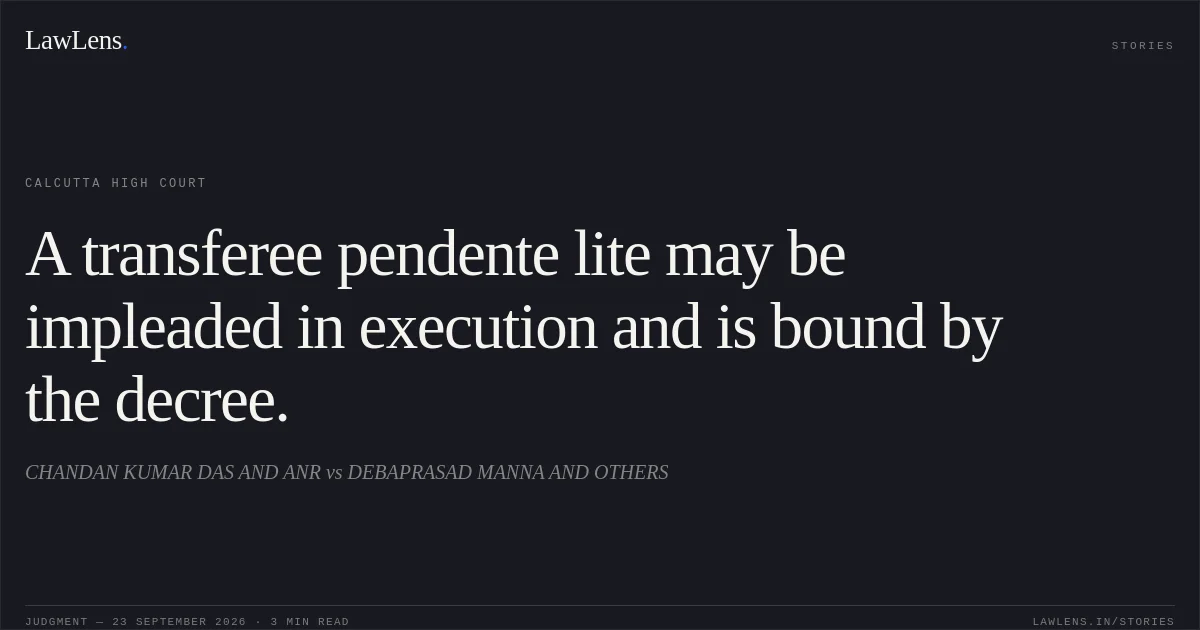
The Court held that the petitioners were transferees pendente lite and representatives-in-interest of a judgment-debtor. They were bound by the decree and could properly be retained in the execution proceedings under Order 22 Rule 10 CPC, notwithstanding that they were not parties to the original agreement for sale.
The executing court’s rejection of their application under Section 151 CPC was found legally correct and free from any jurisdictional or procedural infirmity warranting interference under Article 227.
Source reference: paras. 46–48C.O. No. 2942 of 2026 was dismissed without costs.
Source reference: para. 48Acts & Sections Cited
3 provisions across 2 statutes referred to in this judgment. Each provision opens on LawLens.
Code of Civil Procedure, 19082
Transfer of Property Act, 18821
Original Court PDF
CHANDAN KUMAR DAS AND ANRvsDEBAPRASAD MANNA AND OTHERS
Click to open original judgment
Original judgment, available to read, download and summarize on LawLens.in