01Facts
SEBI filed a complaint before the Chief Judicial Magistrate, Alipore, against M/s. Shekher Plantation (P) Ltd. and its directors, the petitioners, alleging offences under Sections 24(1) and 27 of the SEBI Act, 1992, involving alleged defalcation of ₹1,10,000.
¶ 3The petitioners surrendered before the CJM and were granted bail.
¶ 3Following the amendment to Section 26 of the SEBI Act, the proceedings were transferred to the Judge, 5th Special Court, Calcutta.
¶ 4The petitioners contended that they were unaware of the transfer and could not appear before the Special Court.
¶ 1–2, 5The Special Court nevertheless issued warrants of arrest against them without first issuing summons and rejected their request for acceptance of an application seeking certified copies of the complaint and relevant orders.
¶ 1–2, 5The petitioners challenged the orders dated 8 September 2021 and 18 May 2024 in the present revision.
¶ 102Issues
i.Whether the Special Court could issue warrants of arrest against accused persons who had previously been granted bail, without first issuing summons after transfer of the proceedings from the CJM to the Special Court?
¶ 5–10ii.Whether the impugned orders issuing warrants of arrest and consequentially affecting the petitioners’ attendance before the Special Court were legally sustainable?
¶ 1–2, 8–10iii.What directions should be issued regarding the petitioners’ appearance and expeditious conclusion of the proceedings?
¶ 11–1303Law Applied
The Court applied Section 26-B of the SEBI Act, 1992, which mandates that offences under the Act be taken cognizance of and tried by the designated Special Court notwithstanding the Code of Criminal Procedure.
¶ 9It relied on the principles stated by the Supreme Court in Tarsem Lal v. Directorate of Enforcement, Jalandhar Zonal Office, 2024 SCC OnLine SC 971, particularly that, upon taking cognizance of a complaint where the accused was not arrested during investigation, the normal course is to issue summons rather than a warrant; this principle applies even where the accused is on bail.
¶ 6If the accused fails to appear after service of summons, the court may first issue a bailable warrant and thereafter take further coercive steps under Section 70 of the CrPC.
¶ 6The Court also referred to the procedural framework under Sections 200–205 of the CrPC, including the power to require bonds under Section 88 and to grant exemption from personal appearance under Section 205.
¶ 6Provisions in the judgment · 13 · Linked ones open on LawLens
Securities and Exchange Board of India Act, 1992 Section 24Section 26Section 27
Prevention of Money-Laundering Act, 2002 Section 4Section 44
Code of Criminal Procedure, 1973 Section 70Section 88Section 200Section 201Section 202Section 203Section 204Section 205
04Reasoning
The petitioners had already surrendered and obtained bail before the CJM, and there was no finding that they had been arrested during investigation or had deliberately evaded the process of the transferee court.
¶ 3Although the proceedings were transferred to the Special Court pursuant to Section 26-B of the SEBI Act, the transfer did not dispense with the requirement of providing the accused an opportunity to appear before the transferee court.
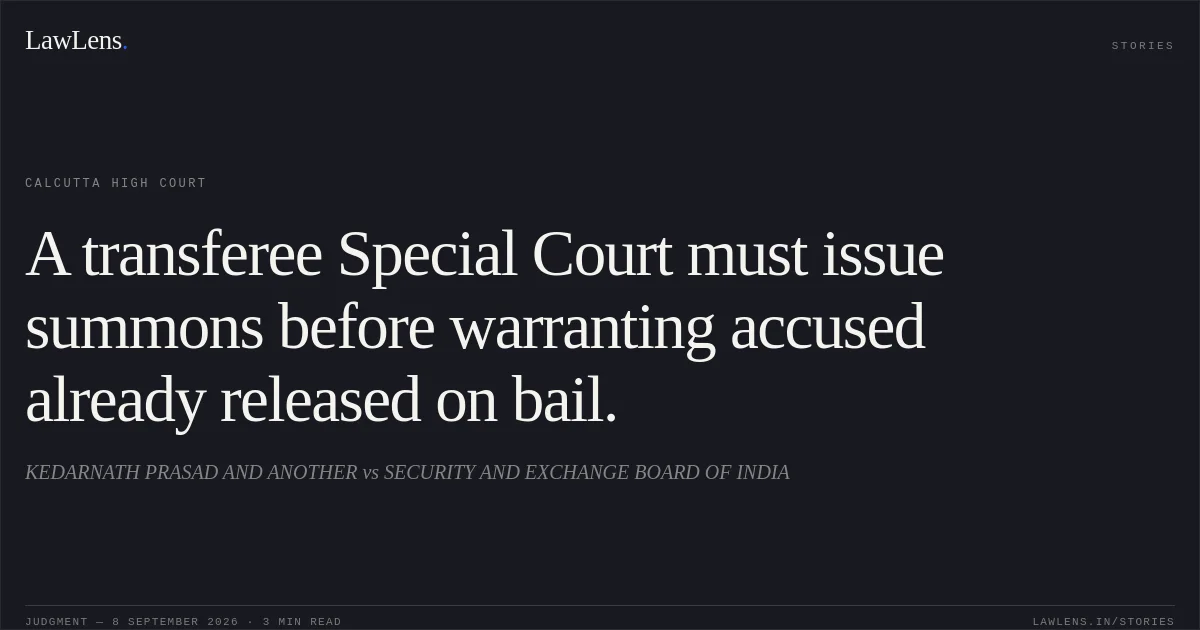
Applying the principle in Tarsem Lal, the Court held that the Special Court should, at the minimum, have issued summons to the petitioners before resorting to a warrant of arrest.
¶ 6, 8–10The absence of such summons rendered the issuance of the warrant procedurally improper and legally unsustainable, notwithstanding SEBI’s contention that the petitioners had failed to appear on earlier dates before the CJM and that the case concerned an economic offence.
¶ 705Holding
The High Court held that the warrant of arrest issued against the petitioners was “palpable and illegal” and set aside the impugned order to that extent.
¶ 10The petitioners were directed to appear before the Trial Court on the next date fixed, failing which the Trial Court was permitted to take all steps available in law to secure their attendance.
¶ 11The Trial Court was further directed to conclude the proceedings logically without granting unnecessary adjournments.
¶ 12The criminal revision, CRR 4073 of 2024, and any connected applications were disposed of; any interim order stood vacated, and the record was transmitted to the Trial Court.
¶ 13–16Original Court PDF
KEDARNATH PRASAD AND ANOTHERvsSECURITY AND EXCHANGE BOARD OF INDIA
Click to open original judgment
Original judgment, available to read, download and summarize on LawLens.in