Facts
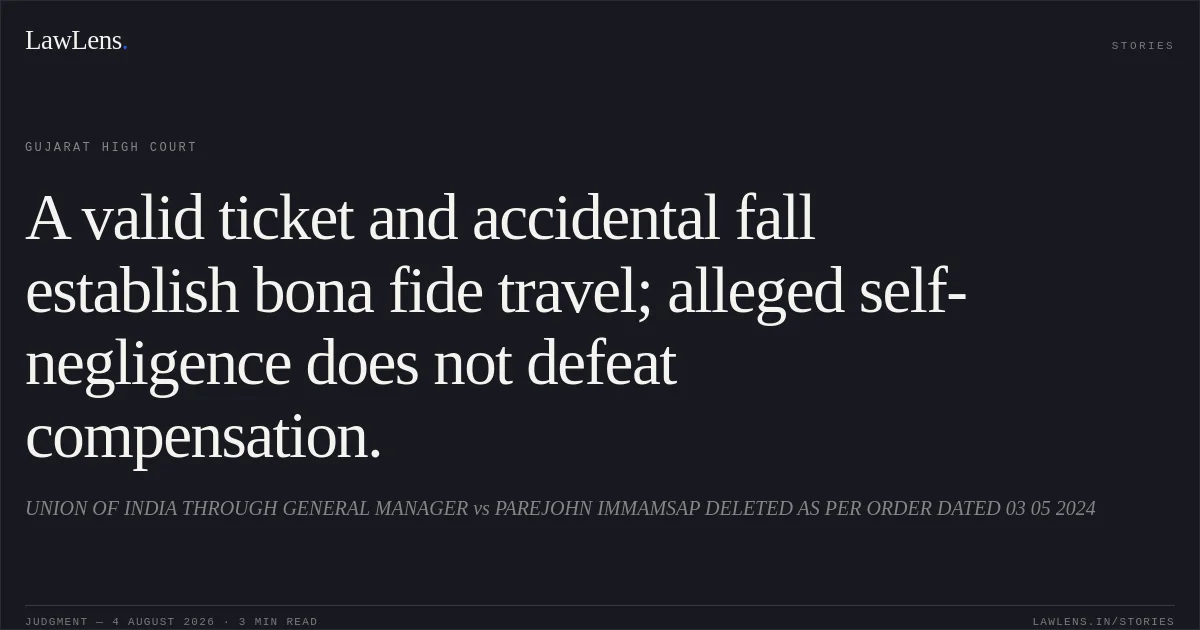
On 12.03.2019, the deceased travelled from Ahmedabad to Yesvantpur by Train No. 16501, allegedly holding a valid journey-cum-reservation ticket bearing PNR No. 8715896694.
Source reference: p.1, para. 2While boarding the train at Platform No. 5, Ahmedabad Railway Station, the train allegedly moved suddenly with a jerk, causing him to fall and sustain grievous injuries; he died during treatment on 13.03.2019.
Source reference: p.1, para. 2The claimants sought compensation under the Railways Act.
Source reference: no citationThe Railway Administration contended that the deceased had attempted to board a running train and that the incident resulted from his own negligence, thereby excluding the Railway’s liability.
Source reference: p.2, para. 2.1The Railway Claims Tribunal, Ahmedabad, allowed the claim and awarded ₹8 lakh with interest from the date of incident until realization.
Source reference: p.1, para. 1; p.2, para. 2.2–2.3The Union of India challenged that order under Section 23 of the Railway Claims Tribunal Act, 1987.
Source reference: p.1, para. 1; p.2, para. 2.2–2.3Issues
Whether the deceased was a bona fide passenger holding a valid railway ticket, so as to claim compensation under the Railways Act.
Source reference: p.3, paras. 4–6Whether the deceased’s fall while boarding the train constituted an “untoward incident” under Section 123(c)(2) of the Railways Act, 1989, or was excluded on the ground of self-negligence.
Source reference: p.2, para. 2.1; p.3, paras. 6, 10Whether the Railway Claims Tribunal was justified in awarding ₹8 lakh with interest to the claimants.
Source reference: p.1, para. 1; p.2, para. 2.2Law Applied
The Court applied Section 23 of the Railway Claims Tribunal Act, 1987, governing appeals to the High Court.
Source reference: p.1, para. 1The Court applied Sections 123(c)(2) and 124-A of the Railways Act, 1989, concerning an “untoward incident” and the Railway Administration’s statutory liability to pay compensation.
Source reference: p.2, para. 2.1; p.4, para. 7Claims under Section 124-A are compensatory and welfare-oriented, and are to be decided on the preponderance-of-probabilities standard rather than proof beyond reasonable doubt.
Source reference: p.4, para. 7; p.7, paras. 19–20Relying on Rajni v. Union of India, 2025 AIR SC 4892, the Court held that credible proof of a valid ticket and an accidental fall can establish bona fide travel; procedural lapses such as absence of a seizure memo or non-examination of an investigating officer do not defeat a legitimate claim.
Source reference: p.4–5, para. 7Relying on Shrikumar Gupta v. Union of India, 2025 LiveLaw (SC) 1115, and Sanyokta Devi v. Union of India, 2023 ACJ 2009, the Court held that minor irregularities, mistaken conduct, or alleged self-negligence do not by themselves absolve the Railways where the claimant establishes bona fide travel and a railway accident.
Source reference: p.5–7, paras. 8–9Reasoning
The Court found that the deceased’s possession of a valid ticket, together with the railway and other evidentiary material placed on record—including the ticket, vardhi and inquest panchnama—supported the claimants’ case of bona fide travel.
Source reference: p.5, para. 5The Railway’s assertion that the deceased fell while attempting to board a moving train, or might have acted negligently or committed suicide, was not sufficient to displace the claim on the applicable standard of preponderance of probabilities.
Source reference: p.3, paras. 4–6Applying the welfare-oriented interpretation of Section 124-A and the principles in Rajni, Shrikumar Gupta and Sanyokta Devi, the Court held that the established fall within the railway premises and the deceased’s bona fide passenger status were sufficient to attract statutory compensation.
Source reference: p.4–7, paras. 7–10The Tribunal’s award was therefore not shown to suffer from any legal error.
Source reference: no citationHolding
The Court answered the issues in favour of the claimants, holding that the deceased was a bona fide passenger and that the incident constituted an untoward railway incident attracting the Railway Administration’s liability under Section 124-A of the Railways Act.
The First Appeal was dismissed, thereby affirming the Tribunal’s award of ₹8 lakh with interest from the date of the incident until realization.
Source reference: p.8, para. 11The Registry was directed to return the record and proceedings, if any, to the concerned Court.
Source reference: p.8, para. 12Acts & Sections Cited
2 provisions across 2 statutes referred to in this judgment. Each provision opens on LawLens.
Railway Claims Tribunal Act, 19871
Railways Act, 19891
Original Court PDF
UNION OF INDIA THROUGH GENERAL MANAGERvsPAREJOHN IMMAMSAP DELETED AS PER ORDER DATED 03 05 2024
Click to open original judgment
Original judgment, available to read, download and summarize on LawLens.in