Facts
Renu, accompanied by her friend Aman Raza, was travelling from New Delhi to Agra Cantt on railway journey ticket No. 23848675.
Source reference: p.1The appellants’ case was that, while the train was between Ballabhgarh and Asaoti, Renu and Aman accidentally fell from the running train and sustained fatal injuries.
Source reference: p.1A railway ticket from New Delhi to Agra Cantt was recovered from Renu during the jamatalashi proceedings and was subsequently verified by the Railway authorities as genuine and issued on 31 August 2017 at 15:50 hours.
Source reference: p.3Their bodies were discovered the following morning near the Up Main Line during routine patrolling by Keyman Dayaram.
Source reference: no citationThe Railway Claims Tribunal dismissed the claim application, holding that the appellants had failed to prove that Renu was a bona fide passenger or that her death resulted from an “untoward incident” under Sections 123(c) and 124-A of the Railways Act, 1989.
Source reference: p.2The appellants challenged that decision under Section 23 of the Railway Claims Tribunal Act, 1987.
Source reference: no citationIssues
Whether the deceased was a bona fide passenger despite the endorsement on the recovered ticket requiring commencement of the journey within three hours or before the departure of the first train.
Source reference: paras. 7–10Whether the deceased’s death was the result of an “untoward incident” under Section 123(c)(2) read with Section 124-A of the Railways Act, 1989.
Source reference: paras. 11–14Whether the Tribunal’s dismissal of the compensation claim was sustainable on the evidence available on record.
Source reference: paras. 14–15Law Applied
The Court applied Sections 123(c)(2) and 124-A of the Railways Act, 1989, under which accidental falling of a passenger from a running train constitutes an “untoward incident” attracting statutory compensation, subject to the applicable exclusions.
Source reference: no citationIt also applied Section 23 of the Railway Claims Tribunal Act, 1987 governing appeals from Tribunal orders.
Source reference: no citationRelying on Dwarika Mahto & Ors. v. Union of India, the Court held that technical objections concerning ticket endorsements cannot, by themselves, defeat a claim where genuine railway travel is otherwise established.
Source reference: p.3Under Union of India v. Rina Devi, the initial burden lies on the claimant to establish the foundational facts of bona fide railway travel, after which the burden shifts to the Railway to prove circumstances disentitling compensation.
Source reference: p.4The Court also relied on Lata v. Union of India for the burden-shifting principle and Surendra Prasad Verma v. Union of India for the rule that delayed discovery of a body, by itself, does not disprove accidental falling from a train.
Source reference: pp.4–5Reasoning
The Court found that recovery of the ticket from the deceased, together with its verification and the absence of any challenge to its genuineness, established the foundational fact of railway travel.
Source reference: para. 7The ticket’s commencement endorsement, without further evidence that the deceased had not boarded the train or that the ticket had become invalid, was insufficient to displace her status as a bona fide passenger.
Source reference: paras. 8–10The Railway produced no cogent evidence from the Guard, Loco Pilot, Ticket Examiner, or other railway official to establish that the deceased had not undertaken the journey.
Source reference: paras. 9, 13As to the manner of death, the earliest railway records described the discovery of the bodies near the railway line and treated the occurrence as a railway accident; they did not indicate trespassing, track-crossing, or suicide.
Source reference: para. 11The fact that the bodies were discovered only during the following morning’s patrol was not determinative, particularly in the absence of contrary evidence.
Source reference: para. 12Accordingly, the contemporaneous records and unrebutted circumstances supported the appellants’ case that the deceased had fallen from a running train.
Source reference: no citationHolding
The Court answered both principal issues in favour of the appellants.
It held that Renu was a bona fide passenger and that her death resulted from an “untoward incident” within the meaning of Section 123(c)(2) read with Section 124-A of the Railways Act, 1989.
Source reference: para. 14The appeal was allowed, the Tribunal’s judgment dated 3 March 2020 was set aside, and the matter was remanded to the Tribunal to assess the compensation payable in accordance with law and direct its disbursement within two months of receipt of the order.
Source reference: para. 15The matter was directed to be listed before the Tribunal on 17 August 2026, and the appeal and pending application were disposed of accordingly.
Source reference: paras. 15–17Original Court PDF
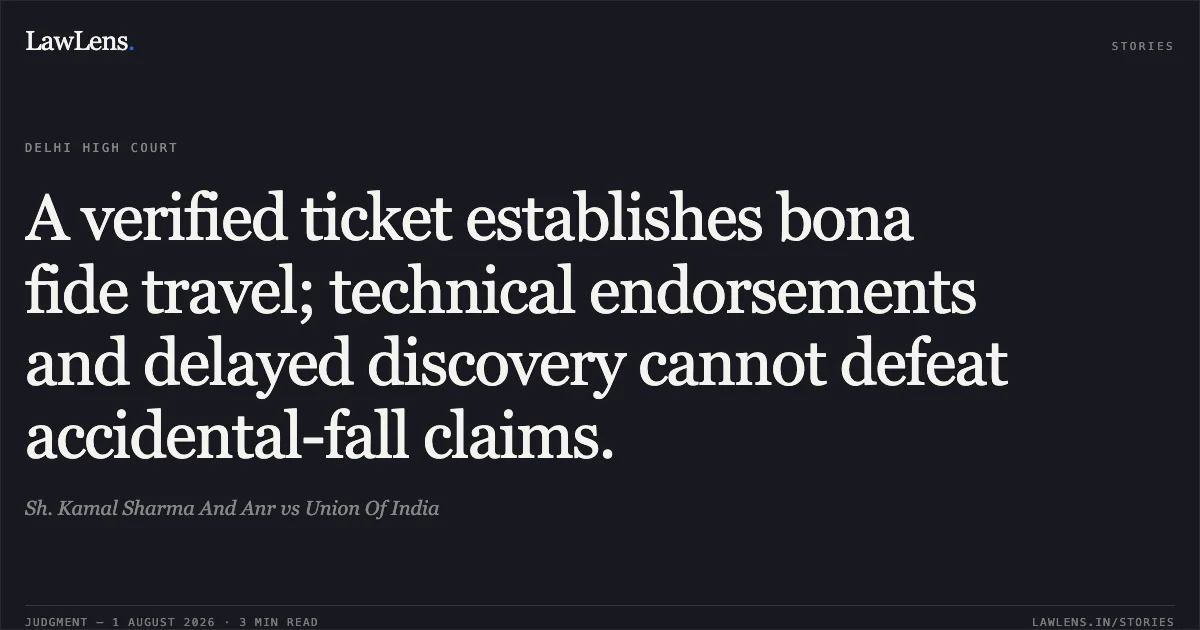
Sh. Kamal Sharma And AnrvsUnion Of India
Click to open original judgment
Original judgment, available to read, download and summarize on LawLens.in