Facts
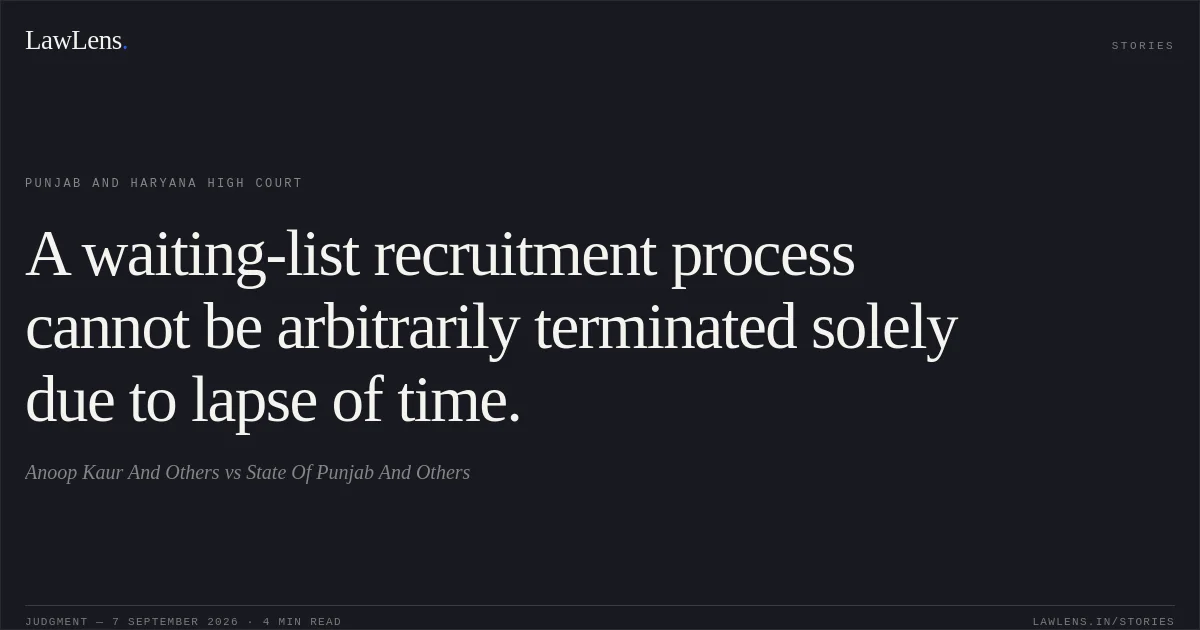
The Punjab Department of Elementary Education issued an advertisement dated 8 March 2019 for direct recruitment to 375 posts of Centre Head Teachers (CHTs) and 1,558 posts of Head Teachers (HTs). The petitioners participated in the selection process and were placed in waiting/select lists in the relevant categories.
Source reference: pp. 2–5After successive phases of recruitment, 16 candidates for HT posts and 19 candidates for CHT posts were identified for appointment. Their station preferences were obtained through a Zoom meeting held on 5 July 2021. By communications dated 7 and 8 July 2021, the Department directed the District Education Officers to issue appointment letters to these candidates.
Source reference: pp. 9–10On 9 July 2021, the Department abruptly directed that appointment letters should not be issued, citing unspecified “legal complications.” Thereafter, by order dated 18 August 2021, the recruitment process was declared complete on the ground that two years had elapsed from its commencement and that issuing further appointment letters from the waiting list would violate Government instructions.
Source reference: pp. 10–12During the proceedings, the State produced an affidavit stating that no operative instruction prescribed a two-year validity period for the waiting list.
Source reference: p. 12Issues
Whether the Department could discontinue the recruitment process and refuse appointment to the petitioners solely because approximately two years had elapsed from commencement of the recruitment process?
Source reference: pp. 11–12, 24–26Whether the petitioners, whose names were included in the relevant select/waiting lists and who had participated in station-allotment proceedings, possessed an enforceable right to appointment against the available vacancies?
Source reference: pp. 7–8, 22–24Whether the communications dated 9 July 2021 and 18 August 2021 were arbitrary, unsupported by the applicable rules or instructions, and liable to be quashed?
Source reference: pp. 9–12, 24–27What relief should be granted where the selection process was halted by the Department’s own decision and the petitioners were subsequently denied appointment?
Source reference: pp. 24–28Law Applied
The Court applied the principle in Shankarsan Dash v. Union of India, (1991) 3 SCC 47, that inclusion in a select or waiting list does not create an indefeasible right to appointment, but the State cannot refuse appointment arbitrarily; any decision not to fill vacancies must be bona fide and supported by appropriate reasons.
Source reference: pp. 26–27Relying on Tej Prakash Pathak v. Rajasthan High Court, 2024 INSC 847, the Court held that the recruitment process commences with the advertisement and ordinarily ends with the filling of vacancies; while select-list placement does not guarantee appointment, existing vacancies impose an obligation on the State to consider eligible candidates fairly and non-arbitrarily.
Source reference: pp. 22–24The Court also relied on Purushottam v. Chairman, M.S.E.B., (1999) 6 SCC 49, for the proposition that a candidate cannot be deprived of appointment merely because the panel expires where the candidate was kept out of employment due to the employer’s illegal or untenable decision.
Source reference: pp. 20–22The principles in Kesar Chand v. State of Punjab, 1988 AIR (P&H) 265 (FB), State of Haryana v. Suman Rani, Ritu v. State of Haryana, State of Punjab v. Venus, and Harjit Kaur v. State of Haryana were applied to emphasise that administrative delay cannot be used arbitrarily to defeat legitimate expectations or deny consideration to candidates in a valid select/waiting list.
Source reference: pp. 6–7, 13–19The Court further held that, under Tej Prakash Pathak, statutory rules bind the recruiting authority, while administrative instructions may fill gaps only where the rules are silent; absent a valid rule or instruction, the authority cannot unilaterally terminate the recruitment process.
Source reference: pp. 12, 23–24Reasoning
The Court found that the Department had first completed the relevant selection exercise, obtained station preferences, and directed the issuance of appointment letters to the 16 HT and 19 CHT candidates. Its subsequent reversal within a day, followed by the 18 August 2021 order, was based exclusively on the alleged expiry of a two-year period.
Source reference: pp. 9–12However, the State could identify no rule, statutory provision, or operative instruction prescribing such a two-year limit for the waiting list; indeed, its own affidavit indicated that no such validity period was in force.
Source reference: p. 12The Department’s conduct was therefore unsupported by a legal foundation and inconsistent with its own earlier decision to proceed with appointment.
Source reference: no citationThe Court held that mere lapse of time, particularly where the recruitment process had been delayed by litigation and departmental inaction, could not constitute a bona fide or compelling reason to deny appointment.
Source reference: pp. 12–16, 24–26Since vacancies existed, the petitioners had undergone the prescribed selection process, had been called for station allocation, and were within the zone of consideration, the Department was required to act fairly and according to merit. The impugned decision reflected non-application of mind, irrationality, and arbitrariness.
Source reference: pp. 24–26Holding
The Court quashed the communications dated 9 July 2021 and 18 August 2021.
It allowed all the connected writ petitions and directed the State to issue appointment letters, as per merit and subject to fulfilment of all other eligibility conditions, to the petitioners whose names figured in the waiting lists and who had been directed to receive appointment letters for the 16 HT and 19 CHT posts.
Source reference: pp. 26–28The Department was permitted to create supernumerary posts if sanctioned vacancies were unavailable for accommodating the eligible candidates.
Source reference: p. 28The appointments were directed to operate prospectively, without retrospective benefits, and the entire exercise was required to be completed within two months from receipt of the certified copy of the judgment.
Source reference: p. 28Original Court PDF
Anoop Kaur And OthersvsState Of Punjab And Others
Click to open original judgment
Original judgment, available to read, download and summarize on LawLens.in