Facts
Mukeshbhai Devkishanbhai Prajapati was employed by M/s. Sakambhari Processors Pvt. Ltd. and died in the course of his employment.
Source reference: pp. 1–2; paras. 1–2.2Following a compromise between the deceased’s legal heirs and the employer, the employer deposited ₹8,67,640 before the Commissioner under the Employees’ Compensation Act, 1923.
Source reference: pp. 1–2; paras. 1–2.2The deceased’s widow, parents, sister and brother thereafter filed Distribution Application No. 36 of 2017 seeking distribution of the compensation amount.
Source reference: pp. 1–2; paras. 1–2.2The Commissioner directed equal distribution among the widow and respondent Nos. 1 to 5.
Source reference: pp. 1–2; paras. 1–2.2Aggrieved by that order dated 20 September 2017, the widow preferred the present appeal under Section 30 of the Employees’ Compensation Act, 1923.
Source reference: pp. 1–2; paras. 1–2.2Issues
Whether the Commissioner could distribute the compensation equally among the widow, parents, sister and brother without applying the statutory definition and categorisation of “dependants” under Section 2(d) of the Employees’ Compensation Act, 1923?
Source reference: p. 2; para. 4Whether the widow’s entitlement to compensation was affected by her subsequent remarriage?
Source reference: pp. 3–4; paras. 5–6Whether the Commissioner’s distribution order was required to be quashed and the matter remanded for fresh determination in accordance with law?
Source reference: p. 4; para. 7Law Applied
The Court applied Section 2(d) of the Employees’ Compensation Act, 1923, which defines “dependant” and specifies the eligible categories in a statutory sequence; distribution of compensation must therefore conform to that provision and cannot be ordered mechanically in equal shares to all relatives.
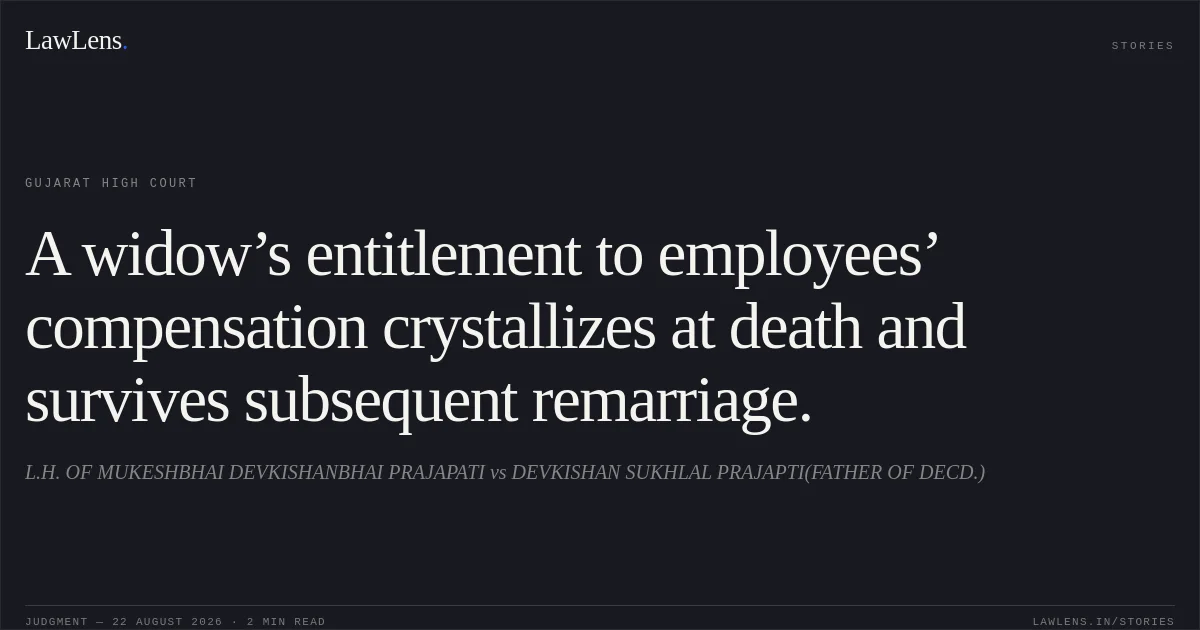
Source reference: p. 2; para. 4The Court also relied on Dincy Devassy v. United India Insurance Co. & Ors., decided by the Delhi High Court on 12 December 2019 and affirmed by the Supreme Court, for the principle that a widow’s entitlement to compensation crystallises upon the death of her husband and is not extinguished or reduced merely because she subsequently remarries.
Source reference: pp. 3–4; paras. 5–6Reasoning
The Commissioner distributed the deposited compensation equally among the widow and other relatives, including the deceased’s parents, sister and brother, without first determining their entitlement under the statutory definition of “dependant” in Section 2(d).
Source reference: pp. 2–4; paras. 4–7The High Court held that such distribution, being contrary to the statutory categorisation, was legally unsustainable.
Source reference: pp. 2–4; paras. 4–7It further held that the widow’s possible remarriage could not defeat an entitlement that had accrued upon the deceased’s death; her status and dependency had to be assessed with reference to the relevant time, and remarriage did not abate or diminish her claim.
Source reference: pp. 2–4; paras. 4–7Since the original distribution order had not applied these principles, the Court considered a fresh determination by the Commissioner necessary.
Source reference: pp. 2–4; paras. 4–7Holding
The appeal was allowed.
The Commissioner’s order dated 20 September 2017 in Distribution Application No. 36 of 2017 was quashed and set aside, and the distribution application was restored to the Commissioner for fresh consideration after hearing all parties and applying the law, particularly Section 2(d) of the Employees’ Compensation Act, 1923.
Source reference: p. 4; para. 7The Commissioner was directed to decide the matter expeditiously, preferably within eight weeks from receipt of the High Court’s order.
Source reference: p. 4; para. 7Acts & Sections Cited
2 provisions across 1 statute referred to in this judgment. Linked provisions open on LawLens.
Employee2
Original Court PDF
L.H. OF MUKESHBHAI DEVKISHANBHAI PRAJAPATIvsDEVKISHAN SUKHLAL PRAJAPTI(FATHER OF DECD.)
Click to open original judgment
Original judgment, available to read, download and summarize on LawLens.in