Facts
The appellant-husband and respondent-wife were married on 21.11.2008 at Patna according to Hindu rites and customs, and had one daughter born on 28.07.2011.
Source reference: p.2, para. 2; p.12–13, para. 17The husband alleged that the wife frequently visited her parental home and, from 24.02.2013, did not return to the matrimonial home.
Source reference: p.2–3, paras. 3–6; p.12–15, para. 17He further alleged that the wife and her parents wanted him to reside at Patna as a gharjamai, which he refused because his aged parents depended upon him.
Source reference: p.2–3, paras. 3–6; p.12–15, para. 17The husband instituted Original Suit No. 148 of 2019 under Section 13(1)(ia) of the Hindu Marriage Act, 1955, seeking divorce on the ground of cruelty.
Source reference: p.3, para. 7Despite service of notice and newspaper publication, the wife did not appear before the Family Court, and the proceedings proceeded ex parte.
Source reference: p.3, para. 7The husband examined himself and his father as witnesses.
Source reference: p.3, para. 8The Principal Judge, Family Court, Hazaribagh dismissed the suit, holding that cruelty had not been proved.
Source reference: p.3, para. 9The husband thereafter filed the present first appeal under Section 19 of the Family Courts Act, 1984.
Source reference: p.3, para. 10; p.16, paras. 23–24Before the High Court, the wife opposed the appeal through amicus curiae, asserting that she had been subjected to physical, mental and economic cruelty by the husband and his family, and that she remained willing to resume matrimonial life.
Source reference: p.9–11, para. 13Issues
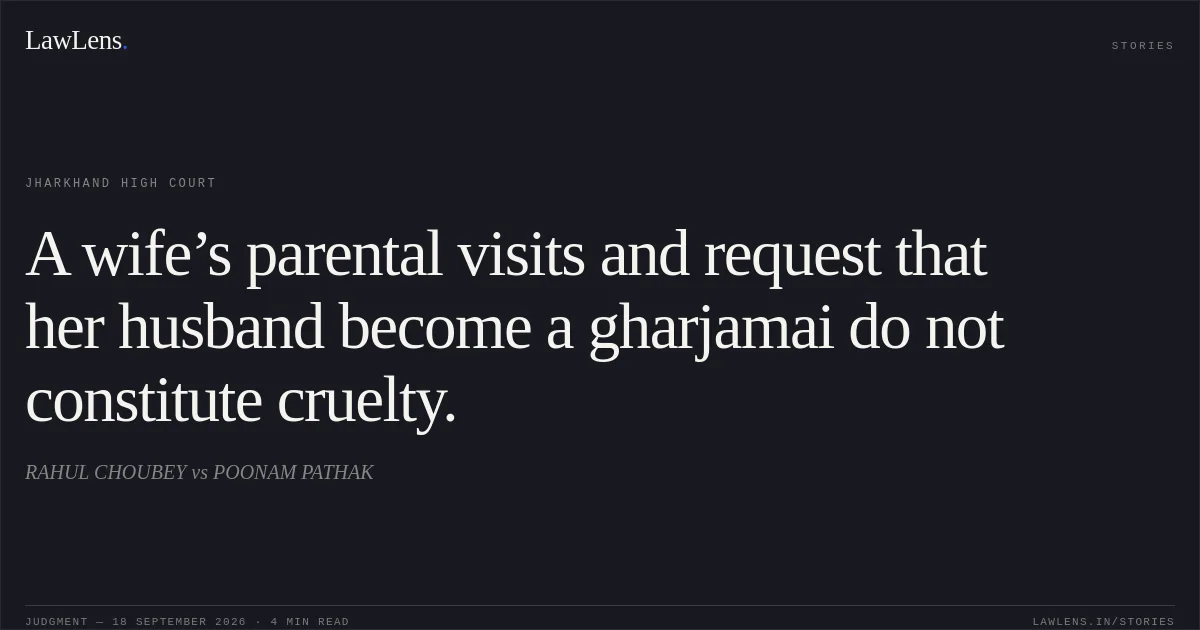
1. Whether the wife’s alleged insistence that the husband reside at Patna as a gharjamai constituted mental cruelty under Section 13(1)(ia) of the Hindu Marriage Act, 1955?
Source reference: p.27–28, paras. 47–522. Whether the wife’s visits to and continued residence at her parental home, as alleged by the husband, constituted matrimonial cruelty warranting dissolution of marriage?
Source reference: p.27–28, paras. 48–523. Whether the Family Court’s finding that cruelty was not proved was perverse or otherwise warranted interference in first appeal?
Source reference: p.16–21, paras. 23–33; p.28, paras. 51–53Law Applied
The Court applied Section 13(1)(ia) of the Hindu Marriage Act, 1955, under which divorce may be granted where one spouse has treated the other with cruelty.
Source reference: p.1–3, paras. 1 and 6Under Sections 7 and 19 of the Family Courts Act, 1984, the Family Court exercises jurisdiction over matrimonial disputes and an appeal lies to the High Court on both facts and law.
Source reference: p.16, paras. 23–25The Court relied on Dr. N.G. Dastane v. Mrs. S. Dastane, holding that cruelty must create a reasonable apprehension that living with the other spouse would be harmful or injurious.
Source reference: p.22, para. 35Shobha Rani v. Madhukar Reddi, which recognises that cruelty has no fixed definition and depends on the parties’ social, economic and cultural circumstances.
Source reference: p.22–25, paras. 36–43Joydeep Majumdar v. Bharti Jaiswal Majumdar, which requires cruelty to be grave and weighty, beyond ordinary marital wear and tear.
Source reference: p.24, para. 42Samar Ghosh v. Jaya Ghosh, which holds that mental cruelty must be assessed on the peculiar facts of each case and admits no rigid formula.
Source reference: p.25–26, para. 44The Court further applied the principles governing appellate reappreciation of evidence from Jagdish Singh v. Madhuri Devi and the meaning of a “perverse” finding from Arulvelu v. State.
Source reference: p.16–21, paras. 25 and 31–33Civil matrimonial claims are decided on the preponderance of probabilities under Section 3 of the Indian Evidence Act, 1872.
Source reference: p.17–18, paras. 28–30Reasoning
The High Court reappraised the evidence and found that the husband’s case rested substantially on his own testimony and that of his father.
Source reference: p.12–15, para. 17The alleged insistence that the husband live as a gharjamai was not shown to involve compulsion, coercion or conduct of such gravity that the husband could not reasonably be expected to live with the wife.
Source reference: p.27–28, paras. 49–52The Court held that the wife’s mere preference or request that the husband reside at Patna did not, by itself, amount to cruelty.
Source reference: p.27–28, paras. 49–52Similarly, visiting one’s parental home was treated as a normal incident of matrimonial life and could not, without more, constitute cruelty under Section 13(1)(ia).
Source reference: p.27–28, paras. 48–52Applying the requirement that cruelty must be grave, weighty and substantially beyond ordinary wear and tear, the Court concluded that the alleged conduct did not satisfy the statutory standard.
Source reference: p.24–27, paras. 42–46Since the Family Court had considered the evidence and its conclusion was supported by the record, the finding was not perverse and did not warrant appellate interference.
Source reference: p.28, paras. 51–53Holding
The Court answered the issues against the appellant.
It held that the wife’s alleged request that the husband live as a gharjamai and her visits to her parental home did not constitute cruelty under Section 13(1)(ia) of the Hindu Marriage Act, 1955.
Source reference: p.27–28, paras. 49–52The Family Court’s dismissal of Original Suit No. 148 of 2019 was affirmed, and the first appeal was dismissed.
Source reference: p.28–29, paras. 53–54Any pending interlocutory application was disposed of, and directions were issued for payment of prescribed remuneration to the amicus curiae.
Source reference: p.29, paras. 55–57Acts & Sections Cited
4 provisions across 3 statutes referred to in this judgment. Each provision opens on LawLens.
Hindu Marriage Act, 19551
Family Courts Act, 19842
Code of Civil Procedure, 19081
Original Court PDF
RAHUL CHOUBEYvsPOONAM PATHAK
Click to open original judgment
Original judgment, available to read, download and summarize on LawLens.in