Facts
The appellant, Nora Hana Peters, claimed to be the sister of Mona Sah @ Mona Angelina Das, who was married to Daniel Das, the owner of land comprising Khata No. 276, Khesra No. 589, measuring 3,511 sq. ft. at Mithanpura, Muzaffarpur.
Source reference: p.2She asserted that Daniel Das executed a Will dated 30 June 1987 in her favour while in sound mind and good health, and that the property was subsequently mutated in her name before the Circle Office and Municipal Corporation.
Source reference: p.2Mona Angelina Das died on 30 December 2014 and Daniel Das died on 4 September 2017; according to the appellant, the couple had no children.
Source reference: p.2The appellant thereafter instituted Probate Case No. 44 of 2018 seeking probate of the Will.
Source reference: p.2The Additional District and Sessions Judge-XIV, Muzaffarpur dismissed the probate case on 3 July 2019, holding that the Will had not been duly proved and could not be regarded as genuine.
Source reference: pp.2–8The court noted that the probate application stated that both attesting witnesses had died, whereas the evidence of PWs 1 to 3 disclosed that one witness, Bunty Walter, was alive but aged about 95 years and unable to move.
Source reference: pp.3–6No attesting witness was examined, nor was any application made for recording Bunty Walter’s evidence by commission or through video conferencing.
Source reference: pp.3–6The present appeal challenged that dismissal.
Source reference: no citationIssues
Whether the appellant proved the due execution and attestation of the Will in accordance with Section 63 of the Indian Succession Act and Section 68 of the Indian Evidence Act?
Source reference: pp.3–6, 9Whether, in the absence of examination of an attesting witness, the Will could be proved under Section 69 of the Indian Evidence Act on the ground that the attesting witnesses were unavailable?
Source reference: pp.5–6Whether the Will’s registration, mutation of the property, and the appellant’s evidence were sufficient to establish its genuineness despite the contradictory statements regarding the availability of an attesting witness?
Source reference: pp.6–7, 9–13Law Applied
The court applied Section 63 of the Indian Succession Act, which requires due execution and attestation of a Will, including execution by the testator and attestation by the prescribed number of witnesses.
Source reference: pp.4–5Section 68 of the Indian Evidence Act requires a document required by law to be attested, such as a Will, to be proved by at least one attesting witness, if such witness is available.
Source reference: pp.4–5Section 69 permits proof of the handwriting and signature of the testator and of an attesting witness only when no attesting witness can be found or is available.
Source reference: p.5The court relied on the principle that the probate court must satisfy itself regarding the Will’s valid execution and genuineness before granting probate.
Source reference: pp.6–7It referred to Rabindra Nath Mukherjee v. Panchanan Banerjee, (1995) 4 SCC 459, which recognises that registration and the Registrar’s endorsement regarding the testator’s sound disposing state of mind may support genuineness, but found that the necessary circumstances were not established here.
Source reference: p.6The court also considered Bhulan Mahto v. State of Bihar, M.A. No. 307 of 2011, decided on 7 July 2019, concerning the evidentiary value of a registered Will supported by the testimony of an attesting witness, but distinguished it on its facts.
Source reference: pp.9–12Reasoning
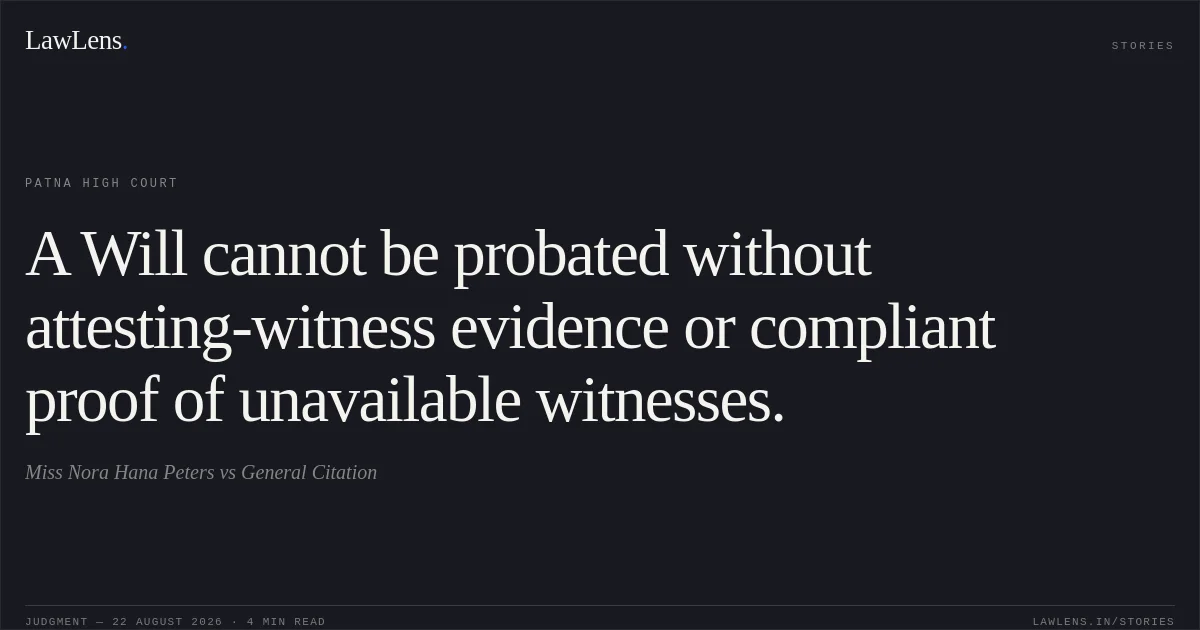
The High Court held that the appellant failed to satisfy the mandatory proof requirements applicable to a Will.
Source reference: pp.3–6, 9Her probate application stated on affidavit that both attesting witnesses had died, but her witnesses later stated that Bunty Walter was alive, though infirm and unable to attend court.
Source reference: pp.3–6, 9This contradiction raised doubt regarding the appellant’s candour and prevented reliance on Section 69, since the statutory precondition of proving that no attesting witness was available had not been established.
Source reference: p.5At the same time, the appellant did not examine any attesting witness under Section 68 and made no request for a commission or other mechanism to record the evidence of the surviving witness.
Source reference: pp.4–6, 9The court further held that mutation and payment of revenue or municipal dues did not substitute proof of the Will’s execution and attestation.
Source reference: no citationAlthough the appellant relied on Bhulan Mahto, that case involved evidence from an attesting witness describing the testator’s voluntary execution of the registered Will in the presence of the witnesses; no comparable evidence was produced here.
Source reference: pp.9–12Consequently, the Will was not proved as the legally executed last testament of Daniel Das.
Source reference: pp.12–13Holding
The High Court answered the issues against the appellant and held that the Will dated 30 June 1987 had not been proved in accordance with Sections 63 of the Indian Succession Act and 68 or 69 of the Indian Evidence Act.
The contradictory pleadings and evidence concerning the attesting witnesses, coupled with the failure to examine the surviving witness or seek a commission, justified rejection of the probate claim.
Source reference: no citationThe court therefore dismissed Miscellaneous Appeal No. 406 of 2023 as devoid of merit.
Source reference: p.13It clarified that the appellant remained at liberty to approach the appropriate court for succession-related relief in accordance with law.
Source reference: p.13Acts & Sections Cited
1 provisions across 1 statute referred to in this judgment. Each provision opens on LawLens.
Indian Succession Act, 19251
Original Court PDF
Miss Nora Hana PetersvsGeneral Citation
Click to open original judgment
Original judgment, available to read, download and summarize on LawLens.in